
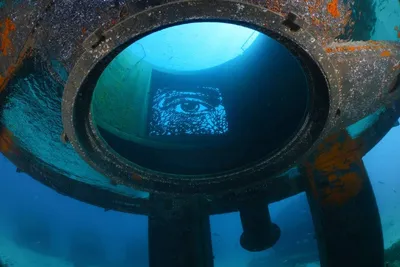
ARTREEF by VHILS: diving into the intersection of art and marine life in Albufeira
Off the coast of Albufeira, in the Algarve, lies one of Portugal’s most original diving sites: ARTREEF by VHILS, a permanent underwater art exhibition that combines contemporary art, industrial heritage, scientific research, and marine conservation.
Located at a depth of approximately 12 metres, next to the Santa Eulália Reef, the park features 13 sculptures created by Portuguese artist Alexandre Farto, known internationally as Vhils.
These works were created from materials salvaged during the dismantling of former EDP thermal power plants. Elements that were once part of energy production have been transformed into sculptures designed to evolve with the ocean and be progressively colonised by marine life.
The result is much more than an underwater museum. ARTREEF also serves as an artificial reef, a scientific research site, and a unique diving experience in the Algarve.
Portugal’s First Permanent Underwater Art Exhibition
ARTREEF by VHILS was presented to the public in 2023 as Portugal’s first permanent underwater art exhibition.
The park covers an area of approximately 1,250 m² and consists of 13 works: eight metal structures and five concrete sculptures. The tallest piece, named Periscope, reaches approximately 5.3 metres in height.
The sculptures are submerged about one mile off the coast of Albufeira, in an area with depths ranging approximately from 10 to 12 metres.
The relatively shallow location allows the works to be viewed in good natural light, making the dive particularly interesting for underwater photography and video.
The exhibition is marked at the surface by an official buoy located at the coordinates N 37.06922391 and W -8.20990784.

Materials from Old Power Stations Transformed by Vhils
Alexandre Farto, known as Vhils, has become internationally recognized for the way he removes, cuts and transforms different layers of materials to reveal hidden faces, memories and stories.
At ARTREEF, the artist brought this approach into a completely different environment: the ocean floor.
Some of the structures used in the artworks come from former EDP thermal power plants, including metal components that were carefully prepared, decontaminated and transformed before being installed in the sea.
By reusing these industrial elements, the project creates a symbolic connection between the energy past, the transition to renewable sources and the need to protect marine ecosystems.
The sculptures were not designed to remain visually unchanged. Natural corrosion, sediments, algae and marine organisms will gradually alter their appearance, allowing nature to continue the work begun by the artist.
An underwater trail composed of 13 sculptures
ARTREEF is composed of different sculptural ensembles that explore the relationship between human beings, industry, energy and the ocean.
Among the works is Periscope, built from the body of an old coal mill and transformed into a cylindrical structure with several faces sculpted into the metal.
The Equilibrium ensemble uses components from old turbines and includes forms inspired by corals. Other works, such as Heroes, Prison, Footprint and Gaze, present volumes, faces and shapes that change in appearance as the diver moves around them.
The route allows visitors to observe the sculptures from different angles, approaching them without touching and always following the guide’s instructions.
The combination of the works’ scale, natural light and the growing presence of marine organisms offers highly distinctive opportunities for underwater photography.

An Ever-Evolving Artificial Reef
Since their installation, the sculptures have begun to serve a second function: creating new surfaces and shelters that can be used by different marine species.
Algae, sponges, bryozoans, anemones, hydroids and other organisms progressively attach themselves to the structures, modifying their texture and appearance.
The openings and spaces within the sculptures also allow fish, crustaceans and other marine animals to move through and seek shelter.
This colonisation does not happen immediately. The reef evolves over the course of months and years, meaning that each visit may reveal new forms of life and different stages in the transformation of the works.
ARTREEF thus constitutes a living exhibition, in which nature continuously participates in the artistic process.
Scientific monitoring conducted by CCMAR
The ecological development of ARTREEF is monitored by the Centre of Marine Sciences of the University of Algarve, CCMAR.
One of the scientific initiatives associated with the project involves rescuing gorgonians accidentally caught by local fishing vessels and transplanting them onto some of the sculptures.
The scientific teams selected five of the 13 works for this assisted biological colonisation process. Some of these sculptures were designed with forms inspired by the branched structure of gorgonians that occur naturally in the region.
In July 2023, the first gorgonians were transplanted onto two sculptures. A new operation carried out in May 2025 made it possible to rescue and transplant around 140 additional specimens.
Scientific monitoring makes it possible to study the survival of the gorgonians, the colonisation of the structures and the evolution of biodiversity on the artificial reef.

What marine life can be observed at ARTREEF?
Although the sculptures are the main visual element of the dive, marine life is playing an increasingly important role in the experience.
According to the experience of the EasyDivers Portugal team, it is regularly possible to observe octopuses, cuttlefish, white seabream, gilthead seabream, damselfish, wrasse and various crustaceans.
Conger eels and moray eels may use cavities and protected areas of the structures as shelter. Nudibranchs and other small organisms can also be found, especially by divers who pay close attention to detail.
Rays are also among the possible sightings in the area, although any encounter with wild animals always depends on the season, conditions and an element of luck.
As biological colonisation progresses, the sculptures gradually become an integral part of the local ecosystem.
What is diving at ARTREEF by VHILS like?
Diving at ARTREEF is carried out exclusively from a boat, as the park is located approximately one mile from the coast.
The average depth is between 10 and 12 metres, with a maximum depth of approximately 12 metres. Depending on air consumption, sea conditions and the route taken, the dive usually lasts approximately 40 to 50 minutes.
The visit is normally organised as a guided route between the different groups of sculptures. The guide presents the works, directs the divers and ensures that the group maintains the necessary distance from the structures.
The site is particularly suitable for divers interested in underwater photography, contemporary art, artificial reefs and observing the evolution of marine life.

What level is required to dive at ARTREEF?
Thanks to its accessible depth, ARTREEF is suitable for divers holding an Open Water Diver certification or an equivalent qualification.
Depending on the conditions, the participant’s experience and the assessment carried out by the centre, introductory experiences accompanied directly by a professional may also be arranged.
Even at a moderate depth, it is important to have proper buoyancy control. Divers must be able to maintain a stable position without touching the sculptures, stirring up sediment or damaging the organisms that are beginning to colonise the works.
Photographers should pay particular attention to their position and the equipment they are carrying. When focusing on a photograph, it is easy to temporarily lose awareness of the distance from the structures.
Rules to Protect Sculptures and Marine Life
ARTREEF should be visited with the same respect afforded to any natural reef or underwater heritage site.
Visitors must not touch, lean on, enter or attempt to pass through the sculptures, even when some of their forms appear to allow such passage.
It is also forbidden to remove organisms, shells or any other element present at the site. The life established on the structures is part of the reef’s ecological evolution.
Divers should follow the route defined by the guide, maintain good buoyancy and avoid contact between their fins, tanks or photographic equipment and the works.
The visit should be carried out with professional supervision, appropriate insurance and compliance with the conditions established by the operators associated with the project.
The role of EasyDivers Portugal in ARTREEF
EasyDivers Portugal was one of the partners involved in bringing ARTREEF by VHILS to fruition and is mentioned by EDP among the entities that contributed to the project’s development.
According to the centre’s team, EasyDivers also took part in the underwater operations required to install the sculptures and contributed to the operational knowledge of the site.
EasyDivers currently organises guided dives to ARTREEF from Albufeira, allowing certified divers and, following an assessment, participants in introductory experiences to discover the park safely.
The team’s knowledge of the sculptures, the route and the local conditions allows it to present not only the technical aspects of diving, but also the artistic and environmental history of the project.
This involvement helps promote ARTREEF among the international diving community and raise visitors’ awareness of ocean protection.
A different diving experience in the Algarve
Taking a dive into ARTREEF by VHILS means exploring a site where art is not protected by walls, display cases or climate-controlled rooms.
The sculptures are exposed to currents, sediments, corrosion and colonisation by marine organisms. Their transformation is part of the work itself.
The project demonstrates how materials associated with former industrial infrastructure can acquire a new artistic, ecological, scientific and tourist function.
For divers, ARTREEF offers the opportunity to observe this evolution directly and to return to the site a few years later to discover a different scene.
It is this combination of art, the circular economy, research and biodiversity that makes ARTREEF one of the Algarve’s most unique dives.
Dive into ARTREEF with EasyDivers Portugal
A EasyDivers Portugal organizes boat trips and guided dives to discover ARTREEF by VHILS off the coast of Albufeira.
Before departure, the team checks each participant’s certification, experience, and needs, preparing the equipment and route according to the sea conditions.
Divers can consult the complete spot profile for EDP ARTREEF by VHILS on Scuba Spot Advisor to discover the location, dive characteristics, photos, and community reviews.
To check availability, learn about the requirements, or book a dive, visit the official EasyDivers Portugal website and contact the team directly.

00 Comments
No comments yet.