
Which Scuba Diving Fins Should You Choose? The Quick Answer
When choosing scuba diving fins, three factors matter more than anything else: foot comfort, the type of diving you do, and ease of finning. A particularly stiff or oversized pair is not necessarily better. The best fins are those you can use comfortably while maintaining sufficient propulsion and good control over your movements.
For beginners who mainly dive in warm water from a boat, comfortable full-foot fins can be a good option. For shore diving, diving with boots, or exploring cooler waters, open-heel fins are often a practical choice.
Here are the four main questions to ask yourself:
- Where will I be diving? From a boat, a beach, a rocky shoreline, or in different destinations?
- What foot protection will I use? Bare feet, thin neoprene socks, dive boots, or drysuit boots?
- What level of effort feels comfortable? A soft, medium, or stiff blade depending on my technique and personal preferences?
- Can I try them before buying? Testing fins in the water tells you much more than reading technical specifications.
If you are just starting out, prioritize a comfortable pair that is easy to put on and control. You can refine your preferences as you gain experience. To explore the rest of the equipment you will need, check out our essential scuba diving equipment guide for beginners.
Full-Foot vs. Open-Heel Fins: What Are the Differences?
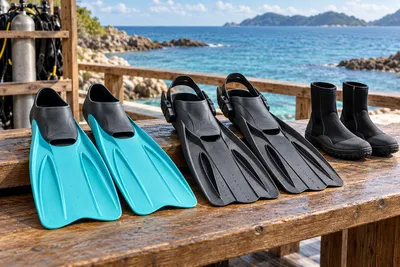
Scuba diving fins generally fall into two main categories. Full-foot fins have a closed foot pocket that surrounds the foot. Open-heel fins have an open back, usually secured with an adjustable strap or an elastic retention system.
The right choice mainly depends on your equipment and diving habits. Here are the key differences:
| Feature | Full-Foot Fins | Open-Heel Fins |
|---|---|---|
| Foot retention | Closed foot pocket | Open heel with a strap |
| Foot protection | Limited without suitable neoprene socks | Often used with dive boots |
| Warm-water diving | Very suitable depending on conditions | Also suitable |
| Cold-water diving | Less versatile | Practical with insulated dive boots |
| Travel | Often compact and lightweight | Standard and travel-specific models available |
| Fit adjustment | Depends on the foot pocket | Adjustable or elastic strap |
There are exceptions: some open-heel fins specifically designed for travel can be worn barefoot or with thin neoprene socks, according to the manufacturer's instructions. Therefore, not all open-heel fins necessarily require dive boots.
For a first pair intended for several diving environments, open-heel fins often provide greater versatility. However, if you only dive in warm water from a boat, properly fitted full-foot fins may be easier to pack and transport.
Before deciding, ask your dive center which types of fins they provide and whether you can compare different models during your training.

How to Choose the Right Fin Size and Test Them with Dive Boots
The size printed on a fin is only a starting point. Two models labeled with the same size may have very different foot pockets, particularly in terms of width, depth, and the area over the top of your foot. There is no universal rule requiring you to go up one size when wearing dive boots.
For open-heel fins, always try them on with the actual dive boots you intend to use underwater. Their thickness, sole, and shape directly affect the fit. A fin that works well with a flexible boot may become uncomfortable with a bulkier one.
During your fitting, check the following points:
- Your foot slides naturally into the foot pocket without painful pressure.
- Your toes are not crushed against the front.
- The top of your foot does not experience excessive pressure.
- The strap holds your heel securely without needing to be excessively tight.
- Your foot does not move excessively inside the fin when you gently move it.
With full-foot fins, also check for rubbing and excessive movement when simulating small finning motions.
If possible, ask for a supervised test in a swimming pool or sheltered water with a diving instructor. Just a few minutes in the water can help you assess the fit, perceived effort, and control offered by the fins. If discomfort persists, try a different foot-pocket shape rather than forcing the fit.
Fin Stiffness and Blade Designs: Soft, Medium, or Stiff?
The blade is the part of the fin that moves water to provide propulsion. Its length, width, shape, and stiffness all influence how the fin feels underwater. Contrary to a common misconception, a stiffer fin is not automatically a better fin.
A soft blade generally offers less resistance during the kicking motion. It may suit relaxed finning, although some divers carrying heavier equipment may find its response insufficient. A stiff blade provides greater resistance and can deliver powerful propulsion, but may require more muscular effort. Medium-stiffness models often provide a useful compromise for divers who are still discovering their preferences.
Several blade designs are available:
- Traditional blade: a continuous surface appreciated for its direct response and control.
- Channel blade: flexible sections and ribs designed to guide how the blade bends.
- Split fin: a blade divided lengthwise into two sections, designed to support certain smooth, regular kicking styles.
- Hinged blade: a design that allows controlled flexing between the foot pocket and the propulsion surface.
Stiffness cannot always be compared directly between manufacturers. Materials, dimensions, and overall construction significantly affect how a fin behaves.
Our advice: compare two models with different stiffness levels while wearing the same equipment and diving in similar conditions. Pay attention to your comfort, your ability to slow down, and how easily you can change direction. Your final choice should suit your actual finning technique rather than a reputation for power.
Fin Straps, Buckles, and Maintenance: The Details That Matter
With open-heel fins, the heel retention system deserves just as much attention as the blade. A strap that is difficult to handle can make gearing up on a boat more complicated, while a worn or incorrectly secured attachment can compromise how well the fin stays on your foot.
The most common systems include:
- Traditional adjustable strap: allows you to customize the fit but requires regular checks to ensure the adjustment remains correct.
- Quick-release buckle: makes removing the fin easier without necessarily changing the strap length.
- Metal spring strap: uses elasticity to accommodate heel movement.
- Elastic bungee strap: generally slips into place easily and reduces the need for adjustments.
Before buying, try putting the fins on and taking them off with wet hands. Make sure you understand how the buckles work and ask whether replacement parts are available.
After every dive, rinse your fins with fresh water to remove salt, sand, and deposits. Allow them to dry in the shade, then store them without keeping the blades compressed or bent for long periods. Regularly inspect the straps, attachment points, and any signs of cracking.
A compatible spare strap can be useful when traveling far from a specialist dive shop. Finally, mark your fins discreetly so you can identify them easily. On a boat carrying several groups of divers, similar-looking equipment can easily get mixed up.
Choosing Fins for Travel, Cold Water, and Current
Your diving environment can significantly influence which fins you should choose. A pair that feels comfortable on tropical boat dives may not necessarily be ideal for entering the water from a rocky Mediterranean shoreline.
For travel: look for fins whose weight, length, and overall size fit your luggage requirements. Some models are specifically designed for easy transport. However, you should still check their comfort and suitability for scuba diving: compact fins are not automatically appropriate for every type of diving. If you already plan to rent equipment at your destination, consider whether bringing your own fins is worthwhile.
For cold water: open-heel fins compatible with insulated dive boots are often practical. When using a drysuit, integrated boots may require a different fin foot pocket. Thermal protection depends on your complete equipment setup, not on the fins alone. Read our guide to choosing a wetsuit according to water temperature.
For areas exposed to current: look for propulsion you can genuinely control. A firm blade may suit some divers but become tiring for others. Never choose a more demanding dive simply because you own powerful fins.
Important: no pair of fins can replace assessing conditions, proper dive planning, a thorough briefing, respecting your personal limits, and appropriate supervision. Always ask your dive center how currents, water entry, and diver pickup will be managed.

Finning Technique, Buoyancy, and Protecting Marine Environments
The quality of your fins alone does not guarantee comfortable movement underwater. Your body position, balance, and finning technique also influence the result. Beginners may benefit more from improving their buoyancy than from immediately replacing their fins.
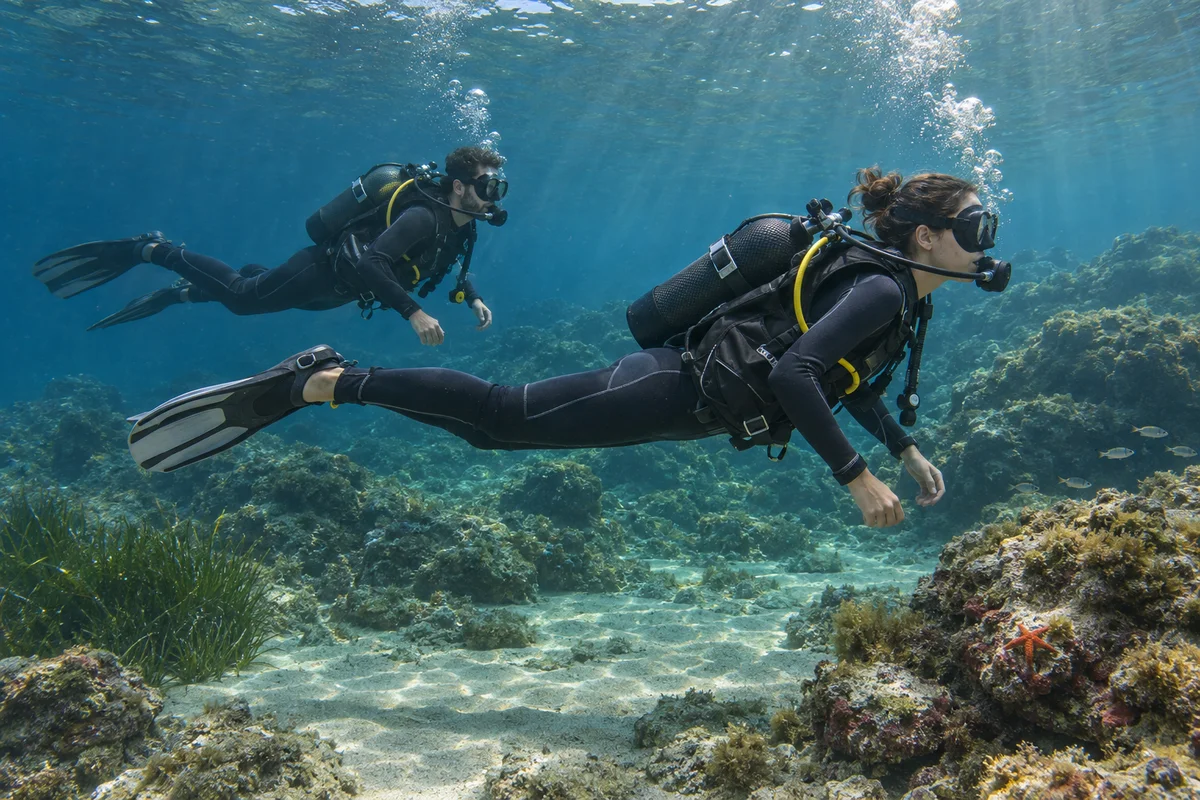
The flutter kick, which resembles alternating leg movements, is widely used for underwater propulsion. The frog kick is another option: the legs follow a different movement pattern that can be useful for controlling movement near the seabed. Not all fins provide the same feel when using these techniques.
The right approach depends on your comfort, equipment, and instructor's recommendations. Practical instruction in finning movements, changing direction, and body-position control should take place with a qualified diving professional.
To help protect underwater environments, keep these principles in mind:
- Maintain sufficient distance from the seabed and living organisms.
- Avoid stirring up sediment with your fins.
- Check your buoyancy before approaching an observation area.
- Adjust your movements to avoid striking corals, marine life growing on rocks, or seagrass beds.
Short fins do not automatically prevent accidental contact, just as long fins do not necessarily cause it. The diver's control remains the deciding factor. If you are a beginner, develop these skills during your training, as explained in our beginner's guide to scuba diving.
Should you buy or rent scuba fins? Checklist and FAQ
When you are new to scuba diving, renting several fin models before buying can be an excellent decision. You can discover differences in comfort and propulsion without making an immediate commitment. Buying becomes particularly worthwhile once you know which size fits you in a specific model and want to enjoy familiar sensations on every dive.
Pre-purchase checklist:
- Have I identified my usual diving conditions?
- Have I tried the fins with my actual dive boots, if required?
- Does the foot pocket hold securely without uncomfortable pressure or rubbing?
- Does the blade stiffness suit my usual finning technique?
- Can I easily operate the straps and buckles?
- Are the weight and dimensions suitable for my travel plans?
- Are compatible replacement parts available?
FAQ: Do I need stiff fins to move efficiently underwater? No. Higher stiffness may suit certain divers, but comfort, technique, and diving conditions should take priority.
Can open-heel fins be worn without dive boots? Some specialized models allow this. Always check the manufacturer's recommendations.
Can I use the same fins everywhere? Sometimes, but cold water, drysuit boots, or different diving activities may justify another pair.
What should I ask my dive center? Which models can I try? Which dive boots are suitable? What blade design works best for my usual dives? Can I compare how different fins feel under supervision?
The best choice is ultimately the one that works for you underwater. Try different fins, compare how they feel, and ask your diving instructor for advice before investing.

00 Comments
No comments yet.