
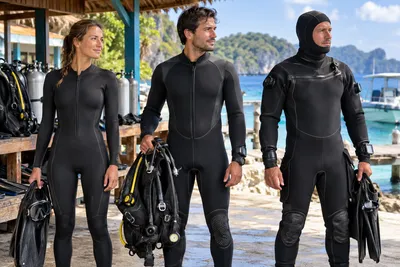
Which wetsuit should you choose? The quick answer
Choosing a scuba diving wetsuit depends first and foremost on the water temperature, but not only on that. As a general reference, tropical water at 28 °C may allow you to dive with lightweight exposure protection or a 1 to 3 mm wetsuit, while water at 15 °C will usually point you towards a 7 mm wetsuit, a semi-dry suit or a drysuit depending on the conditions and the diver.
Above all, wetsuit thickness should not be treated as a universal rule. Two divers doing exactly the same dive may have very different needs. Personal sensitivity to cold, dive duration, depth, the number of dives completed during the day, physical activity underwater and surface conditions can all significantly affect thermal comfort.
As a simple starting point, you can generally keep the following in mind:
- very warm water: lightweight exposure protection or a thin wetsuit;
- warm water: a 3 mm full wetsuit is commonly used;
- temperate water: a 5 mm wetsuit, sometimes combined with a hood or other accessories;
- cold water: a 7 mm wetsuit, semi-dry suit or drysuit;
- very cold water: a drysuit is generally preferred, with suitable undergarments.
If you are still getting familiar with scuba equipment and dive organisation, our guide on getting started with scuba diving also explains the main types of equipment used during your first dives.
Why do we get cold much faster in water?
A scuba wetsuit is not simply designed to prevent an unpleasant sensation: it reduces heat loss to the surrounding environment. Water removes body heat much more efficiently than air. This is why a temperature that feels comfortable on land can start to feel cold after several dozen minutes underwater.
A neoprene wetsuit does not keep you completely dry. A small amount of water enters between your skin and the suit. If the wetsuit fits properly, water exchange is limited and this thin layer warms up against your body. Neoprene also contains gas-filled cells that contribute to insulation. By contrast, a wetsuit that is too loose allows more cold water to circulate and becomes less effective.
Your thermal sensation also changes during the dive. The longer the immersion lasts, the more noticeable cooling can become. Depth also matters: neoprene compresses under pressure, reducing its thickness and affecting both insulation and buoyancy.
Finally, you also need to consider what happens before and after the dive. Waiting on a boat in a wet wetsuit while exposed to wind can cool a diver significantly. Several dives in the same day may also increase the sensation of cold as the day progresses. Choosing thermal protection therefore means considering the entire dive outing, not just the temperature shown on your dive computer.
Indicative wetsuit guide by water temperature
The following table is intended as a practical reference when preparing your equipment. It should not be treated as an absolute rule: body shape, sensitivity to cold, dive duration, wind, surface intervals and personal habits may justify choosing different thermal protection.
| Water temperature | Indicative exposure protection |
|---|---|
| ≥ 27 °C | Lightweight exposure protection or 1 to 3 mm wetsuit depending on personal sensitivity |
| 24 to 27 °C | 3 mm full wetsuit |
| 18 to 24 °C | 5 mm wetsuit, accessories may be useful |
| 10 to 18 °C | 7 mm wetsuit or semi-dry suit; drysuit depending on conditions |
| < 10 °C | Drysuit generally preferred, with suitable training and undergarments |
These temperature ranges deliberately overlap with real-world diving practices. For example, a diver accustomed to 23 °C water may be perfectly comfortable in a 3 mm wetsuit on a short dive, while another diver may prefer a 5 mm suit. A photographer remaining almost motionless for an hour may also feel colder than a diver who is swimming continuously.
Surface temperature alone is not always enough to predict what you will encounter at depth. Some areas have a thermocline, meaning that water temperature can drop noticeably below a certain depth. When diving with a local dive centre, ask about the temperature actually observed at the planned dive sites rather than relying only on the temperature reported at the beach.
Warm water: shorty or 3 mm full wetsuit?
In warm water, it can be tempting to dive in swimwear only. However, lightweight exposure protection often provides greater comfort and also protects your skin from BCD chafing, minor accidental contact and sun exposure before or after the dive.
A shorty, which generally covers the torso while leaving part of the arms and legs exposed, is mainly suitable when the water is very warm and the diver tolerates cold well. Its main advantage is ease of use. However, it provides less insulation than a full-length wetsuit.
A 3 mm full wetsuit is a very versatile choice for many tropical destinations. It protects the full length of the arms and legs and limits water circulation more effectively. Between approximately 24 and 27 °C, it is often a good starting point, although this range should not be treated as a requirement.
Even in water at 28 or 29 °C, some divers still prefer a 3 mm wetsuit, especially for long or repetitive dives. Others find lighter protection perfectly sufficient.
Beginners who are still deciding between different training systems can also read our comparison of FFESSM Level 1, PADI Open Water and SSI Open Water. Entry-level courses generally provide the opportunity to try different equipment and understand your preferences before making a purchase.

Temperate water: why is the 5 mm wetsuit so popular?
The 5 mm full wetsuit is one of the most versatile forms of exposure protection for temperate waters. It provides more insulation than a 3 mm suit while generally remaining easier to use than a very thick wetsuit or a drysuit.
Between approximately 18 and 24 °C, it is a common reference point, but the overall dive conditions must be considered. Water at 22 °C during a thirty-minute dive does not create the same demands as a one-hour dive followed by a long wait on a windy boat. Multiple dives in the same day can also increase the sensation of cold.
There can be significant differences between models: neoprene flexibility, seal design, back or front zipper, internal lining and overall cut. Two wetsuits both labelled as 5 mm can therefore feel quite different in the water.
A hood, gloves or more insulating boots can complement the suit when conditions become cooler. However, it is usually better to find a properly fitting wetsuit rather than trying to compensate for an oversized suit by adding multiple accessories.
For an occasional diver travelling to different regions, a 5 mm wetsuit can be an attractive choice because of its versatility. However, it does not replace more suitable protection when temperatures become genuinely cold. Asking dive centres that operate daily at your destination remains one of the best ways to prepare your equipment.
Cold water: 7 mm wetsuit or semi-dry suit?
When water temperature drops below approximately 18 °C, thermal protection becomes increasingly important. A 7 mm wetsuit provides greater thickness and may be suitable for many cold-water dives, particularly when dive duration remains reasonable and the diver has a good tolerance for these temperatures.
However, a 7 mm wetsuit is thicker, more rigid and more buoyant than a thin wetsuit. It may require more effort to put on and can change the amount of ballast required. Its buoyancy also changes with depth because neoprene compresses under pressure.
A semi-dry suit still operates on the same basic principle as a wetsuit: the diver is not actually kept dry. However, it is designed to reduce water exchange significantly through a close fit, effective seals and a zipper designed to limit water entry. It can therefore provide greater thermal comfort than a conventional wetsuit of the same thickness.
Between 10 and 18 °C, the choice between a 7 mm wetsuit, a semi-dry suit and a drysuit depends greatly on dive duration, the number of dives, surface conditions and individual sensitivity. For long or repetitive dives, a drysuit may become considerably more comfortable.
A very thick wetsuit should never be chosen based only on a number. You must still be able to move freely, reach your equipment, breathe normally and maintain comfortable circulation around the neck, wrists and limbs.


Drysuits: staying dry changes thermal management
Unlike a wetsuit, a drysuit is designed to prevent water from entering by using a waterproof zipper and seals around the neck and wrists. Insulation then depends largely on the trapped air and the thermal undergarments worn underneath the suit.
Depending on the model, the outer shell may be made from neoprene or from materials that provide relatively little insulation on their own. In the latter case, the undergarments provide most of the thermal protection. Their thickness should be adapted to the water temperature, dive duration and the manufacturer’s recommendations.
A drysuit generally has an inflation valve that allows gas to be added during descent and an exhaust valve that allows gas to be released. Managing this air volume affects both comfort and buoyancy. Using a drysuit therefore requires techniques that differ from those used with a wetsuit.
PADI notably recommends specific training in drysuit use. It is not simply a matter of putting on a warmer suit: divers need to learn how to manage the air inside the suit, weighting, descent, ascent and situations specific to this type of equipment.
For water temperatures below approximately 10 °C, a drysuit is generally preferred, but it can also be appreciated in warmer water when dives are long, repetitive or carried out in cold surface conditions.
Fit and body shape: thickness is not everything
A wetsuit works properly when it is close-fitting without being excessively tight. Large gaps around the back, lower back, armpits or legs encourage water circulation and reduce insulation efficiency. Conversely, a wetsuit that is too small can become uncomfortable, restrict movement or place excessive pressure on the body.
Body shape therefore plays a major role. The same size from two different manufacturers may have very different cuts. It is useful to try several models and check that the wetsuit stays in place when you raise your arms, bend your legs or reproduce the movements required to operate your scuba equipment.
For a drysuit, fit involves different considerations. You need enough internal space to wear the intended undergarments and move freely, while avoiding unnecessary excess material. The neck and wrist seals must perform their function without causing excessive discomfort.
This issue is particularly important with rental equipment. A wetsuit that appears to be the correct size on paper may not match your body shape. If you feel cold on every dive while wearing a particular model, the problem may therefore not be its thickness: continuous water exchange inside the suit may explain much of the discomfort.
For people discovering scuba diving and wondering what abilities are actually required before a try dive, our article can you scuba dive if you cannot swim? also explains how first diving experiences typically work.
Hoods, gloves, boots, weighting and maintenance
The wetsuit is only one part of thermal protection. A hood, gloves and boots can significantly improve comfort as water temperature drops. Their thickness should remain consistent with the wetsuit and with local conditions.
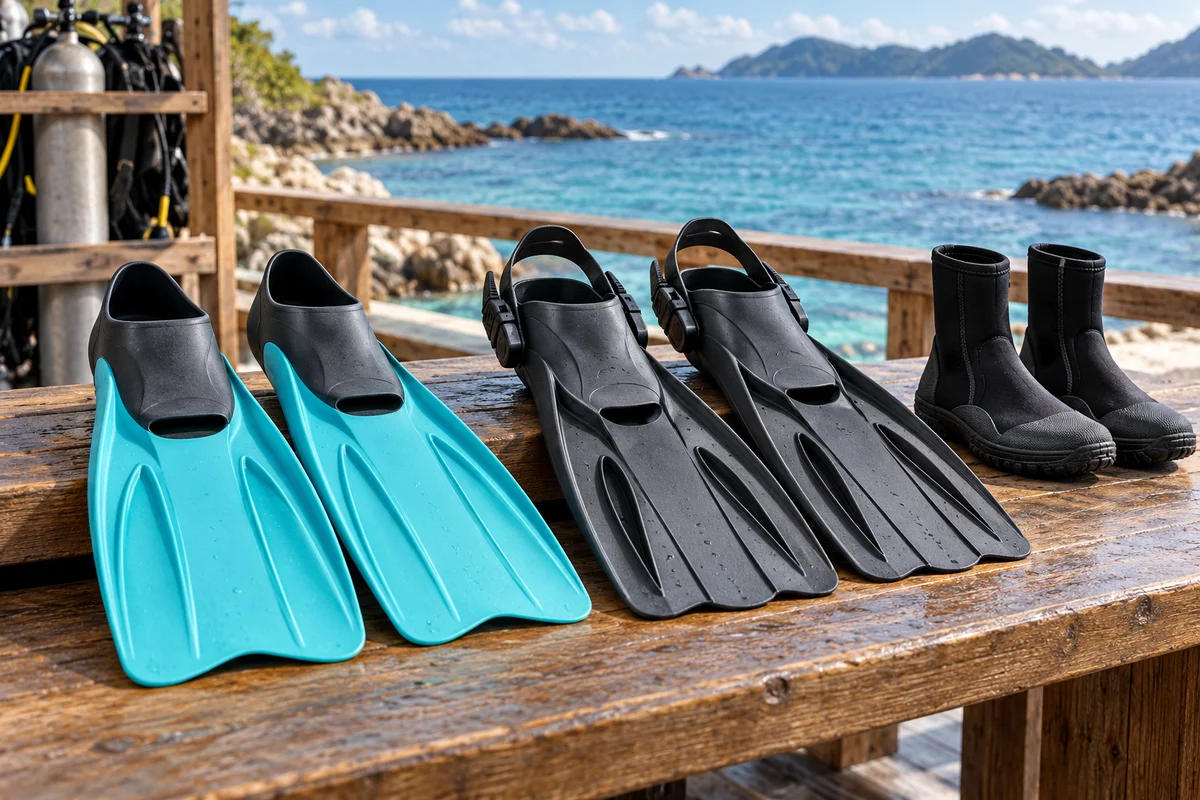
A hood is especially common in cool or cold water. Gloves provide warmth and protection but must still allow you to operate dump valves, clips, instruments and other equipment easily. Boots, meanwhile, must be compatible with the fins you use.
Changing wetsuits can also affect weighting and buoyancy. A thicker neoprene wetsuit contains more gas and generally provides more positive buoyancy at the surface. As neoprene compresses with depth, this buoyancy changes during descent. With a drysuit and thick undergarments, the configuration changes again. An appropriate buoyancy and weighting check is therefore important whenever you make a significant equipment change.
Proper care also helps maintain the suit’s performance and lifespan. After diving, rinse it with fresh water according to the manufacturer’s recommendations, allow it to dry away from direct sunlight and store it without creating deep folds. A wetsuit can be hung on a sufficiently wide hanger.
For a drysuit, the seals, zipper and valves also require attention. PADI and DAN notably recommend careful maintenance of these components and complete drying before storage.
Rent or buy: how to make the right choice before diving
For occasional diving, renting allows you to travel light and use equipment suited to local conditions. It is also a good way to try different thicknesses before buying. The main drawback is that the available cut may not always match your body shape perfectly.
Buying becomes more attractive when you dive regularly. You know how your wetsuit fits, what condition it is in and how it behaves in the water. Before choosing, think mainly about the temperatures in which you will realistically dive most often rather than the most extreme destination you might possibly visit one day.
Before every dive, check the general condition of your exposure protection: zipper, seams, seals, heavily worn areas and accessories. On a drysuit, also check specific components such as the zipper and valve operation in accordance with the manufacturer’s recommendations and your training.
During the dive, an increasing sensation of cold, significant shivering, loss of comfort or growing difficulty staying focused may indicate that your thermal protection is insufficient. You should not try to finish a dive at all costs: signal the problem to your buddy and shorten the dive when conditions no longer allow you to continue comfortably and safely.
In summary, the best wetsuit is not simply the thickest one. It is the one that matches the water temperature, dive duration, your body shape, your sensitivity to cold and the type of activity you plan to do.
Sources: PADI – Wetsuits ; PADI – Dry Suits ; PADI – Dry Suit Diver ; PADI – Diving Accessories ; Divers Alert Network – Tools for a Healthy Drysuit ; DAN – Travel Medical Guide.

00 Comments
No comments yet.