
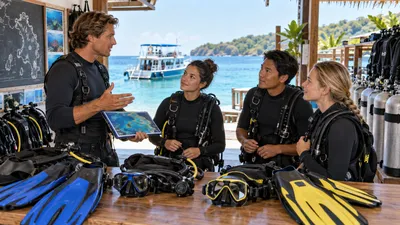
Understanding the Real Difference
Choosing between FFESSM Level 1, PADI Open Water Diver and SSI Open Water Diver is not simply a matter of comparing three logos. All three are entry-level scuba diving courses, but they do not follow exactly the same framework. FFESSM Level 1 is designed within the French system and qualifies a diver to dive under supervision to 20 m. PADI and SSI Open Water courses are designed to train divers to dive with a buddy of equivalent level, within the limits of their training and local regulations.
Three concepts must therefore be kept separate: the depth reached during training, the privileges associated with the certification and the rules applying at the destination where you actually dive. With PADI, the stated adult Open Water training depth is 18 m, or the depth actually reached during training if this was shallower. With SSI, the maximum stated training depth is also 18 m. For FFESSM Level 1, the stated privilege is that of a supervised diver to 20 m.
The right choice therefore depends mainly on your plans: diving mostly in France within a supervised framework, preparing for trips abroad, following a particular training structure or choosing a dive centre whose teaching style suits you. Instructor quality, actual time spent in the water and learning conditions matter just as much as the agency logo printed on the certification card.
Comparison Table
This table summarises only the information provided by the organisations cited. The 'depth' column should not be read as a universal authorisation: it must always be understood in relation to training limits, certification privileges and local rules.
| Course | Age | Open water | Depth / framework | Medical / water skills | Recognition stated |
|---|---|---|---|---|---|
| FFESSM Level 1 | 12 under certain conditions, otherwise 14 | About 5 open-water dives suggested; 4 open-water dives to be validated | Supervised diver to 20 m | Medical certificate of no contraindication | Dual FFESSM/CMAS certification stated as usable in more than 100 countries |
| PADI Open Water Diver | Junior from 10; adult from 15 | 4 open-water dives | Adult trained to 18 m or to the depth actually reached if shallower; specific Junior rules apply | 200 m swim or 300 m mask-fins-snorkel, 10 minutes floating; medical questionnaire and medical approval depending on answers or local law | Entry-level PADI certification |
| SSI Open Water Diver | From 10; under 15 certified as Junior with supervision/restrictions | 4 open-water dives | Maximum training depth: 18 m | Water fitness evaluation; medical questionnaire and medical approval where necessary | International certification |
The amount of theory and confined-water training is not presented in exactly the same way by each organisation in the verified information available. SSI states 6 theory sessions, 6 pool or confined-water sessions and a suggested duration of 16 to 32 hours. PADI describes a progression combining theory, confined water and 4 open-water dives. For FFESSM, the facts retained here mainly concern age, medical requirements, open-water dives and Level 1 privileges.
FFESSM Level 1
FFESSM Level 1 is a first scuba certification within the French federation framework. The stated minimum age is 12 under certain conditions, otherwise 14. A medical certificate confirming no contraindication is required. FFESSM suggests around 5 open-water dives during the learning progression, and 4 open-water dives must be validated for certification according to the official information provided.
Its key characteristic is the privilege attached to the level: a Level 1 diver is a supervised diver to 20 m. This means that '20 m' should not be presented simply as a training depth that can be mechanically compared with the 18 m stated by PADI or SSI. Here, the figure mainly describes the certified diver's operational framework as defined for this level. The French system and supervised diving are therefore central to understanding what this qualification actually allows.
FFESSM also presents Level 1 with a dual FFESSM/CMAS certification, stated as usable in more than 100 countries. For a beginner expecting to dive mainly in French clubs or dive centres, this framework can be easy to understand. When travelling, however, you should still present your certification to the local dive centre and check applicable regulations, because recognition of a card does not automatically mean that French privileges are reproduced identically everywhere.
PADI Open Water Diver
PADI Open Water Diver is an entry-level certification structured around three components: theory, confined-water exercises and 4 open-water dives. The stated minimum age for the adult certification is 15. The Junior programme starts at 10, with specific limits depending on age. Junior rules should therefore be considered separately from those applying to adults.
For ages 10-11, the stated limit is 12 m with the accompaniment required under PADI rules. Divers aged 12-14 remain Junior divers and may go to 18 m with a certified adult. For adults, Open Water training is stated as being to 18 m, or to the depth actually reached during training if that depth was shallower. Again, this training depth should not be confused with an identical authorisation valid in every country and every dive centre.
PADI also requires a water-skills assessment: a 200 m swim or a 300 m swim with mask, fins and snorkel, plus 10 minutes floating. A medical questionnaire is required; medical clearance may be necessary depending on the answers or local law. When choosing a centre, it is useful to ask how theory, confined-water sessions and the four open-water dives are organised.

SSI Open Water Diver
SSI Open Water Diver is available from the age of 10. The official course described in the cited sources includes 6 theory sessions, 6 pool or confined-water sessions and 4 open-water dives. SSI states a suggested duration of 16 to 32 hours. This gives beginners a practical benchmark for comparing how different dive centres organise training, without reducing the course to the number of calendar days advertised.
The stated maximum training depth is 18 m. The distinction between this training limit and actual post-certification diving conditions must be preserved. The principle used here when comparing PADI and SSI is that Open Water training is intended to prepare divers to dive with a buddy of equivalent level within the limits of their training and local regulations. Divers under 15 receive a Junior certification with supervision and restrictions.
SSI also requires a water fitness evaluation and a medical questionnaire, with medical clearance where necessary. SSI presents Open Water Diver as an international certification. For beginners, the most useful questions to ask a dive centre concern the real amount of time dedicated to skills, confined-water conditions, the organisation of the four open-water dives and how the centre supports students who need additional time.
Supervision, Independence and Depth
This is the point that creates the most confusion. FFESSM Level 1 gives the privilege of being a supervised diver to 20 m. An adult PADI Open Water Diver is trained to 18 m, or to the depth actually reached if that was shallower. SSI Open Water Diver states a maximum training depth of 18 m. These numbers therefore do not describe exactly the same thing and should not be compared as though 20 m automatically meant 'more advanced' than 18 m.
The real distinction concerns the diving framework. Level 1 belongs to a French system in which the diver is supervised. PADI and SSI Open Water courses are designed to prepare divers to dive with a buddy of equivalent level, within the limits of the course and in accordance with local rules. This does not mean that an Open Water diver may ignore dive-centre instructions, national restrictions or site-specific conditions.
For a beginner, the best question is therefore not simply 'How deep can I go?'. It is better to ask: who will I dive with, under what framework, with what limits and in what conditions? A successful course should above all make you comfortable with the skills you learned and help you understand your own limits. Maximum depth is only one factor and always remains subject to the privileges of your certification and local regulations.

Recognition When Travelling and Crossovers
When travelling, you need to distinguish between recognition of a certification and the actual privileges applied locally. FFESSM states that its dual FFESSM/CMAS certification can be used in more than 100 countries. SSI presents Open Water Diver as an international certification. For PADI, the facts provided here establish an entry-level Open Water certification and its training rules, but they do not provide a country count that should be repeated in this article.
A card being recognised by a dive centre does not mean that every rule learned in your home country applies identically at the destination. A Level 1 diver is trained within a framework of supervised diving to 20 m, while a PADI or SSI Open Water diver is trained to dive with a buddy of equivalent level within the limits of the course. At the destination, the receiving dive centre and local regulations determine the framework that actually applies.
Regarding crossovers, the facts supplied do not support stating that there is an automatic equivalence between FFESSM Level 1, PADI Open Water and SSI Open Water. It is therefore better to avoid shortcuts such as 'this card is exactly equivalent to that one'. If you change agencies or plan a subsequent course, show your certification and experience to the relevant dive centre so it can tell you which pathway applies. The same approach is sensible before booking dives abroad: certification, age where relevant, training depth and local rules should be considered together.
Course Structure, Skills and Workload
All three pathways involve progressive learning, but the official information available does not describe their workload in exactly the same way. For PADI, the stated structure includes theory, confined-water training and 4 open-water dives. For SSI, the cited programme specifies 6 theory sessions, 6 pool or confined-water sessions, followed by 4 open-water dives, with a suggested total duration of 16 to 32 hours.
For FFESSM Level 1, the information provided states around 5 open-water dives suggested during the learning progression and 4 open-water dives to be validated. It does not provide, in the facts supplied here, a number of theory or pool sessions directly comparable with SSI's figures. It would therefore be misleading to rank the courses solely by the number of sessions, because the organisations do not present their information in the same format.
When comparing two dive centres, ask how theory, confined-water training and open-water dives are actually distributed. Time in the water is particularly important for developing comfort and confidence. Learning conditions also matter: instructor availability, the ability to repeat a skill and progression suited to the group. The agency logo alone does not describe the teaching quality of a particular course; the centre's real organisation and the instructor's ability to support beginners are at least as important.

Medical Requirements, Swimming, Age and Budget
Entry requirements differ. For FFESSM Level 1, the minimum age is 12 under certain conditions, otherwise 14, and a medical certificate confirming no contraindication is required. With PADI, Junior Open Water starts at 10 and adult certification starts at 15. Divers aged 10-11 are limited to 12 m with the required accompaniment, while those aged 12-14 remain Junior divers and may go to 18 m with a certified adult.
With SSI, the minimum age is also 10 and divers under 15 are Junior divers subject to supervision and restrictions. PADI requires either a 200 m swim or a 300 m mask-fins-snorkel swim, plus 10 minutes floating. SSI requires a water fitness evaluation. For medical requirements, PADI and SSI use a medical questionnaire, with medical clearance where necessary; with PADI, local law may also require that clearance.
For budget, avoid comparisons based on an invented 'world average price'. The agencies do not set one universal global price. Instead, ask what the advertised fee actually includes: theory, dives, equipment rental, certification card or certification fees, any licence, insurance and possible boat charges. Two courses with different prices may include different services. The useful comparison is therefore item by item, while also considering water time and learning conditions, which directly affect the experience of a beginner.
How to Choose Your Dive Centre + Verdict and Sources
When choosing a dive centre, start with your actual plans rather than the agency name. If you expect to dive mainly in France within a supervised framework, FFESSM Level 1 clearly follows that logic. If you are looking for an Open Water course designed around diving with a buddy of equivalent level, PADI and SSI follow that approach within the limits of their training and local regulations. None of these facts supports declaring one agency universally better.
Before enrolling, ask how the course is organised, how much time you will actually spend in the water, how the centre handles students who need to repeat a skill and exactly what the price includes. Also check age, medical and water-skills requirements, as well as Junior rules when registering a minor. The verdict is therefore straightforward: choose the framework that best matches your future diving, but give just as much weight to the instructor, time in the water and learning conditions as to the logo printed on the certification.
Official sources:
- FFESSM, Plongeur Niveau 1: https://ffessm.fr/plongeur-niveau-1
- FFESSM, À la découverte de la plongée sous-marine: https://ffessm.fr/a-la-decouverte-de-la-plongee-sous-marine
- PADI, Scuba Certification FAQ: https://www.padi.com/help/scuba-certification-faq
- PADI, Certification Rules: https://blog.padi.com/padi-certification-rules/
- SSI, Open Water Diver: https://www.divessi.com/fr/get-certified/scuba-diving/open-water-diver
- SSI, Open Water Diver ISO 24801-2: https://training.divessi.com/en-au/course/scuba-training-standards-and-procedures/entry-level-programs-1/open-water-diver-iso-24801-2


00 Comments
No comments yet.