
1. Short answer: try dive vs training
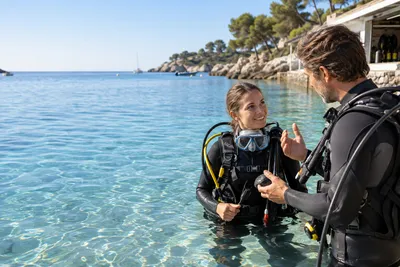
Yes, it is sometimes possible to do a first scuba diving experience without being a good swimmer, or even without having formally learned to swim, provided that the dive center and instructor consider the situation appropriate. An introductory dive takes place under close supervision, in an environment chosen to reduce difficulties. However, this does not mean there is a universal rule stating that swimming ability is never required for a try dive.
The key difference is this: a try dive is a supervised introduction, whereas certification training requires you to demonstrate aquatic and technical abilities. Depending on the training organization, these requirements are formalized in different ways.
- Try dive / Try Scuba: a short, closely supervised experience designed to discover breathing underwater.
- Certification: progressive training with assessments, safety skills and aquatic requirements specific to each organization.
To understand the different steps before your first booking, also see our guide to getting started with scuba diving.
2. Why knowing how to swim and being comfortable in the water are not the same thing
Being able to swim several lengths and being comfortable in the water are two different things. Someone may know breaststroke but panic when water covers their face, when they can no longer touch the bottom or when they have to breathe calmly through a regulator. Conversely, someone who rarely swims may remain relaxed, listen to instructions and move calmly in shallow water.
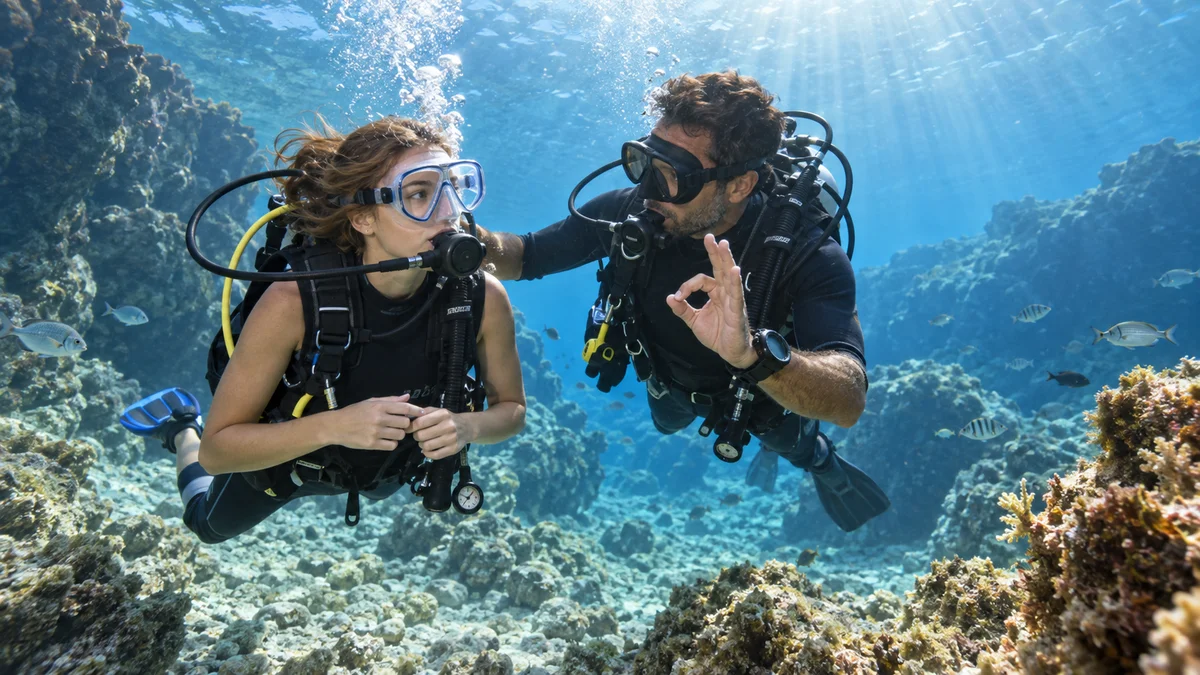
In scuba diving, water comfort matters because it allows you to stay mentally available for learning: breathing slowly, accepting the mask, equalizing your ears, understanding hand signals and following the instructor. Scuba diving is therefore not simply about being able to swim a certain distance.
However, this distinction should not be used to downplay safety. Once you move toward certification, some agencies explicitly require you to demonstrate abilities in the water. Being unable to stay afloat or move through the water can then become a real obstacle to progressing.


3. Doing a try dive if you swim poorly or not at all
For a first introduction, there is no single answer that applies to every dive center and every country. A try dive can often be organized without a formal swim test, but this depends on the dive center, the site, the conditions and the instructor's assessment. The participant should honestly explain their swimming level and any concerns before the session.
Within the FFESSM framework, a try dive is presented as a first introduction to scuba diving, in a swimming pool or protected natural environment, from the age of 8. It takes place one-to-one with an instructor and generally lasts 20 to 40 minutes, between 2 and 6 m depending on age and conditions. The FFESSM discovery page also presents it as accessible without a federation license or medical certificate.
With SSI, the Try Scuba program is also an introductory experience supervised by a professional, in a swimming pool or confined water. It is available from age 8 and the stated maximum depth for this experience is 5 m.
In every case, not knowing how to swim should never be hidden. The instructor may choose an area where you can stand, reduce the depth, adapt the session or decide that another format would be more appropriate.
4. What the instructor needs to know before entering the water
Before the session, clearly explain your relationship with the water. The aim is not to judge you, but to allow the professional to adapt the experience. Important information given before you gear up is always more useful than discovering a difficulty once you are already in the water.
- Say whether you can swim or can only move a few meters.
- Explain whether you are comfortable when you cannot touch the bottom.
- Mention any fear of putting your face in the water, using a mask or breathing through your mouth.
- Say if you have ever panicked in a swimming pool or at sea.
- Ask questions about the water entry, planned depth and how close the instructor will stay to you.
The instructor must be able to organize the session according to the participant and the conditions of the day. A successful introductory dive is not the one where you go deepest, but the one where you remain able to understand instructions, breathe calmly and stop the experience if necessary.
5. PADI Open Water requirements
For the PADI Open Water Diver course, the aquatic requirements are clearly defined. Before completing the course, the student must demonstrate basic water skills showing that they can remain comfortable in the water.
- Swim 200 m continuously, using any swimming style and with no time limit; or
- Swim 300 m using a mask, fins and snorkel, also with no time limit;
- Float or tread water for 10 minutes, using any method.
PADI also requires a medical questionnaire. If some answers indicate that further assessment is needed, medical approval must be obtained; in some countries or jurisdictions, local regulations may also require a medical consultation.
In practice, someone who cannot yet swim cannot simply skip this step to obtain a PADI Open Water certification. A better approach is to gradually improve water confidence before or while preparing for the course.
6. SSI Open Water requirements
For the SSI Open Water Diver course, the official standards require, among other things, completion of pool or confined-water sessions, passing the required assessments and completing a Student Water Fitness Evaluation. This water fitness evaluation must be completed before participating in open-water training dives.
The course also includes at least four open-water training dives. The official SSI source provided here confirms that a water fitness evaluation is mandatory, but the public page cited does not provide a swimming distance that can be quoted reliably. We therefore do not add one.
| Training path | Aquatic assessment | Open water |
|---|---|---|
| PADI Open Water | 200 m or 300 m with mask, fins and snorkel + 10 min floating | Training includes open-water dives |
| SSI Open Water | Mandatory Student Water Fitness Evaluation | At least 4 dives |
| FFESSM Level 1 | Technical and aquatic skills validated within the course | 4 open-water dives to be validated |
7. FFESSM Level 1 and progression in France
The FFESSM Level 1 is a genuine training course, not simply a try dive. FFESSM states a minimum age of 12 subject to parental approval and the approval of the training center manager; otherwise, the reference age is 14. A medical certificate of no contraindication to scuba diving is required.
The federation suggests approximately 5 open-water training dives. At the end of the course, 4 open-water dives must be validated by an FFESSM instructor. Level 1 qualifies the diver to dive under supervision to a maximum depth of 20 m.
Unlike PADI Open Water, the FFESSM page cited here does not present a quantified swim test in the form of a set distance and floating time. It would therefore be incorrect to invent an equivalence. The course nevertheless requires the diver to master the skills needed to move and communicate safely with the supervising instructor.
For a broader comparison of the different pathways, their structures and their differences, see our guide FFESSM Level 1, PADI Open Water or SSI Open Water: which course should you choose?.
8. Simple exercises to become more comfortable before enrolling
If being in the water makes you uncomfortable, a few swimming pool sessions can make a future introductory dive much more enjoyable. The aim is not to practise scuba exercises alone, but to work on simple basics in a supervised environment.
- Walk in an area where you can stand and gradually put your face in the water.
- Exhale slowly into the water and return to calm breathing at the surface.
- Learn to float on your back with a swimming instructor or suitably qualified supervisor.
- Move a few meters without rushing, then gradually increase the distance.
- Get used to opening your eyes behind a mask in a swimming pool while maintaining regular breathing.
Adult swimming lessons or individual sessions can be especially useful for people who are afraid of the water. You do not need to become a competitive swimmer: the goal is to gain enough control and confidence to remain calm and sufficiently independent in the situations required by the course you choose.

9. Situations where it may be better to postpone or choose an adapted session
Postponing a session is not a failure. If you are extremely anxious, cannot tolerate having your face in the water or panic as soon as you cannot touch the bottom, a shallow-water pool session or some prior work on water confidence may be preferable to an open-sea dive.
It is also reasonable to choose another time when conditions make the experience more demanding: rough water, current, poor visibility, a difficult entry or significant cold. The fact that an activity is technically possible does not mean it is the best first experience for a beginner who is not comfortable in the water.
For medical matters, follow the questionnaires, certificates and procedures required by the training organization, the dive center and local regulations. This article does not replace medical advice and cannot determine whether an individual is medically fit to dive.
10. How to choose a dive center + conclusion + official sources
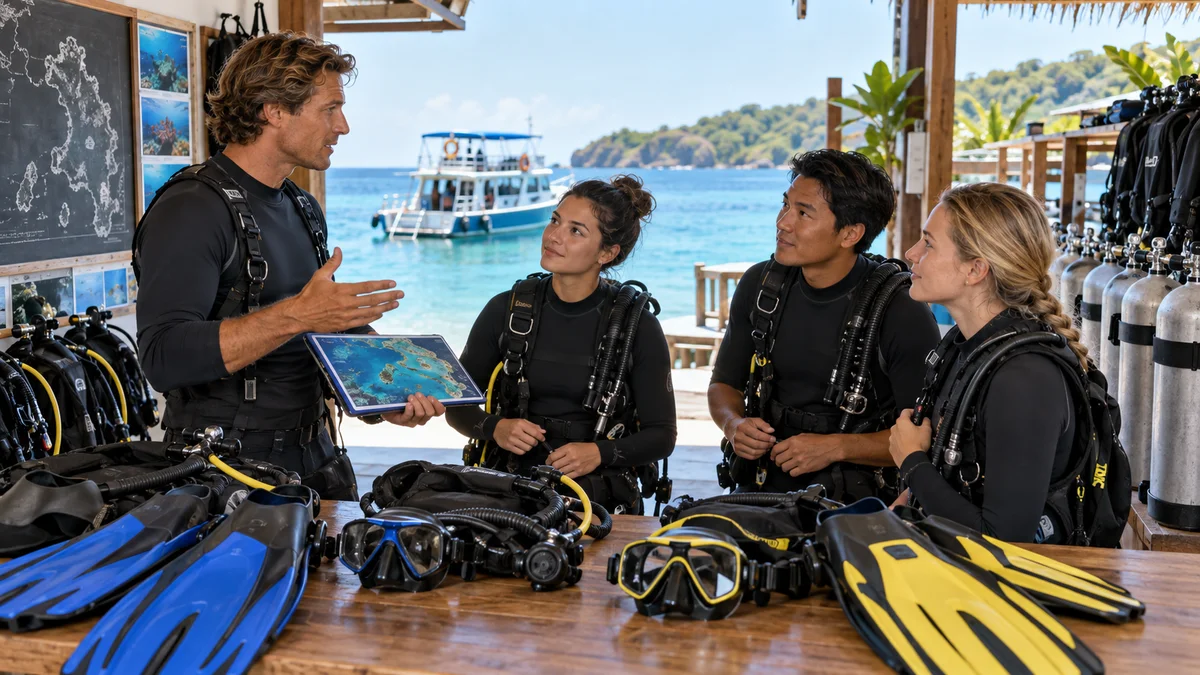
If you are a weak swimmer or cannot swim at all, contact the dive center before booking and ask specific questions. Ask where the introductory session takes place, whether you will be able to stand at the beginning, how many participants will be with the instructor, what depth is planned and how the session can be adapted for someone who is not comfortable in the water.
- Choose a center that takes the time to ask about your water confidence.
- Prefer a first session that is calm, progressive and clearly explained.
- Never hide a difficulty because you are afraid that the activity might be refused or adapted.
- For certification, check the official requirements of the chosen course before enrolling.
In conclusion: under certain conditions, it is possible to discover scuba diving without being a good swimmer. A try dive or supervised introductory experience can often be organized without a formal swim test, but this always depends on the center, the environment and the professional's assessment. Certification, on the other hand, requires a higher level of water confidence and may include mandatory assessments. The right approach is to choose an experience that matches your actual ability, not to try to bypass safety requirements.
Official sources:

00 Comments
No comments yet.