
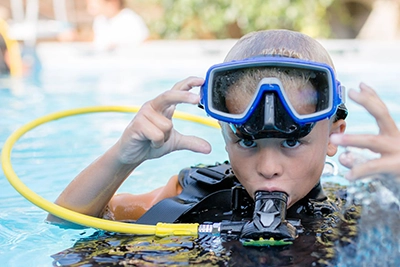
Diving Courses for Children and Teenagers: Exploring the Underwater World from a Young Age
Scuba diving is not just for adults; children and teenagers can also discover the wonders of the underwater world through training tailored to their age and abilities. Here is a comprehensive guide to the options available for young divers up to 18 years old.
1 The First Steps Underwater Discover Diving Safely
Diving Baptism (from 8 years old)
The baptism is a simple and safe introduction to diving, allowing children to breathe underwater for the first time.
Minimum age: 8 years.
Maximum depth: 2 to 6 meters depending on local regulations.
Supervision: Always under the supervision of a certified instructor.
Objective: Discover the sensations of diving and become familiar with the equipment.
2 Specific Programs for Children
Bubble Maker (PADI)
A fun program designed especially for the youngest.
Minimum age: 8 years.
Maximum depth: 2 meters.
Content: Games and activities in the pool to learn the basics of diving in a fun way.
Benefits: Ideal for curious children eager to learn more.
Bronze, Silver, and Gold Diver (FFESSM/CMAS)
A suitable progression for young divers:
Minimum age: 8 years.
Maximum depth: Between 3 and 6 meters.
Content: Workshops in the pool and in natural environments to learn to master the equipment and the basics of diving.
Benefits: A recognized program in France, ideal for a gradual introduction.
3 Junior Diving The First Certifications
Junior Open Water Diver (PADI)
The children's version of the Open Water certification.
Minimum age: 10 years.
Maximum depth:
12 meters for 10-11 years old.
18 meters for 12-14 years old.
Content: Theory, pool practice, and natural environment dives, tailored to children's pace.
Benefits: International certification allowing diving with a certified adult.
Level 1 Junior (FFESSM/CMAS)
A certification for young divers in France.
Minimum age: 12 years.
Maximum depth: 20 meters under supervision.
Benefits: Training focused on safety and technical mastery, tailored for teenagers.
4. Diving for Teenagers Gaining Autonomy
Advanced Junior Open Water Diver (PADI)
For young divers wishing to deepen their skills.
Minimum age: 12 years.
Maximum depth: 21 meters (limit until 15 years).
Content: Specialized dives such as night diving, underwater navigation, or wreck exploration.
Benefits: Perfect for exploring more varied environments and developing new skills.
Level 2 Junior (FFESSM/CMAS)
An advanced training for teenagers.
Minimum age: 16 years.
Maximum depth: 40 meters with an instructor.
Content: More technical training and advanced exercises in natural environments.
5 Specialties for Young Divers
Some specialties can be pursued from the age of 12, offering young divers the opportunity to diversify their experiences:
Junior Nitrox Diving: Enriched air mix for longer dives (from 12 years old).
Wreck Diving: Safe exploration of wrecks (from 12 years old).
Underwater Photography: Learning to capture the beauty of the underwater world (from 10-12 years old).
6 Age Limits and Safety Rules
Diving for children and adolescents is strictly supervised to ensure their safety:
Always dive with an instructor or a certified adult.
Respect depth limits according to age.
Ensure that the child is healthy and comfortable underwater.
7 Why Introduce Children to Diving
Diving offers numerous benefits for young people:
Development of self-confidence and technical skills.
Awareness of ocean preservation and marine life.
Unique and memorable experiences with family or friends.
Conclusion: A Gradual Learning Towards Autonomy
Programs and certifications for children and teenagers allow them to discover diving safely while having fun. From the excitement of the first bubbles to the advanced exploration of the seabed, each step is a new adventure.
Feel free to check the reviews and recommendations of dive centers on Scuba Spot Advisor to find the perfect place to introduce your children to this passion.
Ready to dive into a new adventure?
01 Comments
sophie
May 14, 2026Very good article on diving for young people from the age of 8. It is particularly reassuring for guiding younger ones towards diving, clearly explaining the first steps such as the baptism and supervised immersions. The article emphasizes the importance of appropriate supervision, a gradual progression, and a playful approach to allow children to discover the underwater world safely and with confidence. A great introduction to diving, ideal for sparking interest while remaining calm about safety.