
Two seas, many possible encounters
Thailand offers two marine worlds: the Andaman Sea and the Gulf of Thailand. Reefs, sandy bottoms, pinnacles and seagrass beds support varied Indo-Pacific wildlife.
Conditions, seasons and animal movements differ by site. No sighting is guaranteed; these ten species are possibilities to recognise and observe with care.
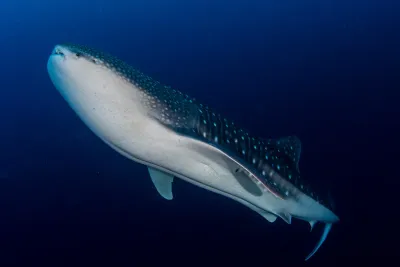
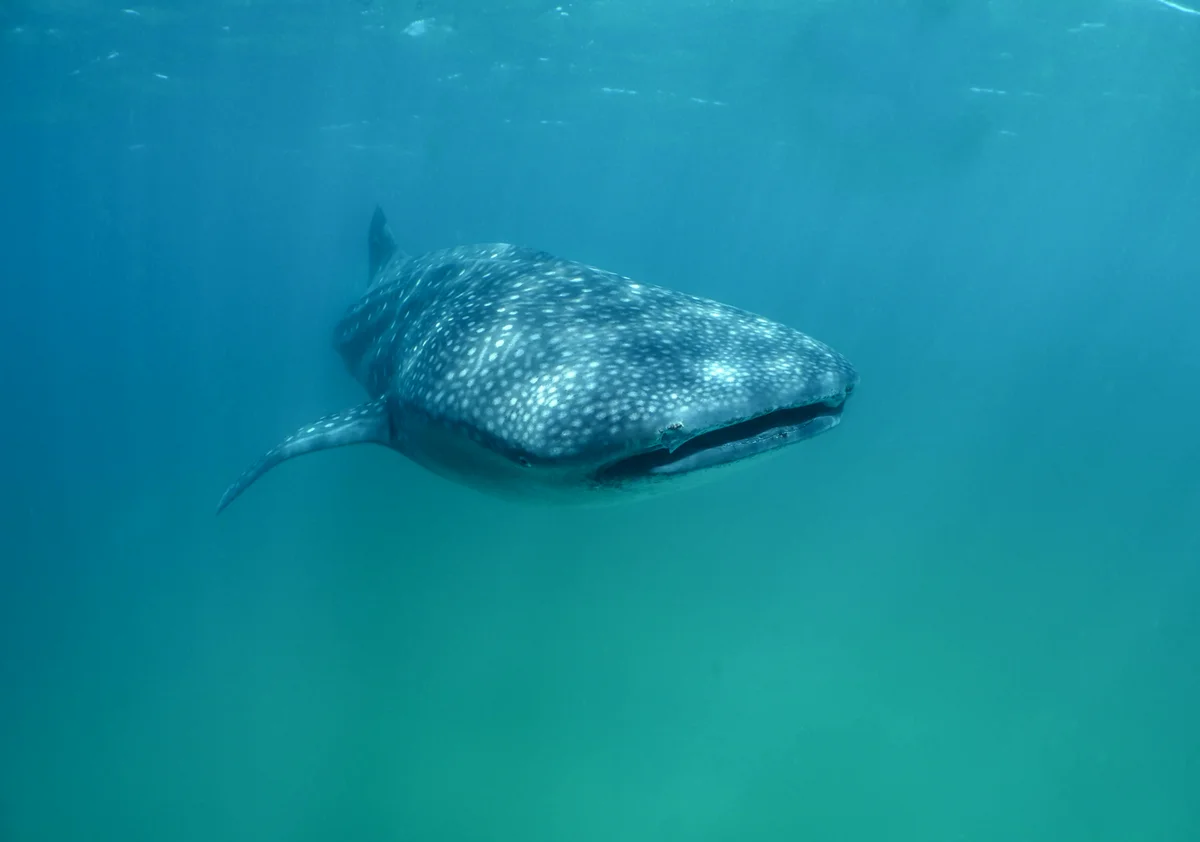
1. Whale shark
The Whale shark (Rhincodon typus) is identified by its massive body, broad flattened head and grey back covered with a unique pattern of pale spots. Despite its size, it filters plankton and small organisms while swimming slowly in open water. In Thailand, encounters are possible around Richelieu Rock, the Similan Islands, Hin Daeng and Chumphon Pinnacle when food and seasonal conditions are favourable, but never guaranteed. Swim calmly parallel to its path, keep a respectful distance, never touch it and avoid moving in front of its mouth or powerful tail.


2. Green turtle
The Green turtle (Chelonia mydas) has an oval brown or olive shell, a relatively small rounded head and strong front flippers. Adults commonly graze in seagrass beds and shallow reef areas, while juveniles eat a wider range of food. Divers and snorkelers may look for it around Koh Tao, the Similan and Surin Islands, Phuket and Phi Phi, depending on local conditions. Approach slowly from the side, never chase it and always leave a clear route to the surface when it needs to breathe. Touching or riding a turtle can disturb and injure it.
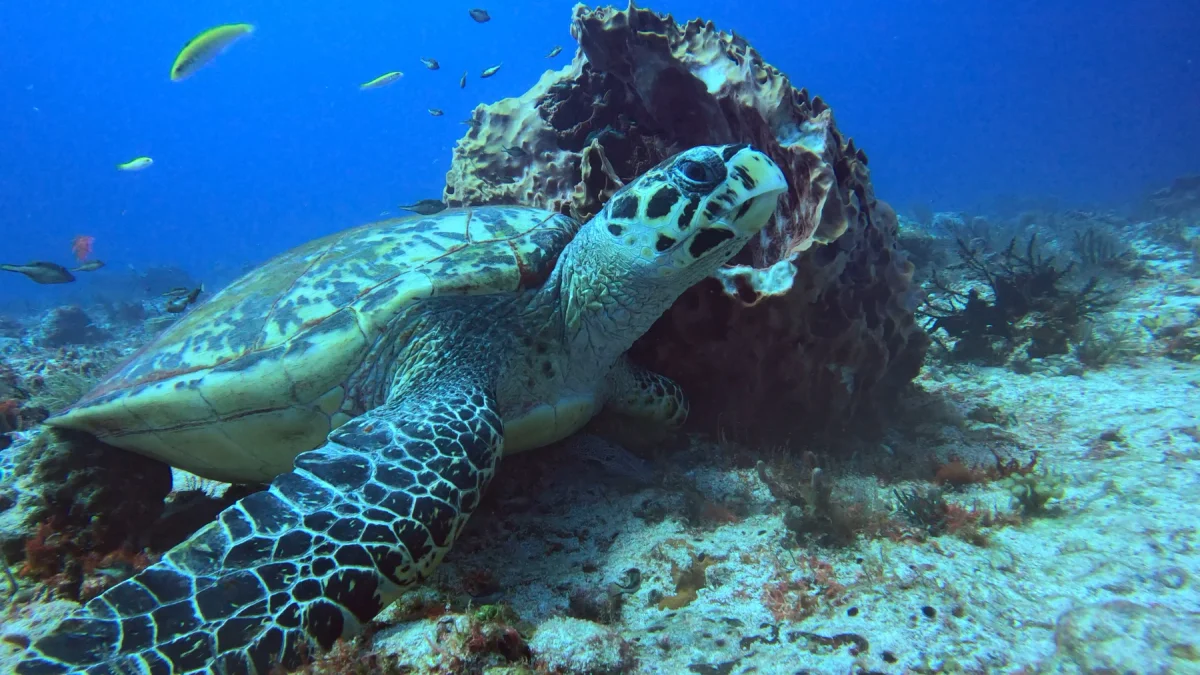
3. Hawksbill turtle
The Hawksbill turtle (Eretmochelys imbricata) is recognised by its narrow curved beak, serrated shell edge and overlapping scutes. It is closely associated with coral reefs, where it searches crevices for sponges and other invertebrates. In Thailand it may be seen on reefs around the Similan and Surin Islands, Phi Phi, Phuket and Koh Tao, although sightings vary. Watch from the side without blocking its route or following closely. Never touch the shell, and maintain careful buoyancy so fins and equipment do not damage the coral habitat on which the turtle depends.


4. Bluespotted ribbontail ray
The Bluespotted ribbontail ray (Taeniura lymma) has a yellow-brown disc covered in bright blue spots and distinctive blue markings along its tail. By day it often rests on sand, beneath a ledge or beside the reef, later searching the bottom for worms, molluscs and crustaceans. Look carefully over sandy patches around Koh Tao, Phi Phi, Phuket and the Similan Islands. Move slowly without raising sediment, leave the animal an open escape route and never attempt to touch it. The spine on its tail is a defensive weapon, so respectful distance protects both the ray and the observer.
View the detailed species profile: Bluespotted ribbontail ray
5. Titan triggerfish
The Titan triggerfish (Balistoides viridescens) has a powerful body, heavy head, thick lips and striking yellow, blue and dark markings. It may overturn stones or blow jets of water into the sand to uncover invertebrates. Common on reefs in both the Andaman Sea and Gulf of Thailand, it can become highly territorial while guarding a nest. If a fish raises its dorsal spine, accelerates or makes repeated approaches, move calmly away horizontally. Never provoke or feed it, and avoid entering the area above a nest, especially during the breeding season.


6. Clark’s anemonefish
Clark's anemonefish (Amphiprion clarkii) has variable dark or orange colouring, pale vertical bands and often yellow fins. It lives with several species of sea anemone: the tentacles provide shelter, while the fish helps defend and maintain its host. Search anemones on shallow reefs around Koh Tao, Phi Phi, Phuket and the Similan Islands. Slow down and hold position at a distance so the fish can resume its natural behaviour. Never touch the anemone or its occupants, and keep fins, gauges and cameras clear of the reef.
7. Giant moray
The Giant moray (Gymnothorax javanicus) has an elongated body, thick head and heavily mottled brown colouring. During the day it commonly remains inside a crevice with only its head showing. Its repeated open-mouth movement pumps water over the gills and is not automatically an aggressive display. It occurs on reefs in both the Andaman Sea and Gulf of Thailand, including the Similan Islands, Phi Phi and Koh Tao. Keep hands out of holes, never feed a moray and leave clear space in front of its shelter so it does not feel trapped.


8. Blue-barred parrotfish
The Blue-barred parrotfish (Scarus ghobban) has a robust body, a beak made of fused teeth and colours that change with age, sex and life phase. By grazing algae from rock and reef surfaces, it contributes to reef processes and can produce sand while crushing material. It can be found on many shallow reefs along both Thai coasts, especially while feeding. Observe by swimming slowly at a distance and allow it to continue grazing. Do not rest on coral, stir the bottom or chase the fish for a photograph.
9. Broadclub cuttlefish
The Broadclub cuttlefish (Sepia latimanus) has a broad flattened body, short arms around the mouth and rippling fins along the mantle. It can rapidly change colour, pattern and skin texture to hide, communicate or hunt. In Thailand, search slowly along reef edges, sandy areas and seagrass habitats in the Andaman Sea and Gulf, where it may remain motionless close to the bottom. Approach gently and hold a stable position. Never touch it, avoid continuous bright lighting and do not deliberately provoke colour changes, which may signal stress rather than entertainment.


10. Zebra shark
The Zebra shark (Stegostoma tigrinum) changes greatly with age: juveniles are striped, while adults are spotted with a broad head and exceptionally long tail. Mainly active at night, it often rests on sand beside reefs during the day and can breathe without constant swimming. In Thailand, possible sites include Phi Phi, the Similan Islands, Koh Bon and Richelieu Rock, but sightings are never assured. This threatened shark needs space: do not touch, surround or block it, and always keep a clear route for it to leave.
Observe without disturbing
Keep your distance and never touch, feed or chase wildlife. Good buoyancy also protects coral and the seabed.
Choose responsible operators. Sources: FishBase, SeaLifeBase and NOAA Fisheries.
00 Comments
No comments yet.