
The Caribbean offers divers and snorkelers a marine fauna that is both varied and distinctive. On reefs, in seagrass beds or above sandy bottoms, some species immediately catch the eye while others reward closer observation. Here are ten emblematic animals to learn to identify, with simple pointers on their habitat, behavior and diet. The aim is not to promise a sighting, but to help you know what to look for when the opportunity arises.
Spotted Trumpetfish — Aulostomus maculatus
With its very long body, tubular snout and chin barbel, the spotted trumpetfish is difficult to mistake once its main features are familiar. Its coloration can range from brown to yellow and may blend with its surroundings. It is found especially around reefs and sea fans, where its camouflage is particularly useful.
- Habitat: coral reefs and areas among sea fans in the Caribbean and western Atlantic.
- Behavior: it often hunts by ambush, sometimes holding a vertical, head-down position.
- Hunting technique: it can also hide behind larger fish to approach its prey.
- Diet: it mainly catches small fish.
An important identification point: unlike trumpetfish relatives of the genus Fistularia, the spotted trumpetfish does not have a caudal filament. DORIS source.


French Angelfish — Pomacanthus paru
The French angelfish has a tall, dark body with scales edged in yellow. Juveniles show much more contrasting yellow bands than adults. On the reef, this species may occur in pairs and defend a territory, giving divers a glimpse of its behavior as well as its distinctive pattern.
- Range: it occurs in the Caribbean and western Atlantic.
- Habitat: it lives on reefs, where it finds shelter and food resources.
- Diet: adults feed mainly on sponges, along with algae and invertebrates.
- Juveniles: young fish can act as cleaners, removing parasites from other fish.
- Size: around 40 cm is a common length.
When observing one, keep your distance and give it space within its territory. Florida Museum source.
Queen Angelfish — Holacanthus ciliaris
The queen angelfish has a distinctive combination of blue and yellow. A dark forehead marking surrounded by blue gives it the appearance of a crown, while the tail is yellow. It can be seen alone or in pairs around reefs, where its contrasting colors make identification relatively straightforward.
- Identification: look for the dark forehead spot outlined in blue and the entirely yellow tail.
- Habitat: it remains associated with coral reefs, often around sea fans and corals.
- Diet: sponges make up most of its diet, along with other invertebrates, algae and other food resources.
- Juveniles: young fish can visit cleaning stations and remove parasites from other fish.
- Size: the species can reach about 45 cm.
A close look at the forehead helps distinguish it from similar angelfish. Florida Museum source.


Southern Stingray — Hypanus americanus
The southern stingray has a diamond-shaped disc, brown to gray above and white underneath. It mainly uses coastal sandy bottoms and generally stays close to the seabed. For divers and snorkelers, its outline can be easy to recognize, but its tail spine means one simple rule applies: look, but do not touch.
- Habitat: coastal sandy bottoms, particularly in the tropical waters of the Caribbean.
- Diet: it searches the bottom for crustaceans, mollusks and other benthic prey.
- Behavior: it can disturb the sand with its pectoral fins while searching for food.
- Safety: its caudal spine can be used defensively; it should neither be touched nor fed.
The name Dasyatis americana still appears in some references, but the accepted name is now Hypanus americanus. Florida Museum source and OBIS taxonomy.
Nurse Shark — Ginglymostoma cirratum
The nurse shark has an easily recognizable appearance: a brown body, barbels near the mouth and rounded dorsal fins. In the Caribbean, it is known for resting under overhangs and in cavities. These refuges should be respected when you want to observe one.
- Resting: during the day, it may remain under overhangs or in cavities, sometimes in groups.
- Activity: it mainly hunts at night.
- Diet: its diet includes crustaceans, mollusks and fish.
- Observation: never block access to its shelter and do not touch it.
- Distinction: this Caribbean species should not be confused with Nebrius ferrugineus, the nurse shark of the Indo-Pacific.
A calm observation from outside the cavity allows you to maintain a respectful distance. Florida Museum source.


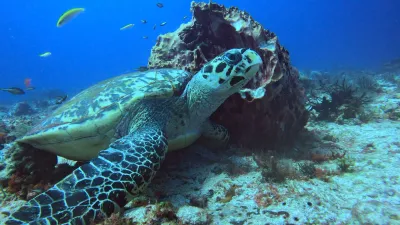
Hawksbill Turtle — Eretmochelys imbricata
The hawksbill turtle is particularly recognizable by its narrow, hooked beak. Its shell has overlapping scutes and a serrated edge, while two pairs of scales are visible between the eyes. In the Caribbean, it is closely associated with reef habitats, where sponges are an important part of its diet.
- Habitat: coral reefs are an important habitat for this turtle.
- Diet: sponges are among its main food resources.
- Breathing: like other sea turtles, it must return to the surface to breathe.
- Observation: always leave it clear access to the surface and do not pursue it.
- Conservation: bycatch, habitat degradation and the historical trade in shell are among the pressures affecting it.
For underwater identification, the beak and overlapping shell scutes are useful clues. NOAA Fisheries source.
Green Turtle — Chelonia mydas
Despite its name, the green turtle does not necessarily have a green shell: it can be brown, gray or olive. Its rounded head and the presence of a single pair of scales between the eyes are useful identification features. In coastal areas, it is particularly associated with seagrass beds, which are important feeding grounds.
- Diet: in coastal stages, its diet consists mainly of seagrasses and algae; young turtles are more omnivorous.
- Habitat: seagrass beds are important feeding areas.
- Breathing: it must regularly return to the surface to breathe.
- Migrations: it can travel between feeding areas and nesting areas.
- Observation: do not feed it and always leave a clear route to the surface.
The best approach is to stay calm and out of its path, allowing it to continue moving naturally. NOAA Fisheries source.


Green Moray — Gymnothorax funebris
The green moray is distinguished by its long, uniformly green body. This characteristic color comes from the yellow mucus covering naturally dark skin. During the day, it generally remains hidden in reef cavities before becoming more active to hunt. For divers, reef holes and cracks are therefore places to observe with the eyes, never with the hands.
- Habitat: it uses cavities and shelters within reefs.
- Behavior: it often remains hidden during the day and mainly hunts at night.
- Diet: its diet includes fish, crustaceans and cephalopods.
- Observation: keep your hands out of cavities and avoid contact.
The apparent green color of its body is therefore not simply green pigmentation: it results from the combination of dark skin and yellow mucus. Florida Museum source.
Great Barracuda — Sphyraena barracuda
The great barracuda has a long, silvery body, a prominent lower jaw and dark spots along the lower sides. It is a visual predator that may remain alone in waters near reefs, although groups are also possible. Juveniles use mangroves and seagrass beds among their habitats.
- Identification: streamlined silver body, protruding lower jaw and dark spots on the lower sides.
- Habitat: reefs and coastal open water; juveniles also use mangroves and seagrass beds.
- Behavior: it is often solitary, but can also be seen in groups.
- Diet: it is a visual predator that mainly hunts fish.
- Observation: do not attract it or pursue it.
Its distinctive shape often makes identification possible before approaching the reef. Florida Museum source.


Leopard Eagle Ray — Aetobatus narinari
The leopard eagle ray has a distinctive silhouette in Caribbean waters. Its dark back covered with white spots contrasts with broad, diamond-shaped pectoral fins. Its flattened head and bill-like snout complete the identification. It moves through open water above reefs, sand or seagrass beds.
- Range: Aetobatus narinari occurs in the tropical Atlantic, including the Caribbean Sea.
- Habitat: it can swim above sandy areas, seagrass beds and reefs.
- Behavior: individuals may be seen alone or in groups.
- Size: a disc width of around 1.5 m is common according to DORIS.
- Important distinction: A. narinari is the Atlantic species; A. ocellatus corresponds to populations in the Red Sea and Indo-Pacific.
If a ray approaches in your direction, stay calm and do not try to block its path. DORIS source.
Observation tips and sources
Observing without disturbing is the guiding principle for all these encounters. Stay calm, avoid pursuits and contact, keep your hands out of cavities and do not feed the animals. With turtles, always leave a clear route to the surface; with rays and eagle rays, do not try to cut across their path; with territorial or resting animals, give them space. Patient observation can often reveal more natural behavior than an insistent approach.
The information in this article relies only on the following verified references:
- Florida Museum — French Angelfish
- Florida Museum — Queen Angelfish
- Florida Museum — Green Moray
- Florida Museum — Great Barracuda
- Florida Museum — Nurse Shark
- Florida Museum — Southern Stingray
- DORIS — Aulostomus maculatus
- DORIS — Aetobatus narinari
- NOAA Fisheries — Hawksbill Turtle
- NOAA Fisheries — Green Turtle
- OBIS — taxonomy of Dasyatis americana / Hypanus americanus


00 Comments
No comments yet.