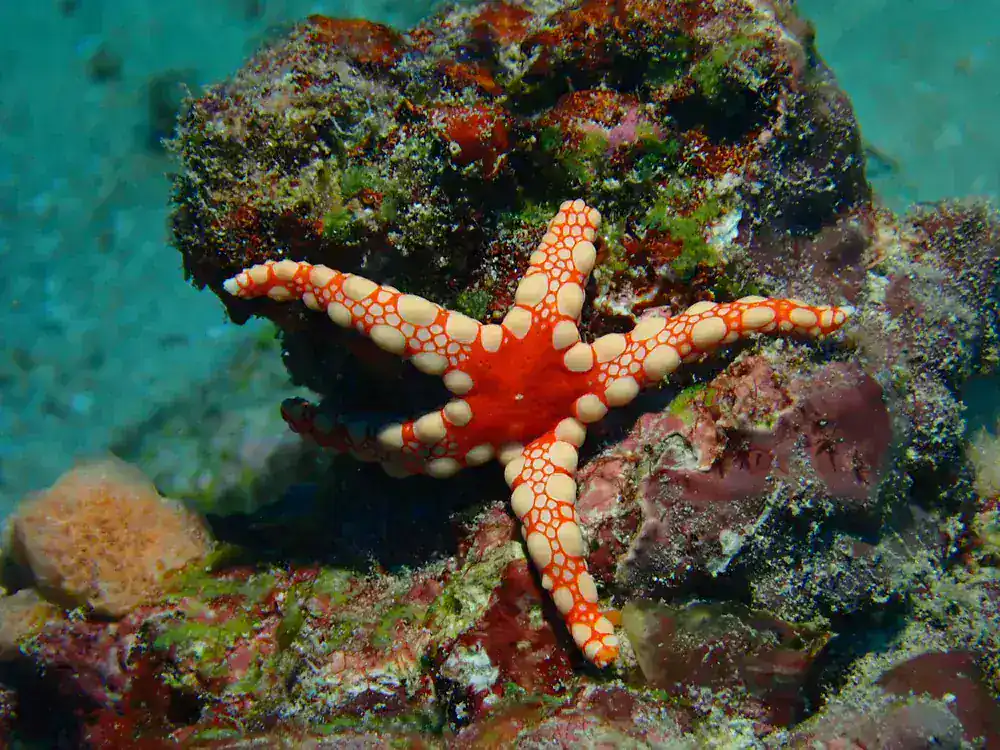
Found in rocky and sandy substrates in shallow waters.
Distribution
Widespread in the Atlantic Ocean, particularly along the coasts of Europe and North America.
Conservation status
Least Concern
Edibility
Not generally used as food; culinary use is poorly documented and consumption is not recommended.
Danger level
Harmless
Usual observation depth
?–30 m
Behaviour
Generally solitary and slow-moving. It is mainly active while foraging and can climb on hard substrates. It is a predatory star capable of opening bivalve shells with its tube feet.
Observation zones
Rocky reef, kelp-covered rocks, seagrass beds, fields of boulders, and adjacent sand or debris.
Diet
Mainly bivalve mollusks, notably mussels and other shellfish; it may also consume barnacles, other sessile invertebrates, carrion, and occasionally other echinoderms.
Reproduction
Oviparous
Identification marks
Large, robust starfish, usually with five broad, tapered arms, a small central disk, and clearly visible rows of pale, conical spines or granules on the upper surface of the arms. Color variable: often brown, reddish brown, orange, or purplish, with the tips of the spines frequently pale.
Similar species
May be confused with the common starfish (Asterias rubens), generally smaller, with thinner arms and without the coarse rows of prominent conical spines characteristic of Marthasterias glacialis. It may also resemble the seven-armed starfish (Luidia ciliaris), but the latter usually has seven arms and is more closely associated with sandy bottoms.
Approach rules
Observe without touching, lifting, or turning the animal over. Control its buoyancy and avoid any contact with the bottom. Keep, when possible, a respectful distance of approximately 1 m. Use moderate lighting and avoid repeated flashes at very close range. Never feed or move the animal.
Protection
No CITES listing is known. This species has not been assessed globally on the IUCN Red List; avoid collection and disturbance, and comply with site-specific conservation regulations.