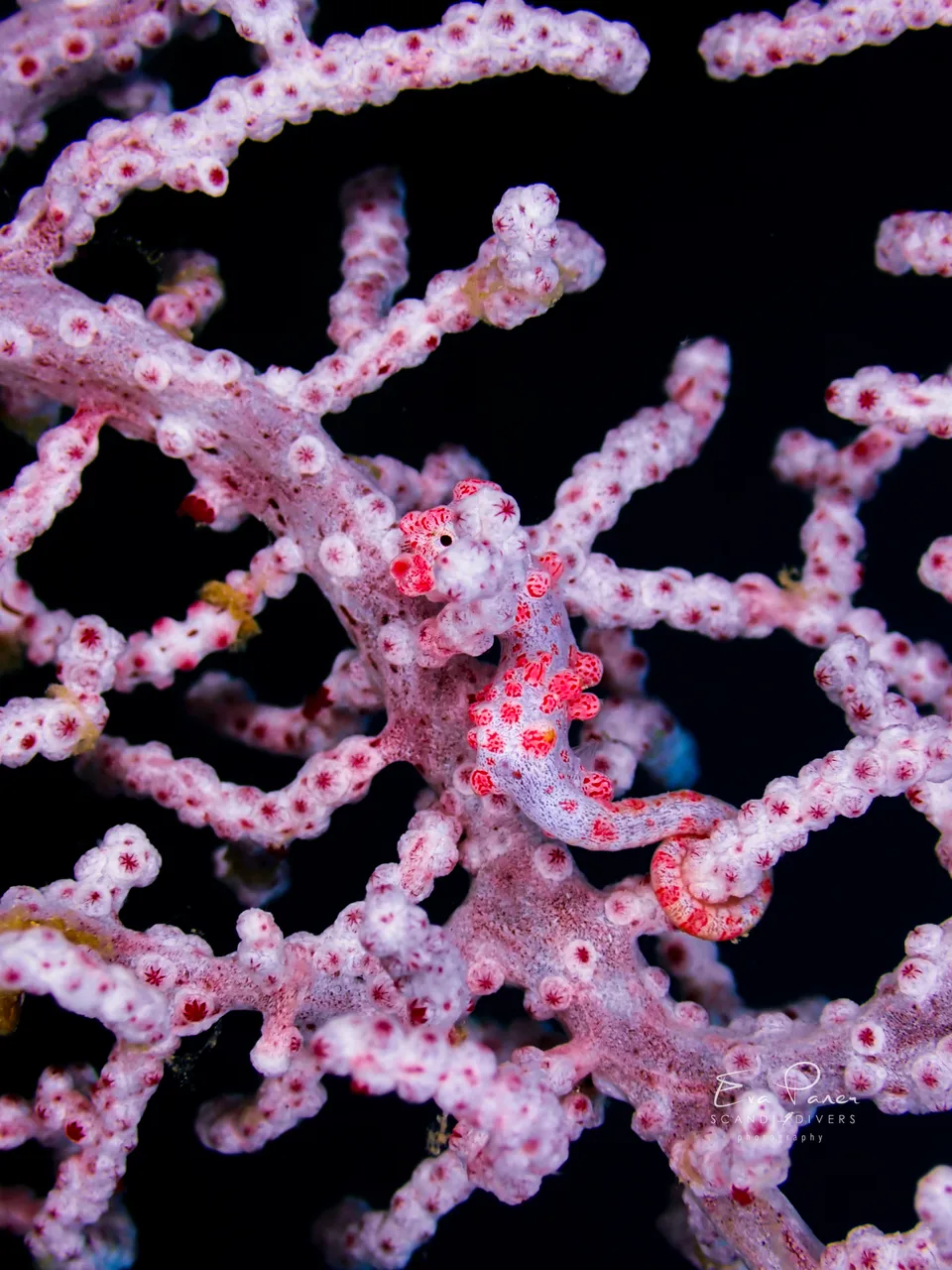
Typically found in association with gorgonian corals.
Distribution
Found in the Indo-Pacific region, particularly around Papua New Guinea and Indonesia.
Conservation status
Least Concern
Edibility
Not suitable for consumption. It is extremely small, has no meaningful culinary use, and international trade in seahorses is regulated under CITES Appendix II.
Danger level
Harmless
Usual observation depth
16–30 m
Behaviour
Most often observed alone or in pairs, firmly attached to its host gorgonian by means of its prehensile tail. It is highly cryptic, sedentary, and generally active during the day. Males incubate the embryos in a pouch.
Observation zones
Coral reef; more specifically large sea fan gorgonians and gorgonian gardens on slopes and drop-offs.
Diet
Feeds mainly on tiny crustaceans and zooplankton, including copepods, sucked in with its tubular snout.
Reproduction
Ovoviviparous
Identification marks
Very small seahorse, generally about 2 cm long, with a rounded body covered in large bulbous protrusions. Its color and tubercles closely mimic the host gorgonian Muricella, often pale with pink or red nodules, or yellow with orange nodules.
Similar species
Can be confused with other pygmy seahorses, especially Denise's pygmy seahorse (Hippocampus denise). H. bargibanti is noticeably stockier and more bulbous, and associated with Muricella gorgonians; H. denise is more slender and lives on other gorgonians. H. pontohi and H. colemani are generally smaller, smoother, and associated with other hosts.
Approach rules
Observe without touching the animal or its host coral. Maintain controlled buoyancy and a respectful distance; avoid any contact with the gorgonian. Do not feed, collect, or move it. Avoid flash or use only minimal, carefully directed light if local rules permit.
Protection
IUCN: Data Deficient. All species of the genus Hippocampus are listed in Appendix II of CITES; international trade is regulated. Avoid collecting or disturbing the animals and their host gorgonians.