Continental and insular shelves, mainly over shallow sandy bottoms, channels, coral and rocky reefs. Juveniles may shelter among mangrove roots.
Distribution
Atlantic Ocean: western Atlantic from Rhode Island and Bermuda to southern Brazil, including the Gulf of Mexico and Caribbean Sea; eastern Atlantic around Cape Verde and from Senegal to Gabon, with rare records farther north.
Conservation status
Vulnerable
Edibility
Edible when properly prepared, but consumption is discouraged because the species is globally Vulnerable and shark meat may contain elevated mercury. International trade is regulated under CITES Appendix II.
Culinary quality / 5
3
Danger level
Caution
Usual observation depth
1–30 m
Lifespan (years)
25
Behaviour
Generally slow and mainly nocturnal. It often rests motionless on the bottom during the day, sometimes alone or in loose groups, and becomes more active at night to search for food. It generally tolerates divers, but may bite hard if handled, harassed, or cornered.
Observation zones
Shallow reefs, reef ledges, caves, crevices, sandy flats, seagrass beds, mangroves and sometimes shipwrecks.
Diet
Benthic predator that sucks up crustaceans, mollusks, sea urchins and bony fish; it can also consume other small animals living on the seafloor.
Reproduction
Viviparous
Identification marks
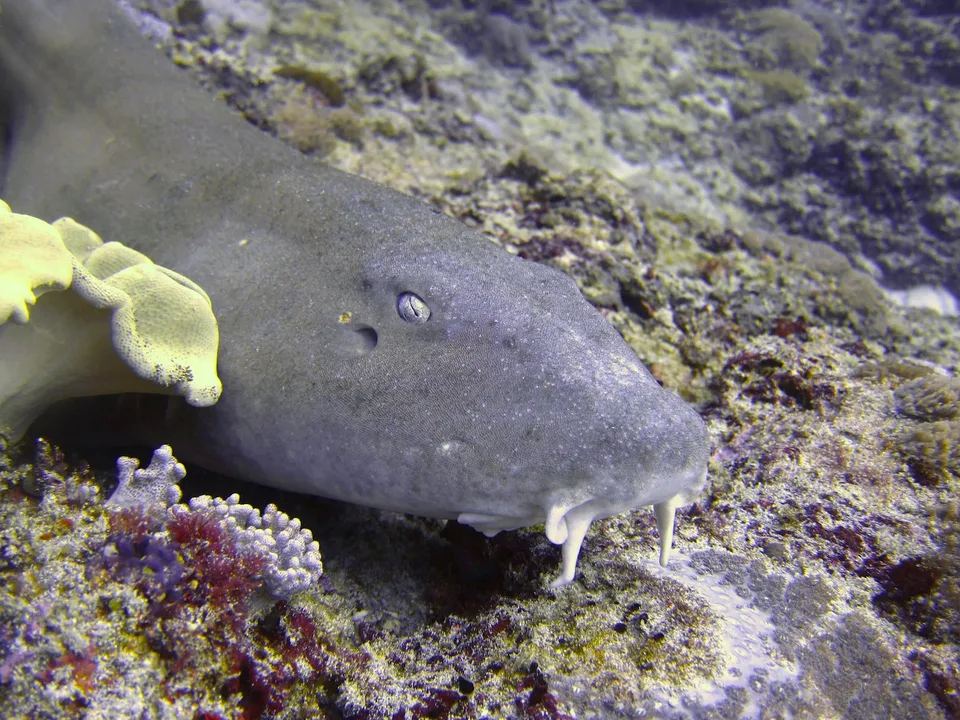
Stocky shark with a broad, rounded head, two conspicuous fleshy barbels beneath the nostrils, a small, far-forward mouth, small eyes, rounded dorsal fins set well back, and a long upper caudal lobe. Adults are generally yellowish brown to dark brown, often with faint spots.
Similar species
May be confused with the tawny nurse shark (Nebrius ferrugineus), found in the Indo-Pacific rather than the Atlantic and having a more pointed snout as well as a distinctly longer, whip-like tail. In the Eastern Pacific, the Pacific nurse shark (Ginglymostoma unami) is very similar; distribution is an important criterion.
Approach rules
Observe calmly and give the shark space, especially near its head and escape route. Do not touch, ride, restrain, corner, or feed it. Avoid flash photography at close range and never place your hands near its mouth or barbels; keep a respectful distance of several meters when conditions permit.
Protection
Classified as Vulnerable globally on the IUCN Red List. Listed in CITES Appendix II, which regulates international trade. Protection and fishing regulations vary by jurisdiction.