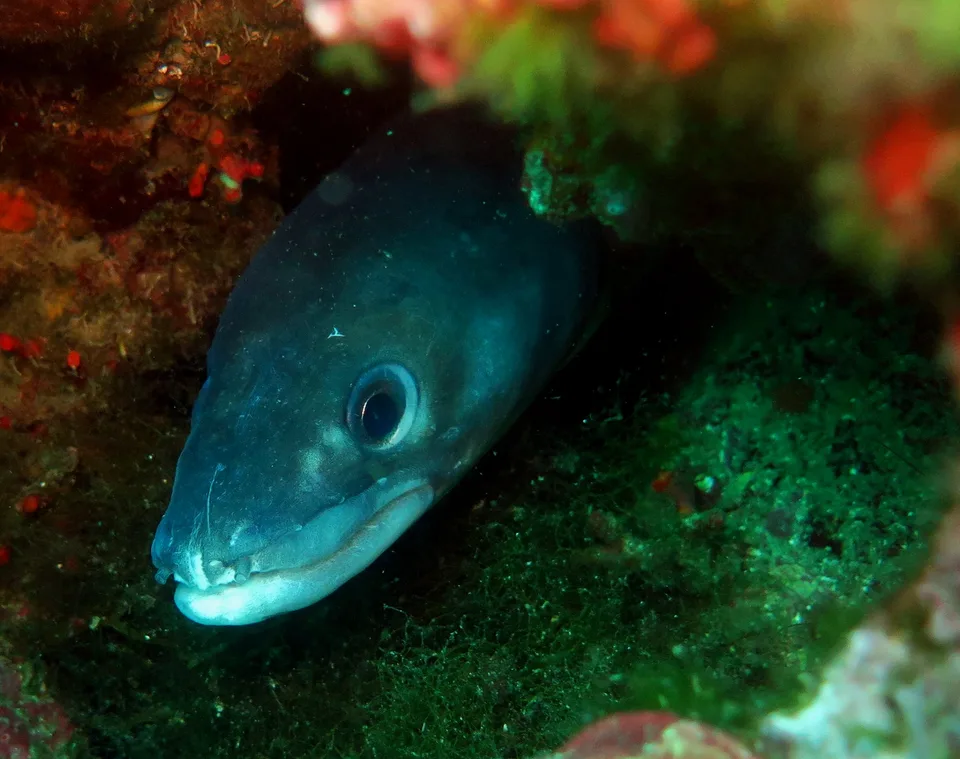
Demersal species of rocky coasts, reefs, caves, crevices, wrecks and sometimes soft bottoms; juveniles may enter coastal lagoons and estuaries.
Distribution
Northeastern Atlantic from Norway and Iceland south to Senegal, including the Mediterranean and Black Sea.
Conservation status
Least Concern
Edibility
Edible and commercially valued, with firm rich flesh. Cook thoroughly; very large individuals can be fatty. Follow applicable seafood-safety advice and local catch regulations.
Culinary quality / 5
4
Danger level
Caution
Usual observation depth
5–100 m
Lifespan (years)
0
Behaviour
Usually solitary, territorial around a shelter, and mainly nocturnal. It spends the day concealed in holes, crevices or wreck structure and emerges to hunt at night.
Observation zones
Rocky reef, cave, crevice, overhang, wreck, boulder field and occasionally sand or mud near shelter; most often seen at night.
Diet
An opportunistic predator feeding mainly on fishes, cephalopods and crustaceans; it may also scavenge.
Reproduction
Oviparous
Identification marks
A very large, robust eel with a broad flattened head, large mouth, prominent pectoral fins and a continuous dorsal, caudal and anal fin. Colour is grey-brown to blackish, usually with a pale margin on the fin.
Similar species
May be confused with the European eel (Anguilla anguilla), which is generally more slender and has its dorsal fin beginning much farther behind the head. Moray eels lack pectoral fins and have a different head profile.
Approach rules
Observe calmly without blocking its shelter or placing hands near the mouth. Keep a respectful distance, do not touch or feed it, and avoid flash photography at close range, especially at night. A conger can inflict a serious bite if threatened.
Protection
Globally assessed as Least Concern on the IUCN Red List. It is not listed in the CITES Appendices. Fisheries, marine protected areas and catch restrictions may apply locally.