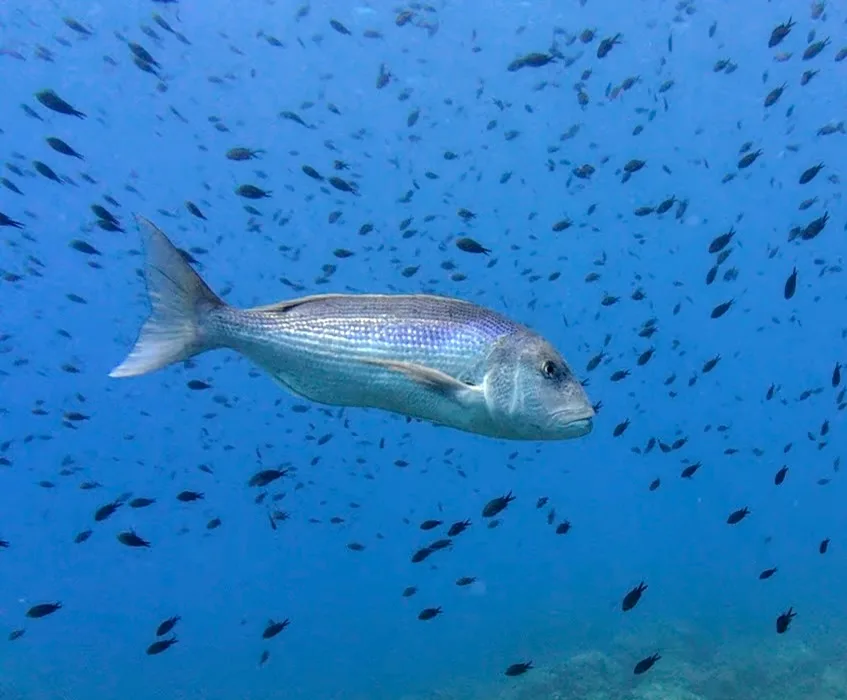
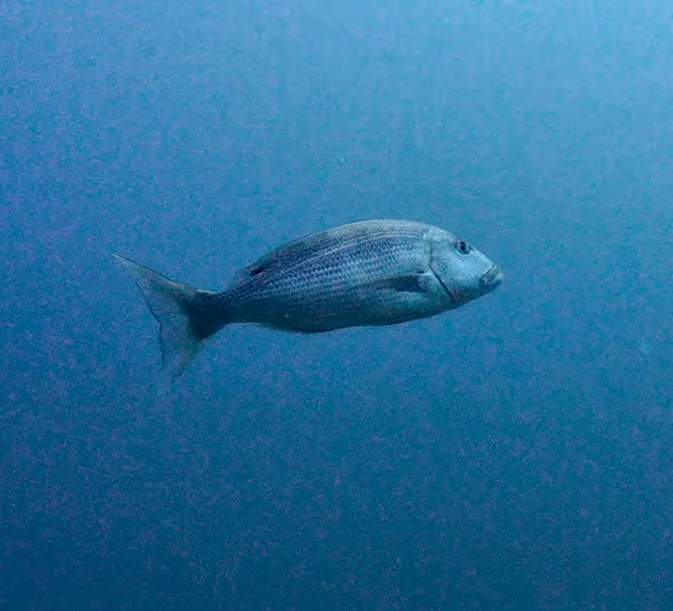
Rocky and coralligenous bottoms, wrecks and seagrass beds. Juveniles often inhabit shallow coastal waters, while adults also occur around headlands, offshore reefs and in open water.
Distribution
Mediterranean Sea and eastern Atlantic, from the British Isles to Mauritania, with rarer records from Senegal, the Canary Islands and Madeira.
Conservation status
Vulnerable
Edibility
Highly regarded edible fish with firm, flavorful flesh. Consume only from responsibly sourced catches and follow applicable seafood-health advice, especially for large predatory fish.
Culinary quality / 5
5
Danger level
Harmless
Usual observation depth
15–80 m
Lifespan (years)
20
Behaviour
Generally solitary or in small groups, especially as adults. It is an active daytime predator that patrols reefs and bottom habitats; juveniles may be more gregarious in shallow areas.
Observation zones
Rocky reefs, reef edges, pinnacles, seagrass beds and adjacent sandy or rubble bottoms; sometimes around shipwrecks offering suitable reef structure.
Diet
Carnivore, feeding mainly on fish, cephalopods, crustaceans and other bottom-dwelling invertebrates.
Reproduction
Oviparous
Identification marks
Robust, laterally compressed sparid, silvery to bluish-gray, with a large mouth and strong canine teeth clearly visible at the front of the jaws. Adults may display faint dark vertical bars; juveniles are often more distinctly barred or spotted.
Similar species
Can be confused with other Dentex species, notably with pinkish sparids related to common pandora and with white dentex. Dentex dentex is distinguished by its robust body, large mouth and prominent anterior canines. The humpback dentex (Dentex gibbosus) develops a pronounced frontal hump.
Approach rules
Approach slowly and quietly from the side, without blocking its escape route. Keep several meters away, do not chase or touch it, use flash sparingly and never at very close range, and do not feed wildlife.
Protection
Classified as « Least Concern » (LC) by the IUCN globally. It is not listed under CITES. Populations may be affected by fishing pressure; responsible fisheries management and size-based protection measures are important.