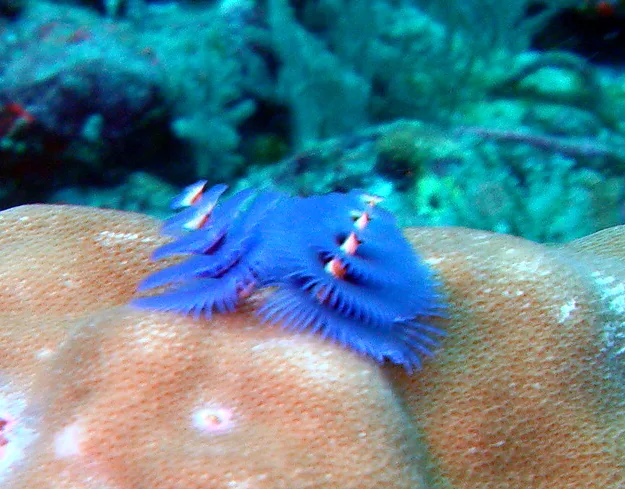
Sessile tube-dwelling worm embedded in massive hard corals, especially Porites species and fire corals of the genus Millepora, on shallow tropical coral reefs.
Distribution
Tropical coral reefs, particularly in the Caribbean Sea, Red Sea and Indo-Pacific. Some populations historically grouped under Spirobranchus giganteus may belong to closely related species.
Conservation status
Not Evaluated
Edibility
Not used as food; culinary quality is undocumented. Do not collect animals from living coral.
Danger level
Harmless
Usual observation depth
1–20 m
Behaviour
Sedentary and generally solitary, although many individuals may occupy the same coral colony. It extends its feeding crown during the day and rapidly retracts into its calcareous tube when disturbed.
Observation zones
Shallow coral reef; mainly on living massive corals.
Diet
Filter feeder. The two spiral crowns of radioles capture plankton and organic particles suspended in the water.
Reproduction
Oviparous
Identification marks
Two symmetrical, brightly colored spiral crowns, resembling small Christmas trees, emerge from a small opening in the coral. The colors vary greatly: red, orange, yellow, blue, white, or striped forms. The worm instantly disappears into its tube when approached.
Similar species
Often confused with other Christmas tree worms, notably Spirobranchus corniculatus and related species of Spirobranchus. The color and shape of the crown are not sufficient; reliable identification to species may require examination of the operculum and tube characters.
Approach rules
Approach slowly without touching the coral or creating turbulence with your fins. Keep a respectful distance so that the worm remains extended. Avoid deliberately causing repeated retractions, do not feed it, and use flash sparingly.
Protection
No species-specific international protection listing is known. Protect its living coral habitat and avoid any collection or degradation.