Found in shallow waters, typically on coral reefs.
Distribution
Caribbean Sea and western Atlantic Ocean.
Conservation status
Least Concern
Edibility
Not suitable for consumption. Sponges are not a conventional food and Aplysina species contain bioactive chemical compounds that may be toxic or irritating.
Danger level
Harmless
Usual observation depth
1–30 m
Behaviour
Sessile and non-social. This sponge continuously filters the water it pumps through its body; it may darken after an injury or exposure to air due to oxidation of its compounds.
Observation zones
Coral reef, rocky reef, hard bottoms and sometimes reef walls or hard substrates associated with mangroves.
Diet
Filter feeder. It captures bacteria, microscopic plankton and organic particles suspended in seawater.
Reproduction
Unknown
Identification marks
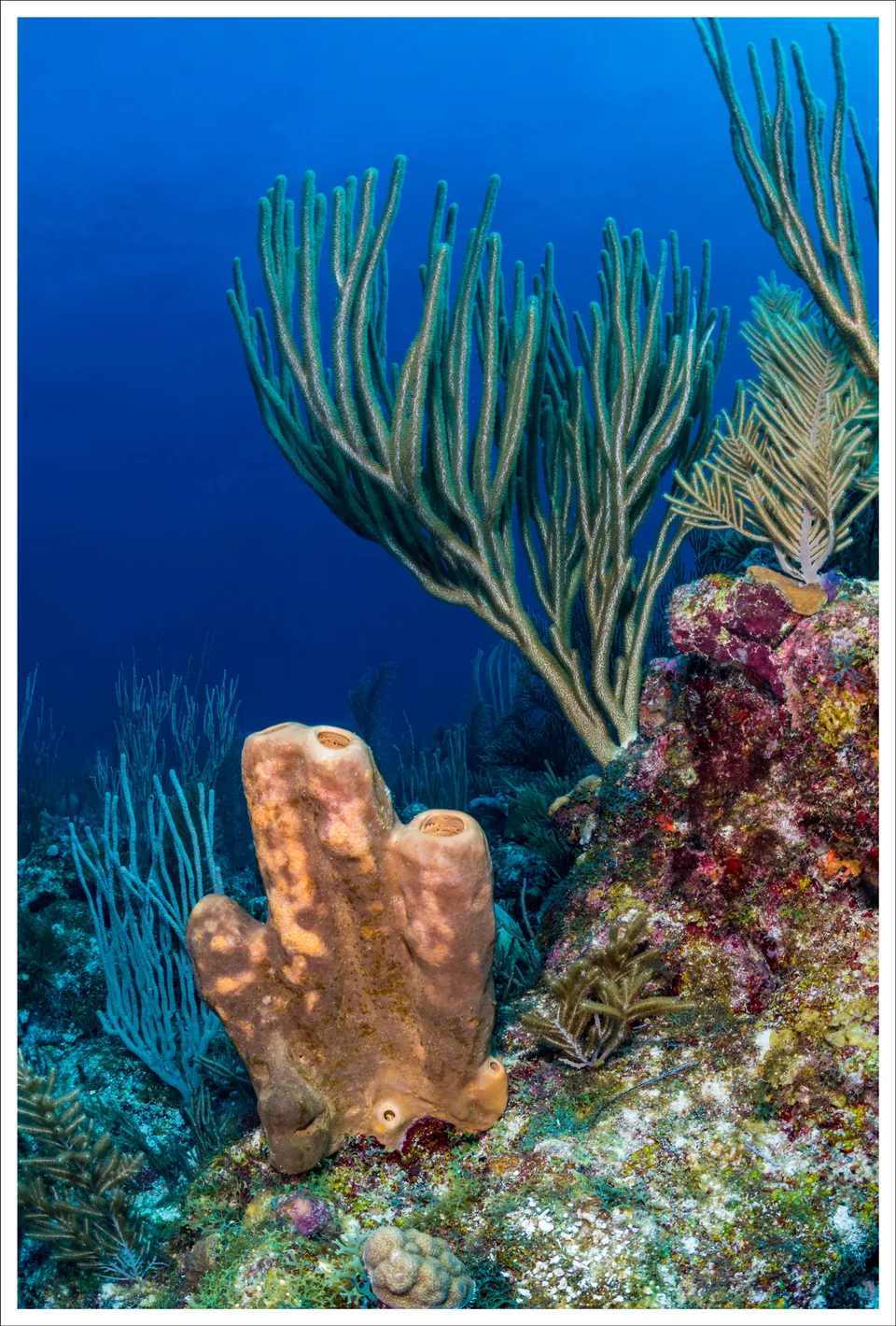
Generally a bright yellow to orange-yellow sponge forming a tuft of smooth, erect cylindrical tubes. The tubes bear large terminal openings (oscula), often with thin walls; damaged tissues may become dark brown to black.
Similar species
It can be confused with other Caribbean sponges of the genus Aplysina. Aplysina cauliformis is more cord-like and branched, whereas Aplysina lacunosa is generally darker, often brown to purplish brown, and more irregular in shape. Color alone is variable; the shape of the tubes and their branching are useful.
Approach rules
Observe without touching, grasping, or inserting anything into the tubes. Maintain good buoyancy to avoid damage caused by fins. Do not feed the wildlife. Avoid flash at very close range and never remove the sponge from the water.
Protection
Generally assessed as « Least Concern » on the IUCN Red List. It is not listed under CITES. Avoid collection and physical damage, as sponges provide habitat and perform important filtration functions on reefs.