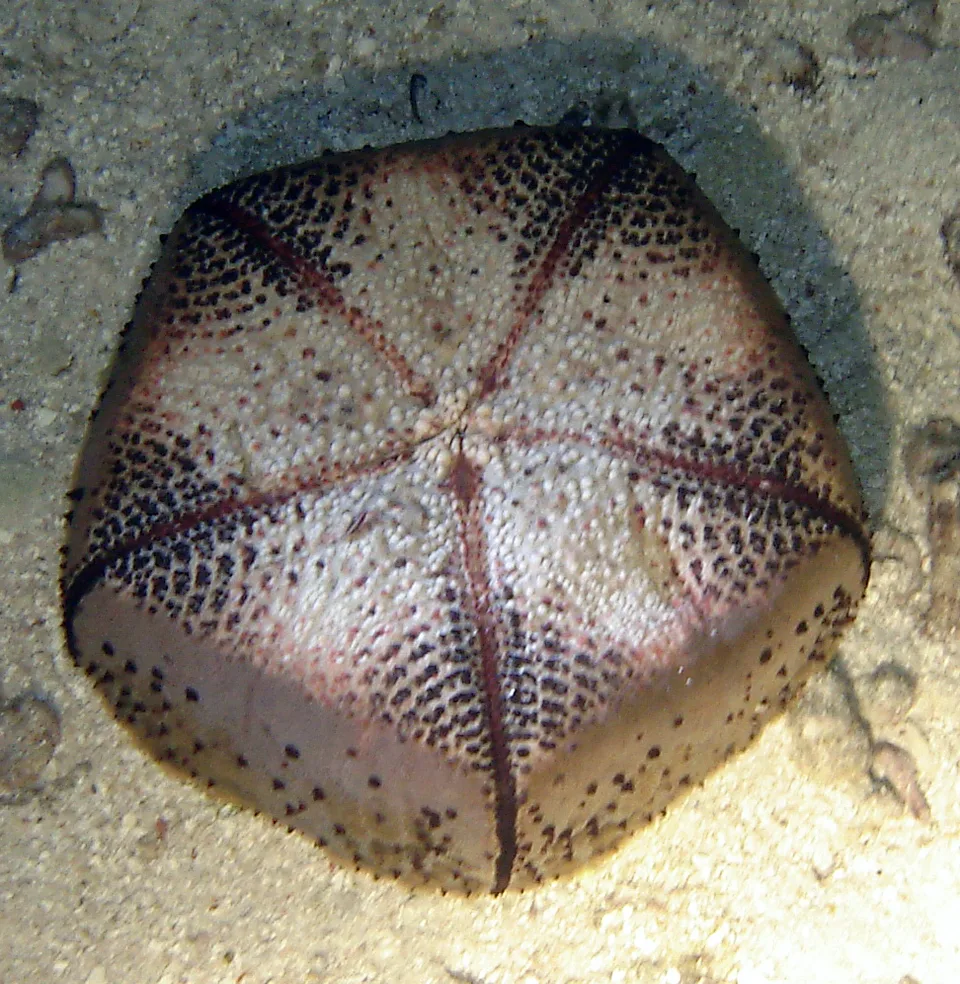
Found in sandy or muddy substrates in shallow coastal waters.
Distribution
Caribbean Sea and the Gulf of Mexico.
Conservation status
Least Concern
Edibility
Not generally used as food and its culinary quality is undocumented. Do not collect living animals; follow applicable local regulations and protected-area rules.
Danger level
Harmless
Usual observation depth
1–30 m
Behaviour
Usually solitary or scattered in loose aggregations on sand. It moves slowly and may burrow or cover itself with sediment. Primarily active in feeding continuously rather than showing a distinct nocturnal lifestyle.
Observation zones
Sand, lagoon, sheltered reef flat, and sandy areas beside reefs.
Diet
Deposit feeder and grazer, consuming microscopic algae, diatoms, organic detritus, and fine particles collected from sediment.
Reproduction
Oviparous
Identification marks
A flattened, thick, oval sea-biscuit test with five petal-like ambulacral areas on the upper surface. The test commonly shows a fine reticulated pattern and is covered in short, dense, movable spines when alive.
Similar species
Can be confused with other Clypeaster sea biscuits, especially Clypeaster virescens and regional congeners. Reliable identification may require examination of test proportions, petal arrangement, pore patterns, and geographic range; photographs of the upper and lower surfaces are useful.
Approach rules
Observe without touching, lifting, turning over, or removing it from the seabed. Maintain neutral buoyancy to avoid stirring sediment. Use no flash or only minimal flash for close photographs, and never feed marine invertebrates.
Protection
Globally assessed as Least Concern by the IUCN. It is not listed in CITES. Protect populations by avoiding collection and disturbance, particularly in marine protected areas.