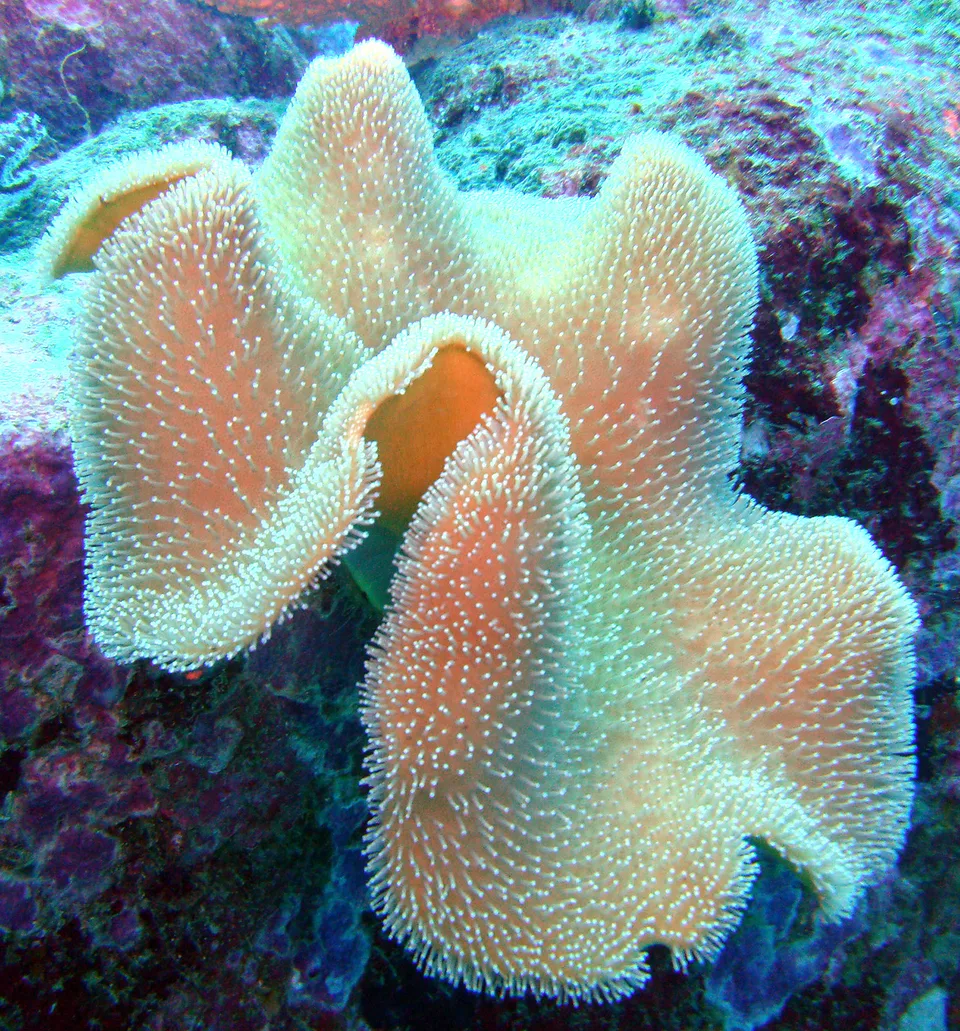
Typically found in shallow, warm waters of the tropical and subtropical oceans, often in coral reefs.
Distribution
Found in the Indo-Pacific region, including the Red Sea and the Great Barrier Reef.
Conservation status
Least Concern
Edibility
Not intended for consumption and without documented culinary use. Do not collect or eat reef corals.
Danger level
Harmless
Usual observation depth
3–20 m
Behaviour
A sessile colonial soft coral. Polyps may retract when disturbed and extend according to light, current, and feeding conditions.
Observation zones
Reef, especially reef flats, shallow reef slopes, and sheltered lagoons.
Diet
Obtains much of its energy from photosynthetic symbiotic algae in its tissues and supplements this by capturing plankton and organic particles.
Reproduction
Oviparous
Identification marks
Large fleshy disc- or cup-shaped colony attached by a thick base. The upper surface bears broad, short, rounded lobes and is often brown, beige, grey, greenish, or yellowish, with small polyps distributed across it.
Similar species
May be confused with Sarcophyton and Sinularia. Sarcophyton usually has a broad cap more clearly carried on a stalk, whereas Sinularia generally has finer, finger-like or bushy branches.
Approach rules
Observe without touching, maintain excellent buoyancy, and avoid contact with fins or equipment. Keep enough distance to avoid causing sedimentation; do not feed. Avoid close-range or repeated flash photography.
Protection
Assessed as Least Concern (LC) by the IUCN. Not listed in the CITES Appendices. Reef corals remain vulnerable to bleaching, habitat degradation, and collection; observe without collecting.