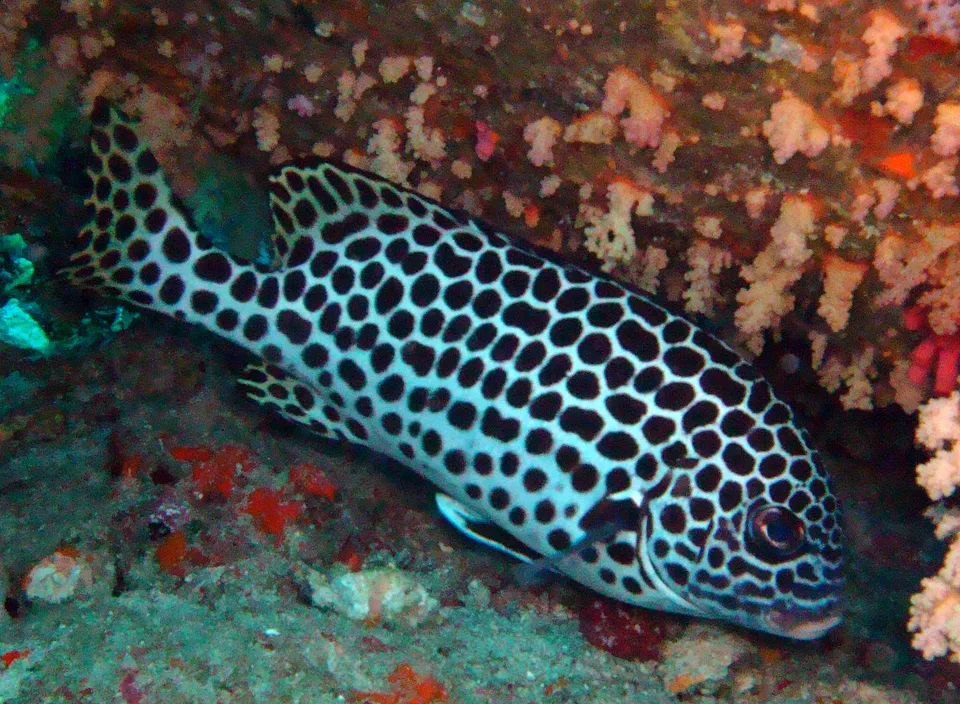
Edible and valued as food, but large reef groupers can carry ciguatera toxins in some tropical areas; avoid eating large individuals where ciguatera is known.
Culinary quality / 5
4
Danger level
Harmless
Usual observation depth
3–30 m
Lifespan (years)
40
Behaviour
Generally solitary and territorial, it rests near reef shelter during the day and hunts mainly at dusk and at night. Adults may gather in breeding aggregations.
Observation zones
Coral reef, reef slope, lagoon, pass, coral patch and rocky crevice; sometimes near reef drop-offs.
Diet
Carnivorous ambush predator, feeding mainly on fish, crustaceans and cephalopods.
Reproduction
Oviparous
Identification marks
Robust grouper with a deep body and a large mouth. The light brownish-grey body bears numerous dark brown polygonal spots and a marbled pattern, often forming an irregular network; several dark, diffuse vertical bars may be visible.
Similar species
May be confused with the marbled brown grouper (Epinephelus fuscoguttatus), which generally has larger, more distinct dark spots. Epinephelus polyphekadion usually shows finer polygonal marbling and a more reticulated pattern.
Approach rules
Approach slowly and calmly, without blocking its escape route or the entrance to its shelter. Keep a respectful distance of at least 2 to 3 m, avoid repeated flashes, and never feed or handle it.
Protection
Classified as Near Threatened by the IUCN. It is not listed in the CITES Appendices. Breeding aggregations are particularly vulnerable to fishing pressure; avoid disturbing them and support the protection of these sites.