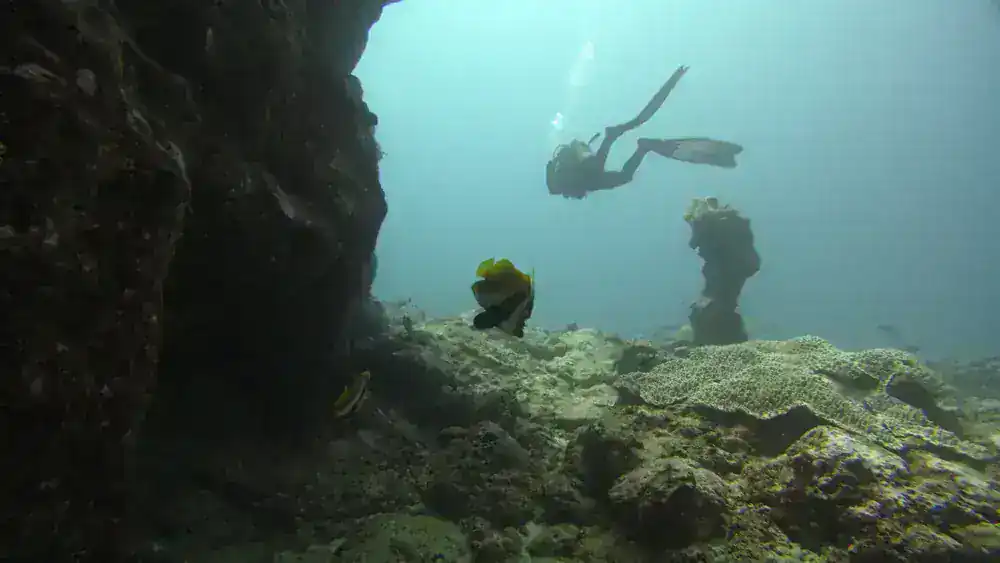
Edible, but small and not generally a valued food fish. As with other reef fishes, ciguatera risk may occur in some locations; avoid consumption where local health advisories warn of this risk.
Culinary quality / 5
2
Danger level
Harmless
Usual observation depth
1–30 m
Lifespan (years)
5
Behaviour
Diurnal. Observed alone, in pairs or in small loose groups; it actively traverses the reef while feeding. Adults are often in pairs, whereas juveniles may be more solitary.
Observation zones
Coral reef, reef flat, lagoon, reef slope, rubble zones and sandy bottoms near reefs.
Diet
Mainly benthic invertebrates, including coral polyps, polychaete worms and small crustaceans; it also consumes algae and other small sessile organisms.
Reproduction
Oviparous
Identification marks
Oval, laterally compressed body, white to yellowish, with dark chevron-shaped lines; a black band crosses the eye. A distinct black spot is located toward the rear of the dorsal fin, and many adults bear a long filament arising from the rear of this fin.
Similar species
Often confused with the vagabond butterflyfish (Chaetodon vagabundus), which also displays a chevron pattern. C. auriga usually has a distinct black dorsal spot and, in many adults, a dorsal filament; C. vagabundus lacks this characteristic long filament and shows a more pronounced dark band on the caudal peduncle.
Approach rules
Approach slowly and calmly without blocking its movement on the reef. Keep a respectful distance of approximately 2 m, do not touch or pursue the animal, avoid repeated flashes at very close range, and never feed it.
Protection
Classed as « Least Concern » on the IUCN Red List. It is not listed under CITES. Protect reef habitat and avoid collection or disturbance in marine protected areas and other regulated sites.