Coastal and oceanic waters, often near coral reefs.
Distribution
Tropical and subtropical oceans worldwide.
Conservation status
Vulnerable
Edibility
Edible in principle, but consumption is not recommended: this vulnerable, slow-reproducing ray is protected by international trade controls and should not be targeted or purchased.
Danger level
Harmless
Usual observation depth
5–40 m
Lifespan (years)
40
Behaviour
Generally solitary or observed in small groups, it may form larger aggregations at feeding sites and cleaning stations. Primarily active during the day, it is highly mobile and may undertake seasonal movements.
Observation zones
Reef slopes, outer reefs, channels and passes, lagoons, cleaning stations, seamounts and blue water adjacent to reefs.
Diet
Filter-feeder feeding on zooplankton, notably small crustaceans, copepods, krill-like organisms, fish eggs and larvae.
Reproduction
Ovoviviparous
Identification marks
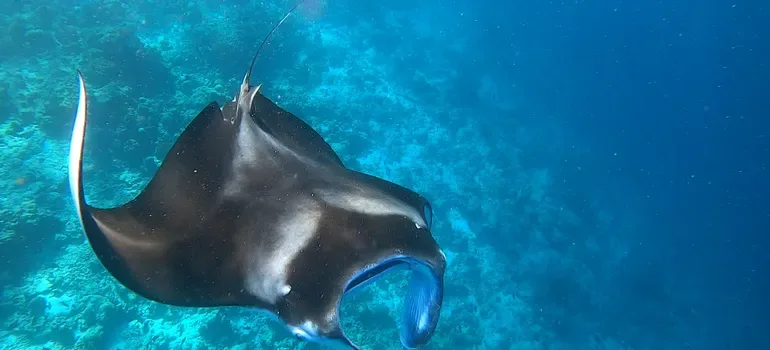
Large diamond-shaped body, broad triangular pectoral fins, cephalic lobes directed forward, terminal mouth and absence of a functional caudal spine. The light ventral surface generally bears an individual pattern of dark spots; the back is often dark gray to black with a light area at the shoulders.
Similar species
Often confused with the oceanic manta ray (Mobula birostris). The reef manta ray is generally smaller, has a terminal mouth rather than one projected forward, and usually shows a less pronounced dark band between the gill slits on the underside. It may also be confused with other devil rays of the genus Mobula, which are generally smaller and have different mouth and fin proportions.
Approach rules
Observe calmly, keep a respectful distance of at least 3 m, stay out of its path, and never chase, touch, block, ride, or encircle it. Avoid flash photography and never feed or bait mantas. Let the animal decide whether to approach.
Protection
Globally assessed as Vulnerable on the IUCN Red List. All species of the genus Mobula are listed in CITES Appendix II, which regulates international trade. Comply with the protection measures applicable to the site and country.