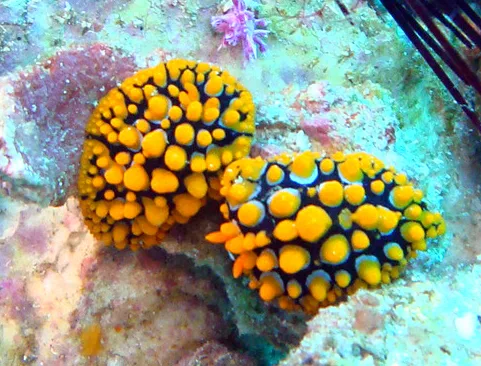
Typically found in shallow waters, often on coral reefs.
Distribution
Found in the Indo-Pacific region.
Conservation status
Least Concern
Edibility
Not edible. This nudibranch is unsuitable for consumption and may contain defensive toxins acquired from its sponge prey.
Danger level
Caution
Usual observation depth
1–20 m
Behaviour
Generally solitary and slow-moving. It moves over reef surfaces in search of sponges; it relies on its warning coloration and chemical defenses rather than fleeing.
Observation zones
Coral reef, reef flat, lagoon, coral rubble zone and reef slope; on hard substrate rather than in open water.
Diet
Sponge specialist, consuming certain demosponges. Its defensive substances may originate from its sponge diet or be associated with them.
Reproduction
Oviparous
Identification marks
Oval, broad and flattened body, cream to light-colored background, with clearly visible yellow to orange tubercles or spots surrounded by black rings, as well as black markings on the back. The rhinophores are retractile and there is no apparent branchial plume.
Similar species
It may be confused with other Phyllidia species. Phyllidia varicosa generally has more continuous longitudinal black ridges and yellow tubercles, whereas P. ocellata shows distinct yellow-orange spots encircled in black. Phyllidia coelestis is usually whiter or bluish, with a different black line pattern.
Approach rules
Observe without touching or collecting. Maintain good buoyancy and avoid any contact with the animal or surrounding reef. Do not feed it. Avoid flash at very close range and never handle it for a photograph.
Protection
No specific international trade listing is known. The species is not listed under CITES; avoid collection and disturbance, as nudibranchs are vulnerable to habitat and reef degradation.