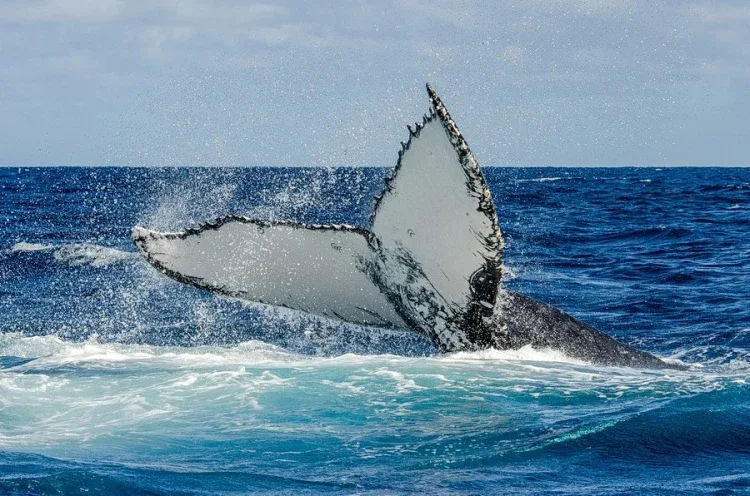
Found in oceans worldwide, primarily in tropical and temperate waters
Conservation status
Least Concern
Edibility
Not suitable for consumption: this is a protected wild cetacean in many jurisdictions and commercial whaling is internationally restricted. Do not consume or trade its meat.
Danger level
Caution
Usual observation depth
?–200 m
Lifespan (years)
80
Behaviour
Generally solitary or in temporary small groups, but may form large feeding aggregations. Highly migratory; known for breaching, tail slaps and pectoral fin slaps, and complex songs produced mainly by males in breeding grounds. Active day and night.
Observation zones
Open water, coastal bays, channels, nearshore waters, migratory routes and offshore feeding areas; often observed at the surface or just below.
Diet
Feeds primarily on krill and small schooling fish, including herring, capelin, sardines, anchovies and similar prey. Uses its baleen to filter food, often through lunge feeding or cooperative bubble-net feeding.
Reproduction
Viviparous
Identification marks
Very long white to dark pectoral fins, often representing about one third of the body length; head covered in tubercles bearing hair follicles; dark body; small dorsal fin on a hump; and broad caudal fin with individual black and white patterns.
Similar species
May be confused with Bryde’s whales, fin whales, or other large rorquals. The exceptionally long pectoral fins, tuberculated head, and frequent exposure of the caudal fin distinguish the humpback whale. Bryde’s whales have shorter, smoother fins and generally three ridges on the head; fin whales are more slender and have much shorter fins.
Approach rules
Observe passively and follow all local whale-watching regulations. Keep a considerable distance, avoid separating mothers and calves, do not pursue or touch the animal, swim toward it, feed it, or block its path. Do not use flash; reduce the vessel’s speed and engine noise. A minimum distance of 100 m is commonly recommended, with a greater distance for mothers and their calves.
Protection
Evaluated as “Least Concern” globally by the IUCN, but the humpback whale remains protected by international conservation measures. The species is listed in Appendix I of CITES; commercial international trade is generally prohibited, except under limited CITES provisions.