Edible and highly regarded as food, but large reef-associated individuals may carry ciguatera toxins. Avoid eating suspect fish and follow local public-health advice.
Culinary quality / 5
4
Danger level
Caution
Usual observation depth
1–40 m
Lifespan (years)
24
Behaviour
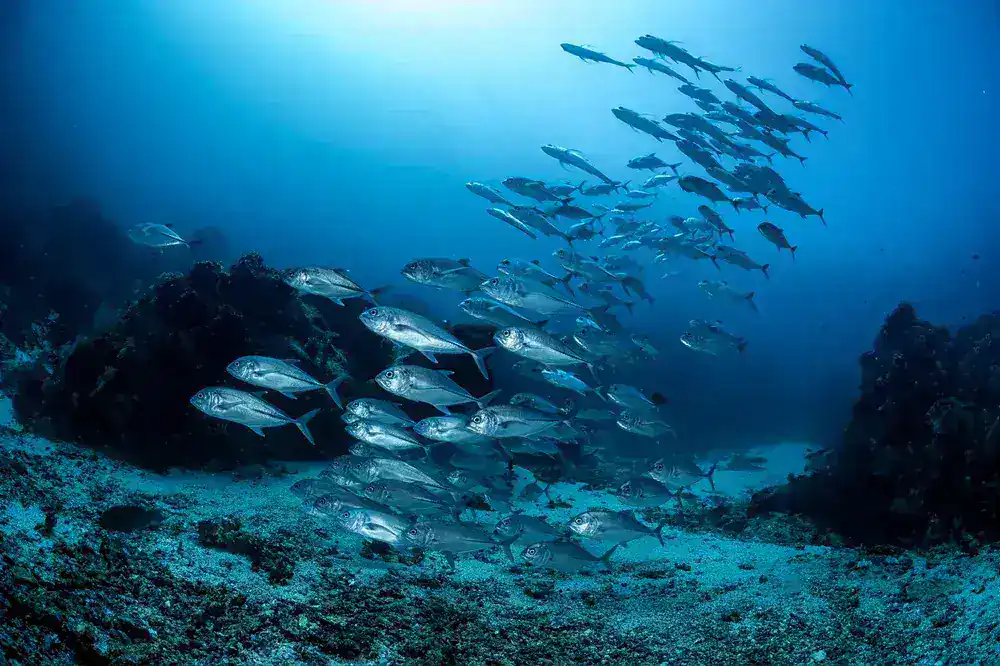
Powerful and active predatory fish. Adults are often solitary or in small groups, while juveniles frequently form schools. It hunts around reefs during the day and is also highly active at dawn, dusk, and at night.
Observation zones
Reef, reef pass, outer slope, channel, lagoon, blue water near seamounts, rocky coast, mangrove and estuarine areas for juveniles.
Diet
Feeds mainly on fish, crustaceans and cephalopods. Large individuals are opportunistic predators capable of capturing a wide variety of reef and pelagic prey.
Reproduction
Oviparous
Identification marks
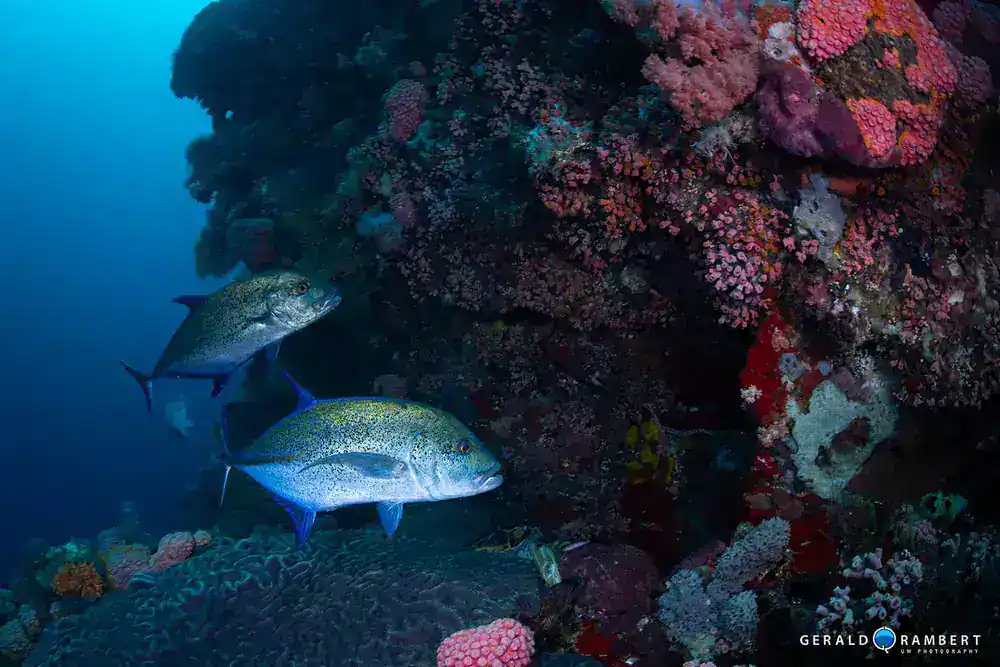
Very large carangid with a deep, laterally compressed body, and a steep, blunt forehead. Adults are dark grey to almost black above, often paler below, with a distinct black spot on the upper edge of the operculum. The straight part of the lateral line bears strong bony scutes; juveniles are silvery with dark vertical bars.
Similar species
Often confused with other large Caranx species. The bluefin trevally (Caranx melampygus) generally has bright blue fins and spots, rather than the dark coloration of adults and the abrupt head of the giant trevally. The bigeye trevally (Caranx sexfasciatus) has proportionally much larger eyes and often displays more pronounced body bars.
Approach rules
Observe calmly without blocking its path. Keep a respectful distance of at least 3 m, more during feeding activity. Do not touch it, pursue it, corner it or feed it. Avoid flash at close range, especially during night dives.
Protection
Globally assessed as Least Concern by the IUCN. It is not listed under CITES. Applicable fishing and harvesting measures are determined locally.