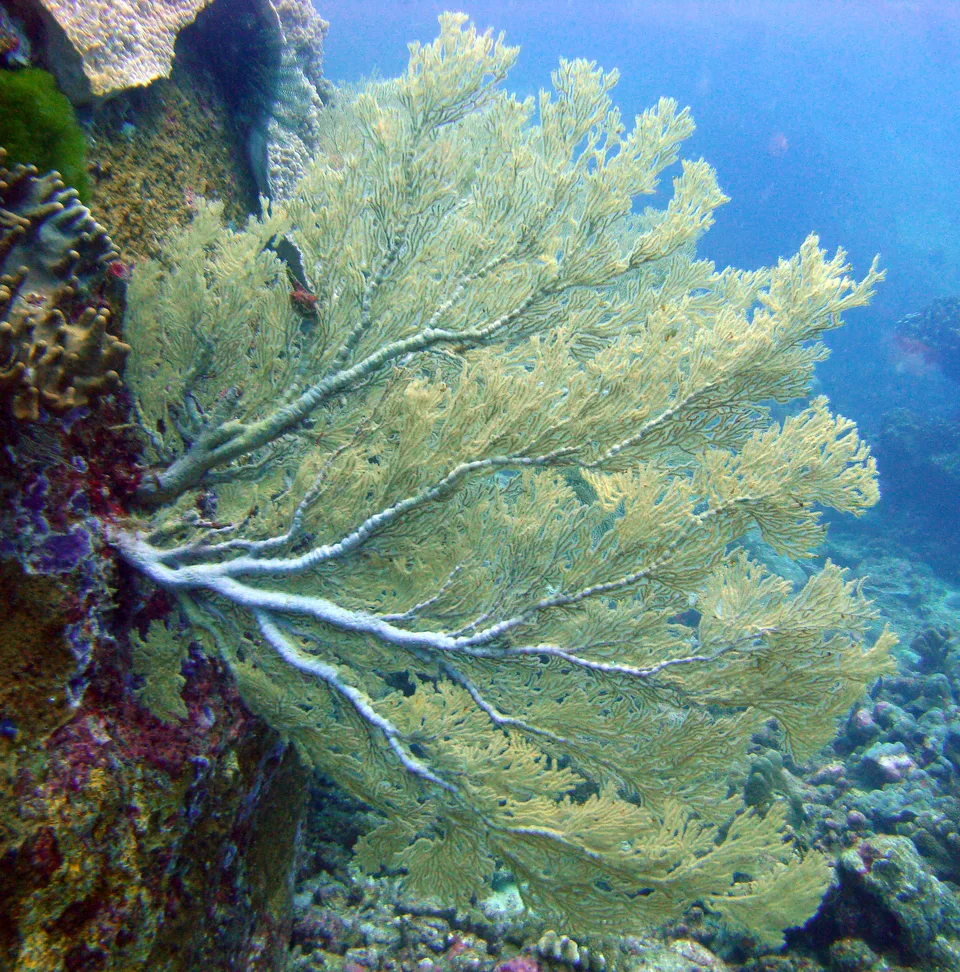
Found in tropical and subtropical oceans worldwide.
Conservation status
Least Concern
Edibility
Not edible and not used as food. Do not collect or consume it.
Danger level
Harmless
Usual observation depth
3–30 m
Behaviour
Colonial sessile octocoral. Its fan is often oriented toward the current to capture suspended food particles. The polyps extend to feed, especially when water movement is favorable.
Observation zones
Reef ; shallow reef slopes with hard substrate ; reef crests ; sometimes around pilings or other hard artificial structures.
Diet
Suspended plankton and fine organic particles captured in the water column by the polyps.
Reproduction
Oviparous
Identification marks
Large erect fan-shaped colony, with a branched, net-like skeleton. Generally beige, brown, yellowish or purplish, often with small visible polyps; the broad fan frequently faces the prevailing current.
Similar species
May be confused with other Caribbean fan gorgonians and sea whips, notably Gorgonia flabellum. Colony shape and color overlap; reliable identification may require examination of the branch network and microscopic skeletal characters.
Approach rules
Observe without touching, holding, or striking the colony with your fins. Maintain good buoyancy and keep your fins away from the branches. Avoid any contact with the equipment; do not feed wildlife and do not use flash at very close range.
Protection
Assessed as “Least Concern” by the IUCN. Not listed in the CITES Appendices. Avoid collection and physical damage, and comply with the applicable rules of protected areas and sites.