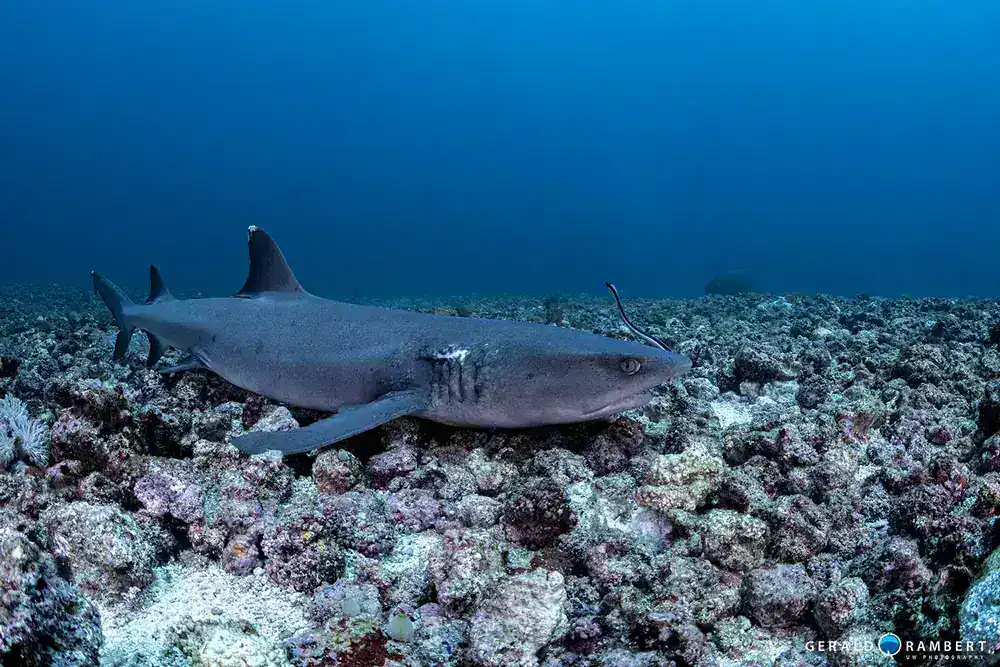
Shallow tropical coastal waters, especially coral reefs, reef flats, lagoons, mangroves, sandy areas and reef drop-offs. Juveniles frequently use very shallow protected waters as nursery areas.
Distribution
Tropical Indo-Pacific, from the Red Sea and East Africa to the Hawaiian Islands and the Tuamotu Archipelago, north to Japan and south to Australia. It has also entered the eastern Mediterranean through the Suez Canal.
Conservation status
Vulnerable
Edibility
Edible, but it is a Vulnerable shark species and international trade is regulated under CITES Appendix II. Consumption is not recommended from a conservation perspective; shark meat may also contain elevated mercury.
Culinary quality / 5
3
Danger level
Caution
Usual observation depth
?–30 m
Lifespan (years)
13
Behaviour
Generally solitary or observed in small groups. Active day and night, it patrols reef edges and shallow lagoons. Usually wary of divers, it may become persistent in the presence of food and bite if harassed or cornered.
Observation zones
Reef, reef flat, lagoon, pass, sandy shoals, edges of seagrass beds and mangrove areas; sometimes near drop-offs.
Diet
Feeds mainly on bony fish, particularly reef fish, but also consumes cephalopods, crustaceans, and other small marine animals.
Reproduction
Viviparous
Identification marks
Slender reef shark, brownish gray, with a short, broad, rounded snout. The first dorsal fin has a very conspicuous black tip, generally separated from the lighter base by a pale band; the lower lobe of the caudal fin is also marked with black. The first dorsal fin begins above or just behind the posterior edge of the pectoral fins.
Similar species
Often confused with the blacktip shark (Carcharhinus limbatus), which is generally more coastal and pelagic, has black tips on several fins, but lacks the characteristic pale band beneath the black tip of the first dorsal fin. It may also resemble the grey reef shark (Carcharhinus amblyrhynchos), which is more robust and has a dark posterior margin on the caudal fin rather than a first dorsal fin with a distinctly black tip.
Approach rules
Observe calmly from a respectful distance, ideally at least 3 m away. Do not block its access to open water, pursue it, touch it or corner it. Avoid flash photography at close range and never feed or bait sharks; leave the water in case of feeding activity or agitated behavior.
Protection
IUCN Red List: Vulnerable (VU). International trade in this species is regulated by CITES Appendix II. Favor non-extractive observation and responsible shark conservation practices.