
What to know before choosing
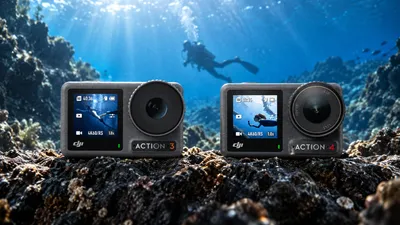
Action 3 and Action 4 share the same compact shape, 145 g weight, 155° field of view, 4K at 120 fps, dual touchscreens and DJI magnetic mount. For divers, the decisive differences are mainly sensor size and colour workflow.
Action 3 remains very capable in clear, shallow water. Action 4 pulls ahead as light falls, when recovering shadows or grading colour in post.
Key differences
| Feature | Action 3 | Action 4 |
|---|---|---|
| Sensor | 1/1.7 inch | 1/1.3 inch |
| Without housing | 16 m | 18 m |
| DJI housing | 60 m | 60 m |
| Colour | 10-bit after update, D-Cinelike | 10-bit D-Log M + official LUT |
| microSD | up to 256 GB | up to 512 GB |
Both use a 1,770 mAh battery and have no internal storage. Batteries and the 60 m housing are cross-compatible.

Underwater image quality
Action 4’s 1/1.3 inch sensor gathers more light. Shadows look cleaner, dynamic range is wider and deeper, overcast or twilight scenes retain more detail. TechRadar also found better low-light performance and grading latitude.
In bright tropical shallows the gap narrows. Red light loss with depth is physical: neither camera replaces a video light, suitable filter or careful colour correction.
Without housing: snorkeling and freediving
Action 3 is rated to 16 m and Action 4 to 18 m without a housing. That suits snorkeling, surface entries and moderate freediving when battery and USB-C doors are perfectly clean and closed.
DJI still recommends a housing for long shoots, high pressure or impacts. The extra two metres alone should not decide the upgrade.

With housing: down to 60 metres
Inside DJI’s housing, both cameras are officially rated to 60 m. The same housing and batteries work across both generations, useful for an existing Action 3 kit.
Set resolution, stabilisation and white balance before descent. The large housing buttons remain glove-friendly; a two-handle tray improves stability and carries video lights.
Stabilisation and framing while diving
Both offer RockSteady and HorizonSteady. In practice the gap is small: buoyancy, slow finning and a two-handed grip matter more than camera generation.
HorizonSteady can limit some resolution/frame-rate combinations. For natural underwater footage, favour 4K, RockSteady, slow movement and short clips.
Real battery life between dives
DJI claims up to 160 minutes for both, under different lab protocols that do not represent 4K underwater shooting. Screens, Wi-Fi, 4K/60, stabilisation and temperature reduce runtime.
Tom’s Guide exceeded 80 minutes of mixed use on Action 4 and observed indoor heat. Water changes thermal conditions. Carry a charged spare between dives.
Why Action 3 still makes sense
Action 3 already delivers 4K/120, excellent stabilisation, 16 m without housing and 60 m with one. A firmware update added 10-bit D-Cinelike colour, though without Action 4’s official D-Log M LUT.
It suits snorkeling, bright dives, a backup camera or a tight budget. DJI now lists it as unavailable, so used stock is the logical route. One MPB France unit was €184 when checked; price varies.
Why pay more for Action 4
Action 4 earns its premium with a 1/1.3 inch sensor, cleaner shadows, 10-bit D-Log M plus DJI LUT, 18 m without housing and cards up to 512 GB. These gains matter for wrecks, depth, overcast days and advanced editing.
On 13 September 2026, DJI France listed €239 Standard, €308 Diving and €339 Adventure combos. The Diving Combo makes sense if you own no housing or floating grip.
Verdict: which should you choose?
Choose Action 3 for clear water, snorkeling, a backup camera or a good used deal that is meaningfully cheaper. Choose Action 4 for deep or dark dives, wrecks, D-Log M and more grading headroom.
Our overall diving pick is Action 4, while Action 3 offers better value when substantially cheaper.
Main sources: DJI Action 3, DJI Action 4, DJI FAQ, TechRadar and Tom’s Guide.

Our rating — DJI Osmo Action 3
3.9 / 5Excellent value for clear water, snorkeling and budget-conscious divers. The score combines official specifications and cited independent tests, focused on underwater use.
Our rating — DJI Osmo Action 4
4.4 / 5Our overall diving pick thanks to the larger sensor, D-Log M and stronger low-light headroom. The score combines official specifications and cited independent tests.
00 Comments
No comments yet.