Coastal marine and brackish waters, including bays, lagoons, estuaries, coral and rocky reefs, and sandy bottoms. It swims near the surface as well as close to the seabed.
Distribution
Atlantic Ocean, mainly the western Atlantic, including the Gulf of Mexico, the Caribbean Sea and the Brazilian coast. Its presence in the eastern Atlantic remains probable but less certain.
Conservation status
Endangered
Edibility
The flesh is edible and may be sold locally, but this Endangered ray should not be targeted or consumed where alternatives are available. Handle only if legally and responsibly sourced; the tail spines are hazardous.
Culinary quality / 5
2
Danger level
Caution
Usual observation depth
5–30 m
Lifespan (years)
25
Behaviour
Generally solitary or observed in small groups; aggregations may form in feeding areas and during reproduction. It is mainly active during the day, swims above the bottom, and may leap out of the water.
Observation zones
Reef edges, lagoons, sandy reef flats, seagrass beds, channels, bays and coastal passages in open water.
Diet
Mainly bottom-dwelling invertebrates, notably bivalve mollusks, gastropods, crustaceans and worms; it also consumes small fish. Its flattened dental plates crush hard-shelled prey.
Reproduction
Ovoviviparous
Identification marks
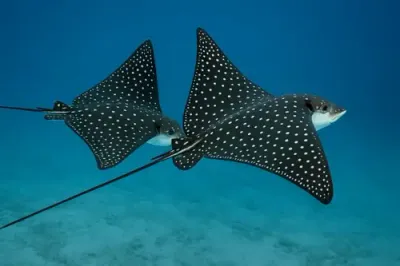
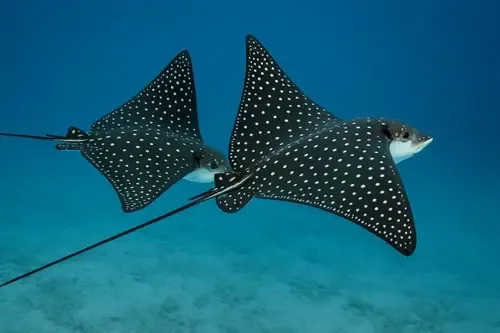
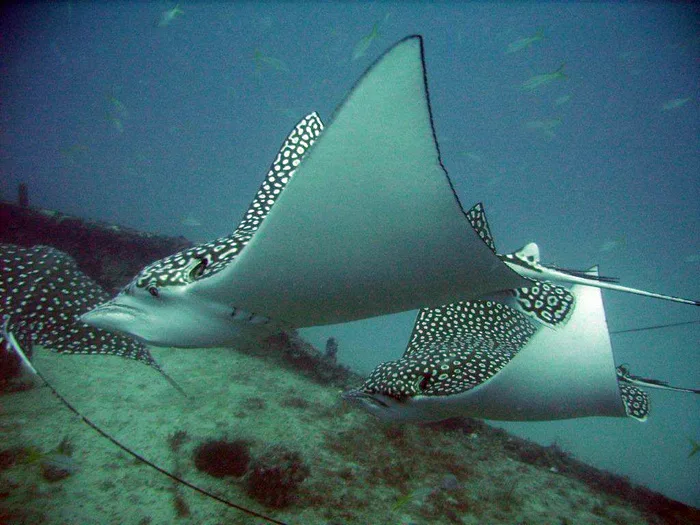
Large diamond-shaped ray, with a very long whip-like tail bearing venomous spines. The dark upper surface is covered with numerous distinct white spots; the underside is pale. The head is broad and protruding, resembling a duck's bill.
Similar species
It is most often confused with the ocellated eagle ray, Aetobatus ocellatus, found in the Indo-Pacific. Geographical location is the most reliable criterion: A. narinari is a western Atlantic species. It may also resemble other eagle rays, but its numerous white dorsal spots and long whip-like tail are characteristic.
Approach rules
Observe calmly and let the ray choose its distance. Do not block its path, chase it, touch it, restrain it, or position yourself above it. Stay well clear of the tail and its spines; do not feed it. Avoid flash, especially at close range.
Protection
Globally assessed as Endangered (IUCN). Declines are mainly linked to fishing pressure, bycatch, and degradation of coastal habitats. Avoid disturbing it and do not target this species.