Indo-Pacific region, including the Red Sea and parts of the Indian and Pacific Oceans
Conservation status
Least Concern
Edibility
Edible, but not generally recommended: surgeonfishes can carry ciguatera toxins in some areas. Avoid eating large individuals and follow local health advisories.
Culinary quality / 5
3
Danger level
Caution
Usual observation depth
1–20 m
Lifespan (years)
30
Behaviour
Observed alone, in pairs or in small, loose groups. Active during the day and primarily grazes on reef surfaces; it may defend a feeding territory. Juveniles often frequent more sheltered areas.
Primarily grazes on filamentous algae and algal turf; it may also ingest associated small invertebrates and detritus while feeding.
Reproduction
Oviparous
Identification marks
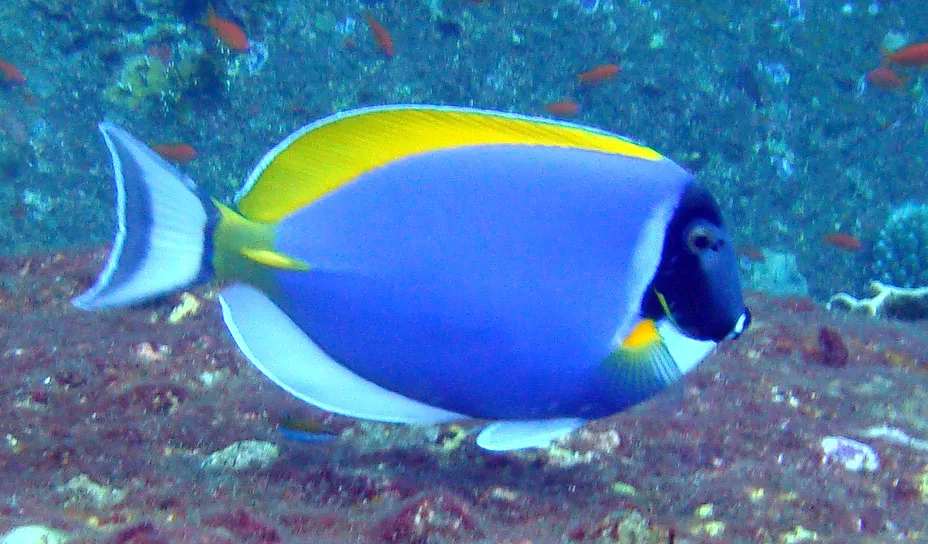
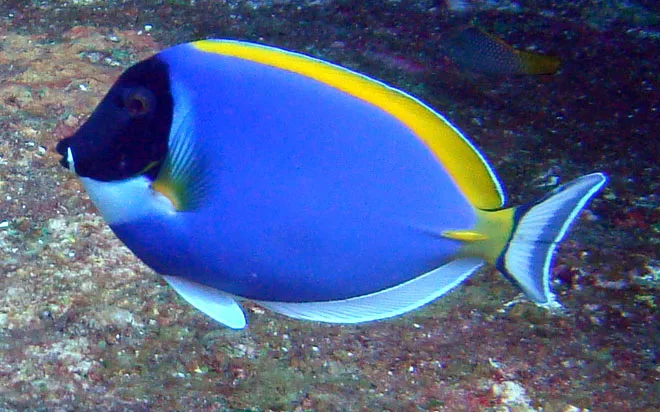
Intensely blue body, black face and throat, highly contrasting white chest, bright yellow dorsal fin, and white base of the tail. The caudal peduncle bears a sharp defensive spine.
Similar species
Often confused with the white-faced surgeonfish, Acanthurus japonicus. A. japonicus has a much whiter face, whereas A. leucosternon has a predominantly black face and a very conspicuous white chest.
Approach rules
Approach slowly and calmly without cutting across its feeding path. Keep a respectful distance of at least 2 to 3 m, do not touch or pursue it, avoid flash photography at close range, and never feed it. Beware of the sharp spine near the tail.
Protection
Classified as Least Concern globally on the IUCN Red List. It is not listed under CITES. Protect reef habitat and avoid collection or disturbance; local protections and regulations may vary.