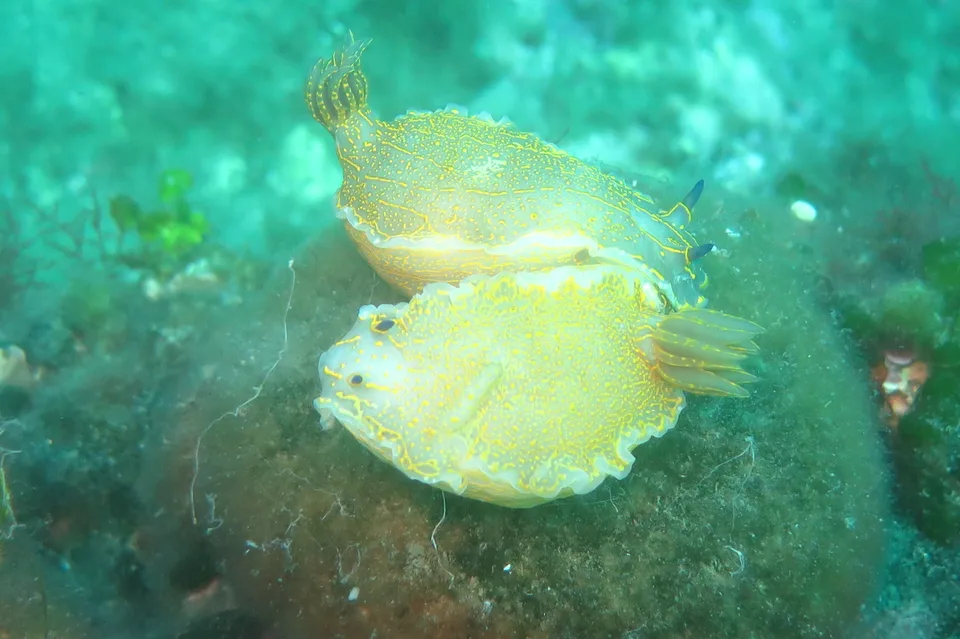
Shallow coastal waters on rocky and algal bottoms, seagrass beds, and occasionally sandy or muddy substrates.
Distribution
Northeastern Atlantic, from the British Isles southward to West Africa, including Macaronesian islands; also widespread in the Mediterranean Sea.
Conservation status
Not Evaluated
Edibility
Potentially edible, but not generally recommended: sea hares may retain compounds or toxins derived from their algal diet. Do not eat without reliable species identification and expert local food-safety guidance.
Culinary quality / 5
2
Danger level
Harmless
Usual observation depth
1–15 m
Lifespan (years)
0
Behaviour
Usually solitary and slow-moving, grazing mainly during low-light periods or at night. Individuals may gather seasonally for mating. When disturbed, it can release purple ink and a milky defensive secretion.
Observation zones
Rocky reef, algae-covered boulders, seagrass meadow, and adjacent sand or rubble.
Diet
Herbivorous; grazes primarily on brown, red, and green algae.
Reproduction
Oviparous
Identification marks
A large, soft-bodied sea hare with variable brown, olive, greenish, or reddish mottling; prominent ear-like rhinophores; broad lateral parapodia; and a small internal shell concealed by the mantle. It lacks the conspicuous broad red margin typical of Aplysia fasciata.
Similar species
May be confused with Aplysia fasciata, which typically has a broad dark red to orange-red parapodial margin, or with Aplysia punctata, which is generally more distinctly spotted. Colour is variable in all sea hares, so identification should use several features.
Approach rules
Approach slowly and observe without touching, chasing, or lifting the animal. Keep a respectful distance, avoid flash photography at close range, and never feed it. Do not provoke defensive inking.
Protection
No CITES listing is known. Follow general marine-wildlife best practice: do not collect or disturb animals, and comply with any site-specific protected-area rules.