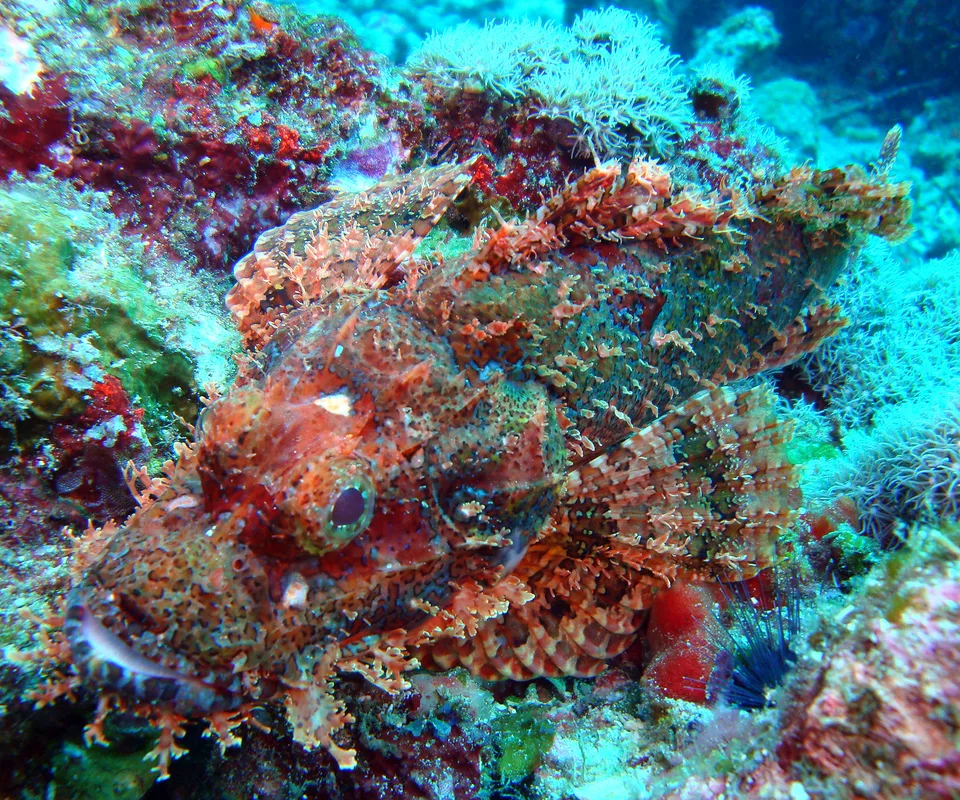
Typically found in rocky or coral reef environments.
Distribution
Found in tropical and subtropical waters worldwide.
Conservation status
Least Concern
Edibility
Not recommended for consumption or handling: the dorsal, anal and pelvic spines are venomous and can cause severe painful injuries. Culinary use is poorly documented.
Danger level
Caution
Usual observation depth
10–30 m
Behaviour
Usually solitary, sedentary and strongly cryptic. It spends much of the day motionless, swaying slightly like algae or soft coral, and ambushes passing prey.
Observation zones
Coral reef, rocky reef, reef rubble, sponge gardens, soft-coral areas and algae-covered substrates.
Diet
A carnivorous ambush predator feeding mainly on small fishes and crustaceans.
Reproduction
Oviparous
Identification marks
A small, deep-bodied scorpionfish with an extremely variable colour pattern, from yellow or pink to red, brown, purple or nearly black. It has prominent fleshy skin flaps and fringing on the head and body, a large mouth, and venomous fin spines. Its irregular outline closely resembles algae, sponge or soft coral.
Similar species
Often confused with other Rhinopias species, especially the paddle-flap scorpionfish (Rhinopias eschmeyeri) and lacy scorpionfish (Rhinopias aphanes). Identification requires close examination of the pattern and shape of skin appendages, fin rays and head spines; colour alone is unreliable.
Approach rules
Observe without touching or attempting to move it. Keep a respectful distance, maintain good buoyancy and avoid placing hands on the reef nearby. Do not feed it. Avoid flash photography at close range, and take particular care not to contact its venomous spines.
Protection
Not listed in CITES and not known to be subject to species-specific international trade controls. It may be protected within marine protected areas or under local regulations; consult applicable local rules.