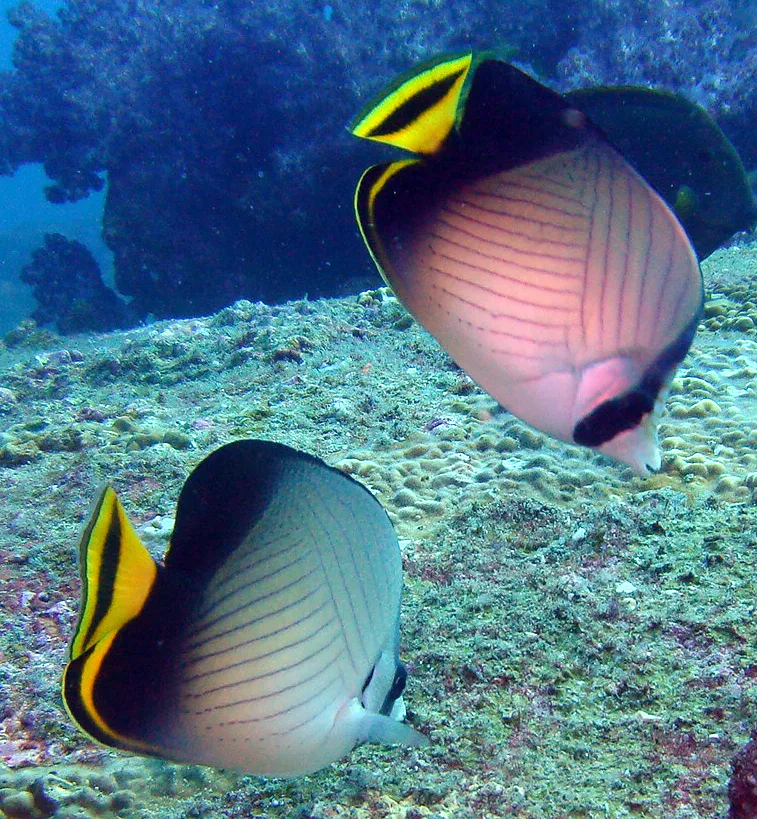
Indo-Pacific region, including the Red Sea and the eastern coast of Africa.
Conservation status
Least Concern
Edibility
Potentially edible, but it is not generally recommended: reef fishes may present a ciguatera poisoning risk. Culinary quality is poorly documented.
Danger level
Harmless
Usual observation depth
3–25 m
Behaviour
Diurnal and active on reefs. Observed alone, in pairs or small groups; pairs may defend a territory. Juveniles are often more solitary.
Observation zones
Coral reef, lagoon, sheltered reef flat and outer reef slope.
Diet
Omnivore, feeding mainly on benthic invertebrates, including coral-associated invertebrates and polyps; it also consumes algae.
Reproduction
Oviparous
Identification marks
Large butterflyfish with a broad dark vertical band crossing the eye, a yellow head and body, and a large saddle-shaped black spot on the upper rear part of the body and at the base of the dorsal fin. The rear part of the dorsal fin often forms an elongated filament.
Similar species
May be confused with other dark-backed Chaetodon, notably the blackback butterflyfish (Chaetodon melannotus). C. ephippium is distinguished by its more clearly defined black saddle on the upper rear part of the body and by the often elongated filament of its posterior dorsal fin.
Approach rules
Approach slowly and calmly without blocking its access to coral shelter. Keep a respectful distance, do not chase or touch it, do not feed it, and avoid repeated flashes at close range.
Protection
Classified as « Least Concern » on the IUCN Red List. It is not listed in the CITES appendices; protection of reef habitats and responsible practices in the aquarium trade are beneficial.