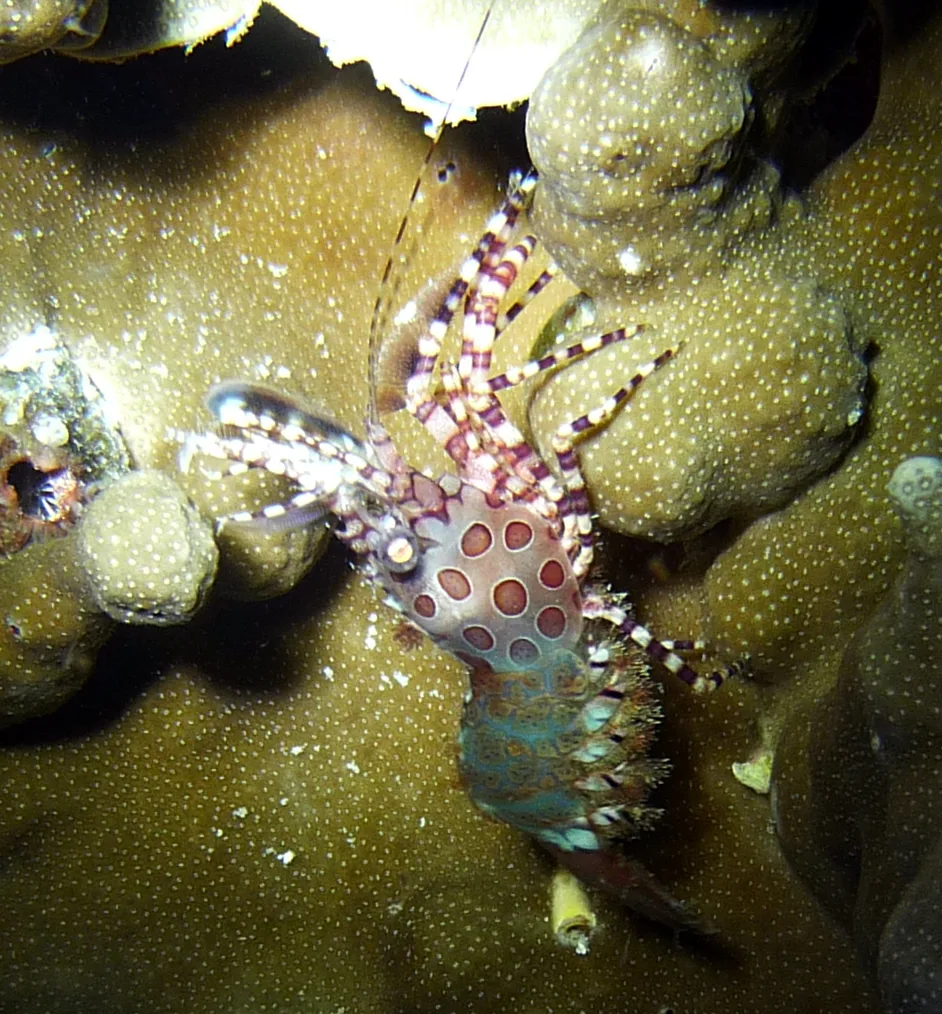
Typically found in coral reefs and rocky substrates.
Distribution
Found in the Indo-Pacific region.
Conservation status
Least Concern
Edibility
Not a food species. It is very small and primarily known in the aquarium trade; culinary quality is undocumented and consumption is not recommended.
Danger level
Harmless
Usual observation depth
3–20 m
Behaviour
It is generally observed in heterosexual pairs, sometimes with a small group of juveniles. Secretive during the day, it may emerge to feed; pairs defend a small territory around their shelter and prey.
Highly specialized predator of starfish. It feeds mainly on the tube feet and soft tissues of living starfish, including acanthaster when available.
Reproduction
Oviparous
Identification marks
Small flattened shrimp with broad leaf-shaped claws; white to cream body covered with large, sharply defined violet, blue-brown, or reddish spots. Legs and claws bear visible colored bands or spots.
Similar species
Often confused with Hymenocera elegans, a name also treated as a synonym or regional form of H. picta. Harlequin shrimp are distinguished from other reef shrimp by their broad, foliaceous claws, flattened body, and obligate diet of starfish.
Approach rules
Approach slowly and remain at a distance from its shelter. Do not touch, handle, feed, or collect it. Do not use flash, or use only minimal, indirect flash; avoid blocking its retreat or disturbing the starfish it feeds on.
Protection
No CITES listing is known. Hymenocera picta has not undergone a global assessment on the IUCN Red List; avoid unnecessary collection, particularly for the aquarium trade, and comply with site-specific conservation rules.