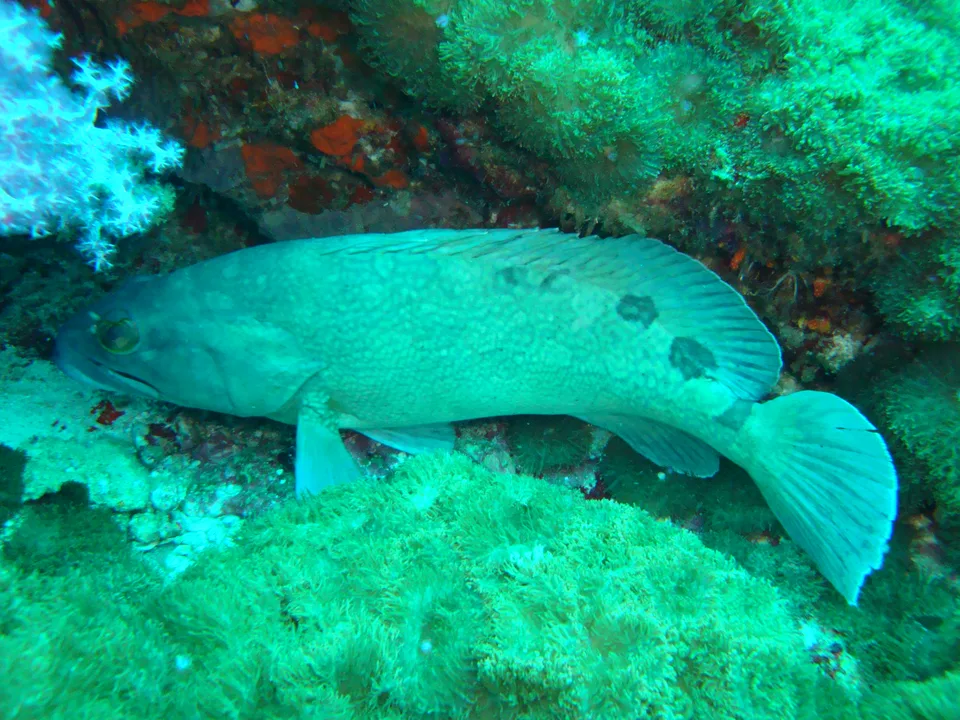
Typically found in rocky or coral reef environments.
Distribution
Found in tropical and subtropical waters worldwide.
Conservation status
Least Concern
Edibility
Edible and regarded as good eating, but large reef groupers can carry ciguatera toxins. Avoid eating large individuals in areas where ciguatera occurs and follow public-health advice.
Culinary quality / 5
4
Danger level
Caution
Usual observation depth
10–50 m
Lifespan (years)
41
Behaviour
Generally solitary and faithful to its shelters. It is a large ambush predator, usually calm toward divers but capable of rapid feeding attacks; adults may temporarily aggregate for breeding.
Observation zones
Reef slopes, coral bommies, passes, caves, ledges, overhangs and sometimes wrecks; mainly on coral or rocky structures rather than in open water or on bare sand.
Diet
Carnivore. Feeds mainly on fish, crustaceans, and cephalopods, which it swallows with its large mouth.
Reproduction
Oviparous
Identification marks
Very large grouper with a massive body, broad head, and enormous mouth. Body pale gray to brown, covered with large rounded dark brown to black spots, forming a characteristic “potato” pattern.
Similar species
May be confused with the giant grouper (Epinephelus lanceolatus). The giant grouper grows larger and generally exhibits more irregular mottling, rather than the large, round, sharply defined dark spots of the potato grouper.
Approach rules
Approach slowly and calmly, keep a respectful distance, and do not block its exit or enter its shelter. Do not touch, feed, harass, or pursue the animal. Avoid using flash at very close range, especially when it is resting in a cave or under an overhang.
Protection
Globally assessed as “Least Concern” on the IUCN Red List and not listed under CITES. Local pressures may exist; avoid disturbing it and respect the rules applicable to the site, fisheries, and protected areas.