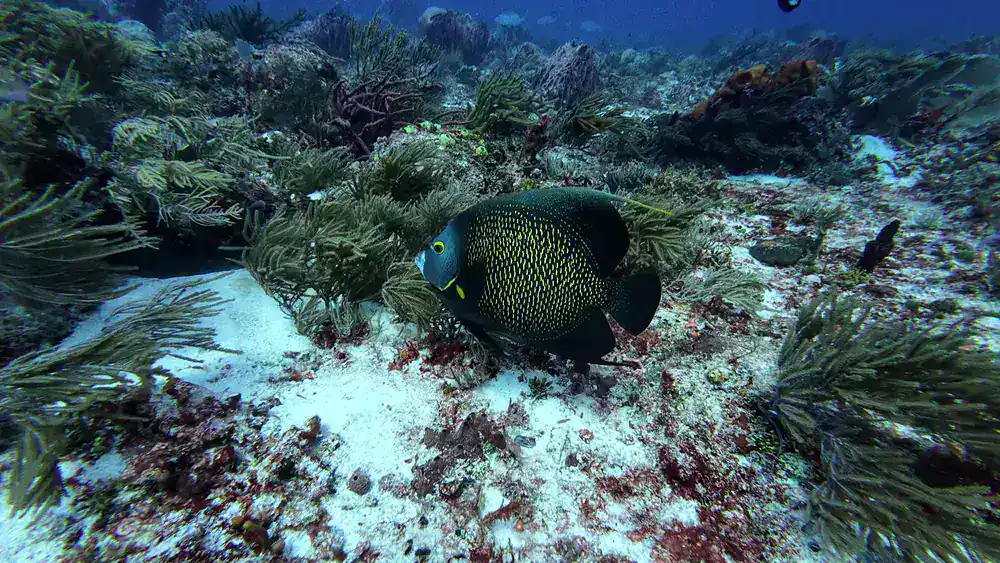
Coral and rocky reefs, reef slopes, ledges, and patch reefs; juveniles also use sheltered mangroves and seagrass-associated areas.
Distribution
Western Atlantic: from Florida, the Bahamas, and the Gulf of Mexico through the Caribbean to Brazil.
Conservation status
Least Concern
Edibility
Edible, but it may carry a risk of ciguatera poisoning in some tropical areas. Consumption is best avoided where ciguatera is known or suspected.
Culinary quality / 5
3
Danger level
Harmless
Usual observation depth
3–30 m
Lifespan (years)
18
Behaviour
Usually seen alone, in pairs, or in small groups. Adults often form pairs, particularly during breeding. Diurnal and generally inquisitive; juveniles may act as cleaner fish, removing parasites from other fishes.
Observation zones
Reef, reef slope, coral heads, rocky ledges, patch reef, wrecks near reefs, mangrove edges, and seagrass-associated shallows for juveniles.
Diet
An omnivore feeding mainly on sponges and algae, with additional tunicates, hydroids, bryozoans, and other small benthic invertebrates.
Reproduction
Oviparous
Identification marks
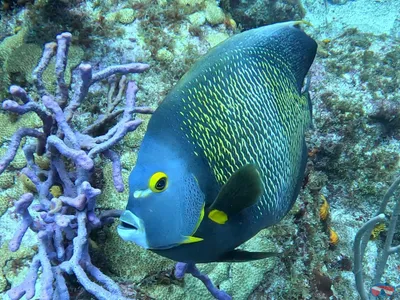
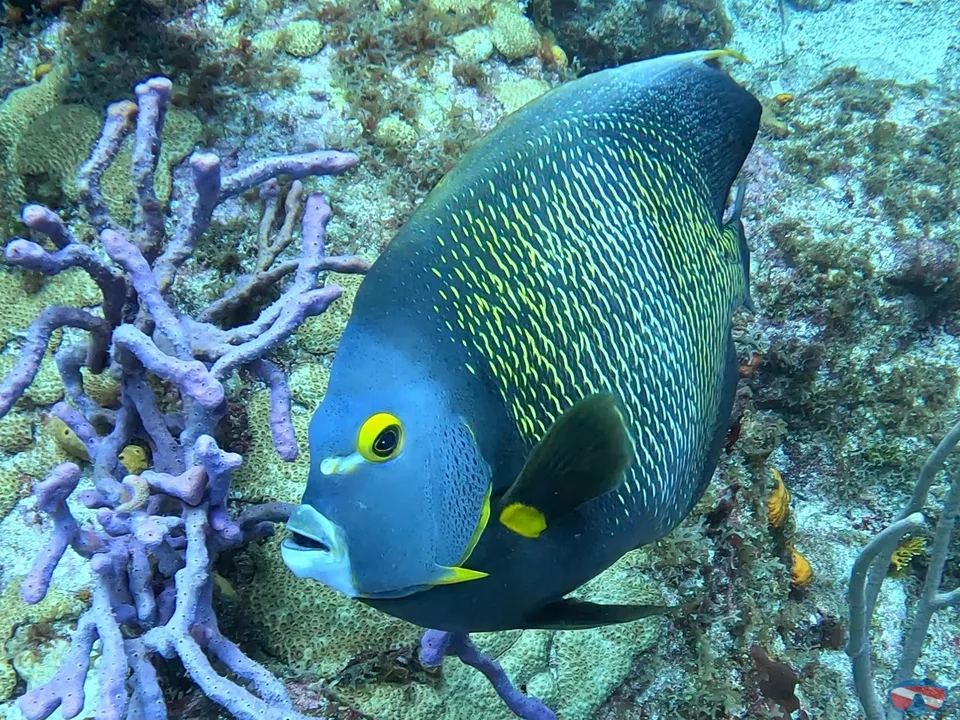
A deep-bodied angelfish with an overall dark gray to black body; most scales have bright yellow edges, creating a conspicuous reticulated pattern. The face has yellow markings around the eye, and the pectoral fin is yellowish. Adults have a pale, crescent-shaped mark at the base of the tail.
Similar species
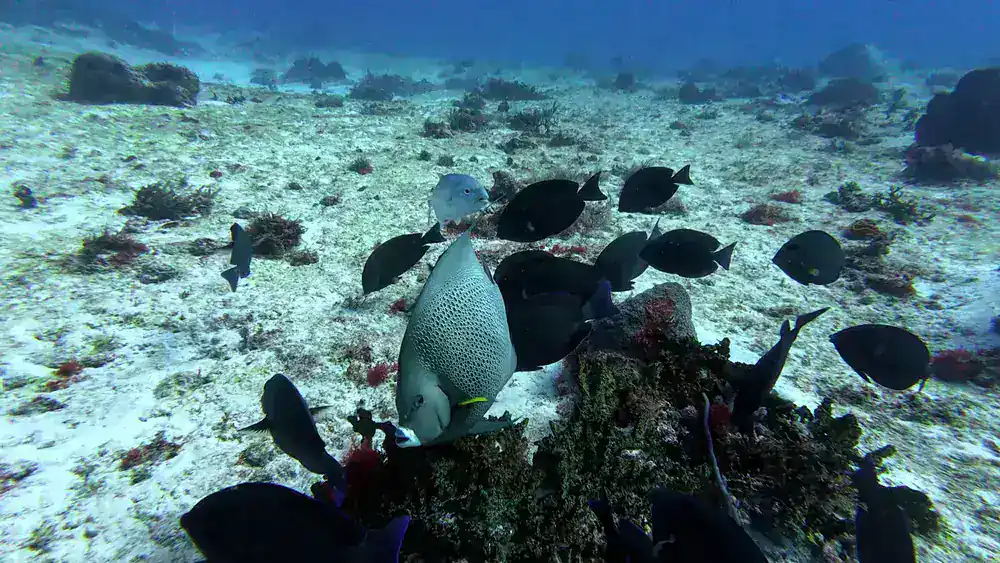
Most often confused with the gray angelfish (Pomacanthus arcuatus). The French angelfish is darker and has distinctive yellow-edged scales, yellow facial markings, and a yellowish pectoral fin; the gray angelfish is generally more uniformly gray or brown and lacks this strong yellow reticulation.
Approach rules
Approach slowly and calmly without blocking its route or cornering it. Keep a respectful distance of at least 2–3 m, avoid touching reefs or the fish, do not feed it, and use flash only sparingly and never at very close range.
Protection
Globally assessed as Least Concern on the IUCN Red List. It is not listed in the CITES Appendices. Local protection or fisheries measures may still apply.