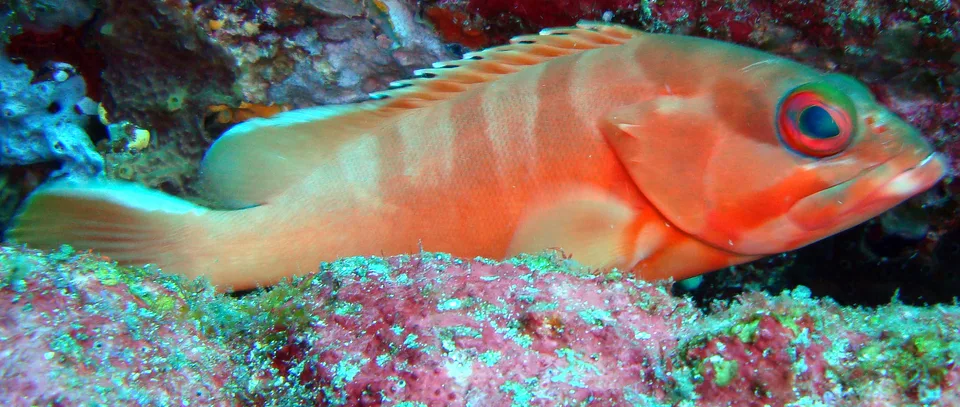
Coral and rocky reefs, generally near shelters, crevices, and overhangs.
Distribution
Tropical Indo-Pacific, including the Andaman Sea and Thai waters.
Conservation status
Least Concern
Edibility
Edible and commercially caught in parts of its range. As with other reef groupers, there can be a ciguatera poisoning risk in some areas; follow current seafood-health advice.
Culinary quality / 5
3
Danger level
Harmless
Usual observation depth
10–60 m
Behaviour
Usually solitary and associated with reef shelter. It is an ambush predator, often resting close to holes, crevices or ledges and becoming more active around dusk and dawn.
Mainly small fishes and crustaceans; it may also take other mobile benthic invertebrates.
Reproduction
Oviparous
Identification marks
A small, robust grouper with a pale grey, brownish or reddish body, usually showing about five dark vertical bars. A conspicuous blackish patch on the rear part of the spiny dorsal fin is a key mark.
Similar species
It can be confused with other small Indo-Pacific groupers. The honeycomb grouper, Epinephelus merra, has a dense honeycomb pattern rather than broad dark bars; the orange-spotted grouper, Epinephelus coioides, has numerous orange-brown spots and grows much larger.
Approach rules
Approach slowly and remain clear of its retreat route and shelter. Do not touch, chase, corner or feed it. Keep a respectful distance; use flash sparingly and never repeatedly at close range.
Protection
Globally assessed as Least Concern by the IUCN. Although not CITES-listed, reef habitats and local grouper populations can be affected by fishing pressure; support sustainable sourcing and reef protection.