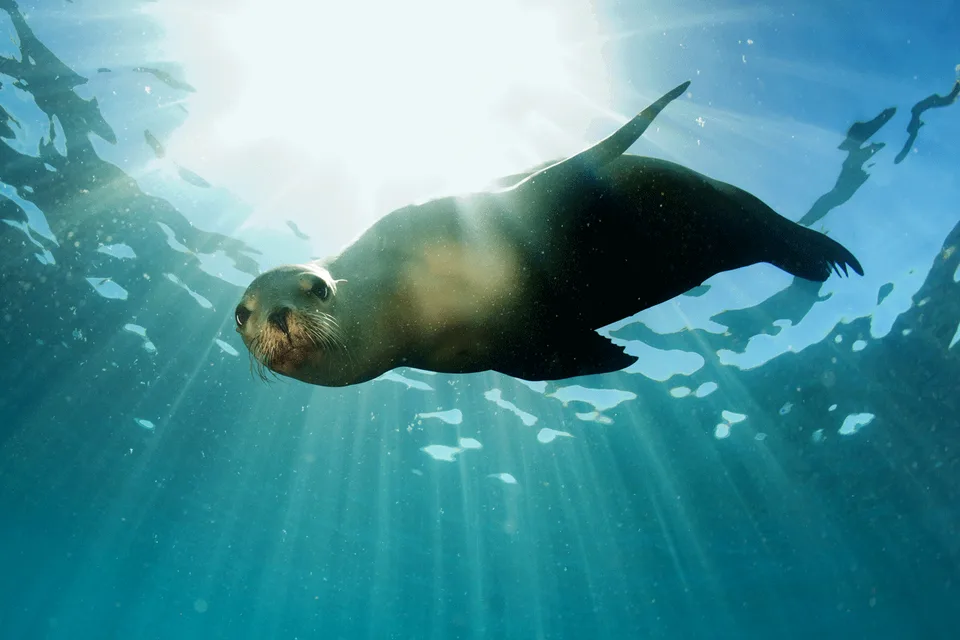
Coastal areas, often found on beaches and rocky shores.
Distribution
Found along the western coast of North America, from Canada to Mexico.
Conservation status
Least Concern
Edibility
Not generally consumed. Avoid consumption: as a marine mammal, it may carry pathogens and contaminants, and it is subject to wildlife protections in many parts of its range. Follow applicable regulations.
Danger level
Caution
Usual observation depth
?–50 m
Lifespan (years)
20
Behaviour
Highly social and gregarious, forming large resting and breeding colonies. Often active during the day, but may feed at night. Agile swimmer; males can be territorial and aggressive during the breeding season. It uses barks and other vocalizations.
Observation zones
Rocky reefs, kelp forests, coastal blue waters, sandy beaches, islands, bays, harbors, docks, jetties and resting buoys.
Diet
Opportunistic predator feeding mainly on schooling fish and cephalopods, notably anchovies, sardines, mackerel, hake, rockfish, squid and octopuses. Diet varies according to region and season.
Reproduction
Viviparous
Identification marks
Eared seal with a streamlined body, visible external ear flaps, and long foreflippers. Adults are brown to dark brown; males are much larger, with a pronounced sagittal crest, a broad neck, and a lighter, often blondish head. They can turn their hind flippers forward and walk on all fours on land.
Similar species
It can be confused with the Steller sea lion, which is noticeably larger, paler, and has a broader muzzle. The Guadalupe fur seal has denser fur and a more pointed muzzle. The harbor seal has no external ear flaps and cannot turn its hind flippers forward to walk on all fours.
Approach rules
Observe calmly from a distance and never block the passage between the animal and the water. Do not touch it, pursue it, encircle it, or separate mothers from their young; do not approach resting or breeding colonies. Stay well away from males and any agitated animal. Do not feed it. Avoid flash photography.
Protection
Least Concern according to the IUCN. This marine mammal is protected or managed by wildlife and marine mammal conservation measures in certain parts of its range. It is not listed in the CITES Appendices.