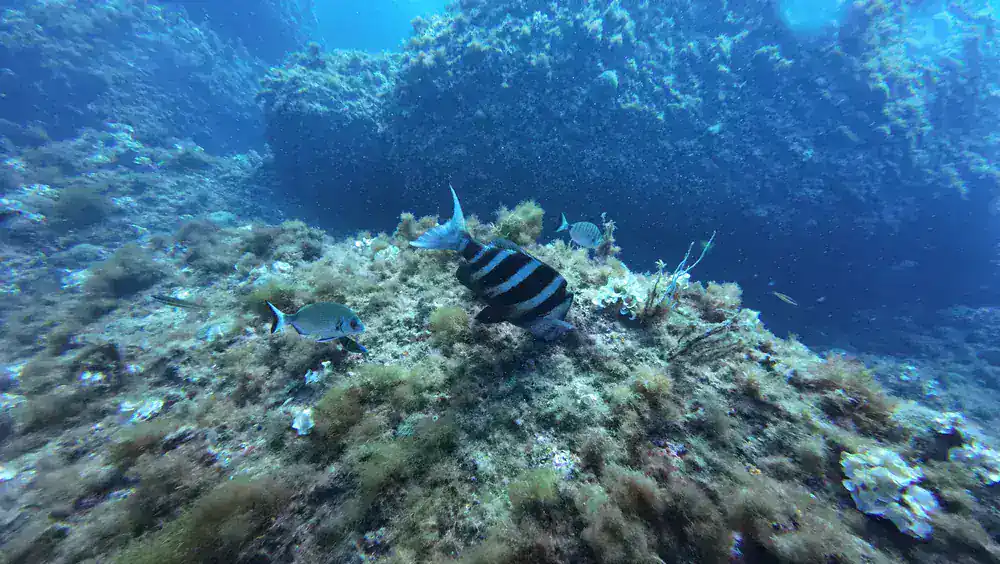
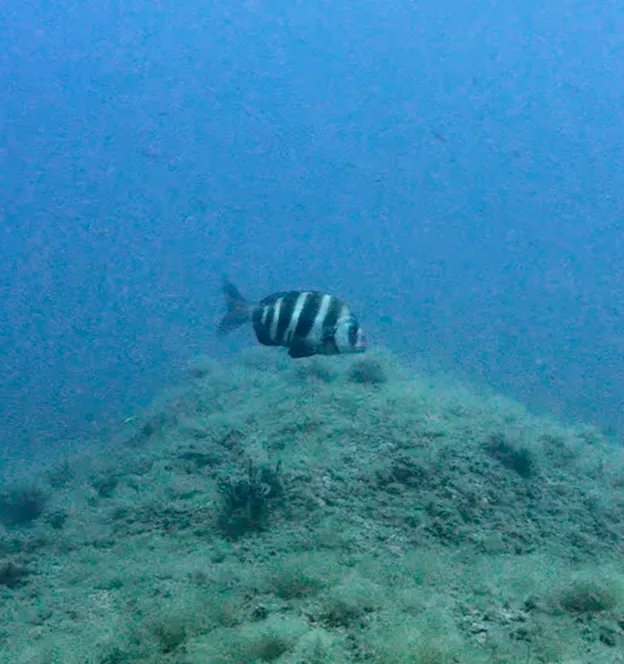
Juveniles occur in very shallow rocky areas, seagrass beds and rock-sand transition zones. Adults mainly inhabit rocky bottoms, reefs and wrecks, usually between 10 and 100 m, but may descend to 300 m.
Distribution
Eastern Atlantic Ocean, from the Bay of Biscay along the northwestern African coast, including Madeira and the Canary Islands, and the Mediterranean Sea.
Conservation status
Least Concern
Edibility
Edible and regarded as a good food fish. Consume only fish from clean waters and follow local health advice and fishing rules.
Culinary quality / 5
4
Danger level
Harmless
Usual observation depth
5–30 m
Lifespan (years)
21
Behaviour
Usually solitary or found in small groups, often close to cover. It is mainly active by day and uses strong jaws to feed on bottom-dwelling invertebrates. Like other Diplodus seabreams, it is a protandrous hermaphrodite.
Observation zones
Rocky reef, reef wall, boulder slope, seagrass edge and sandy patches adjacent to hard reef; occasionally around artificial structures.
Diet
Mainly benthic invertebrates, especially molluscs, crustaceans and sea urchins; it may also take other small bottom animals.
Reproduction
Oviparous
Identification marks
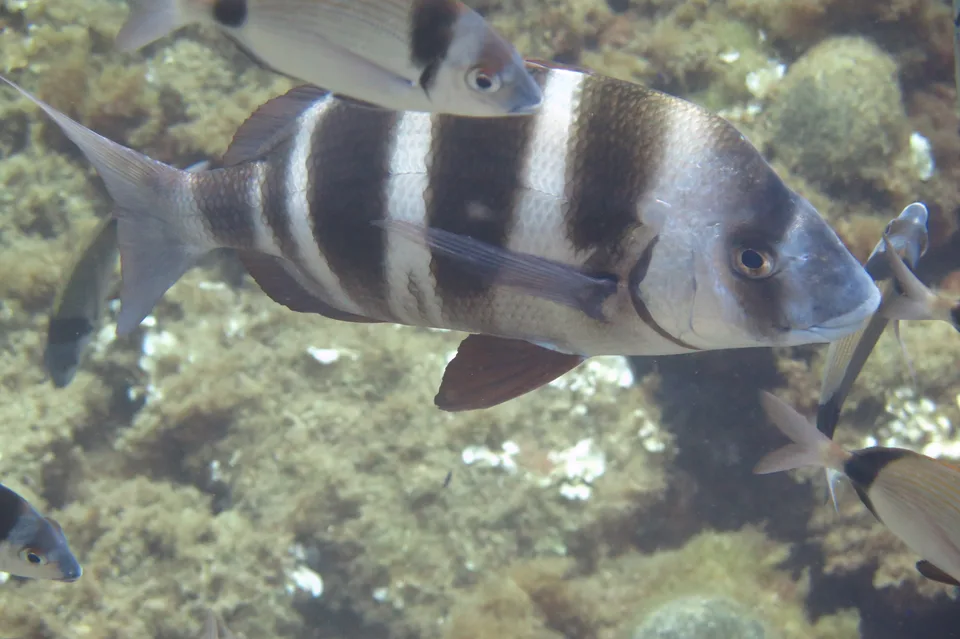
Deep, laterally compressed silvery body with five broad dark vertical bars, a dark mark at the base of the tail, conspicuously thick lips and strong incisor-like teeth. Adults can become very large for a Diplodus.
Similar species
It may be confused with other Diplodus seabreams. Diplodus sargus has less distinct narrow barring and a prominent black caudal-peduncle saddle; D. vulgaris has two main dark bands; D. puntazzo has a more pointed snout. The five broad zebra-like bars and thick lips distinguish D. cervinus.
Approach rules
Harmless but can be wary. Approach slowly and calmly from the side, avoid blocking its escape route, and keep about 2–3 m distance. Do not touch or feed it; avoid flash photography or use it sparingly.
Protection
IUCN Least Concern globally. It is not listed in the CITES Appendices. Follow applicable national, regional and protected-area regulations.