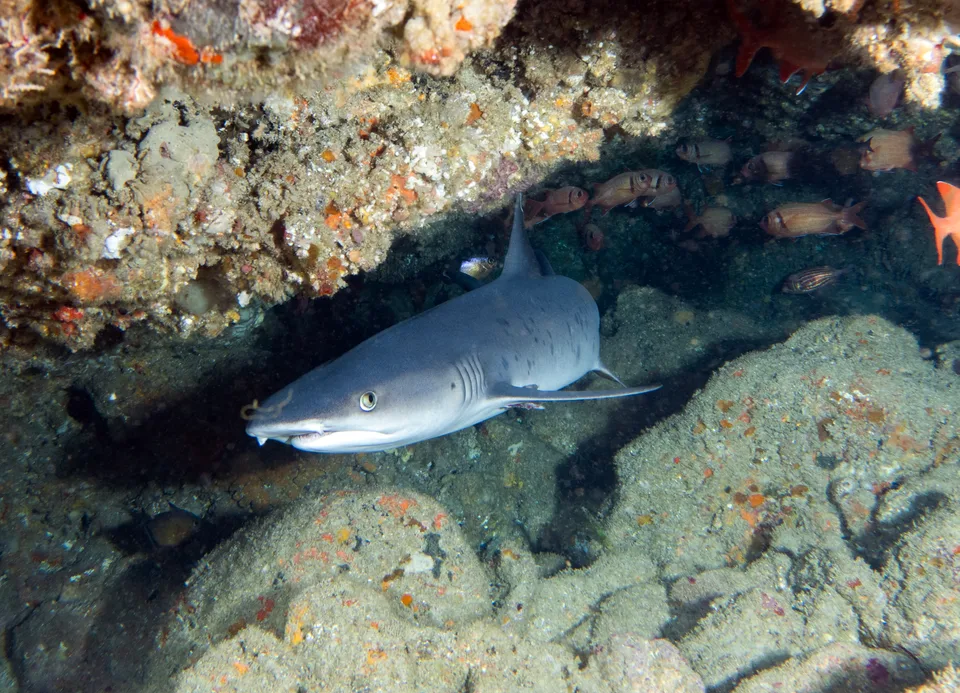
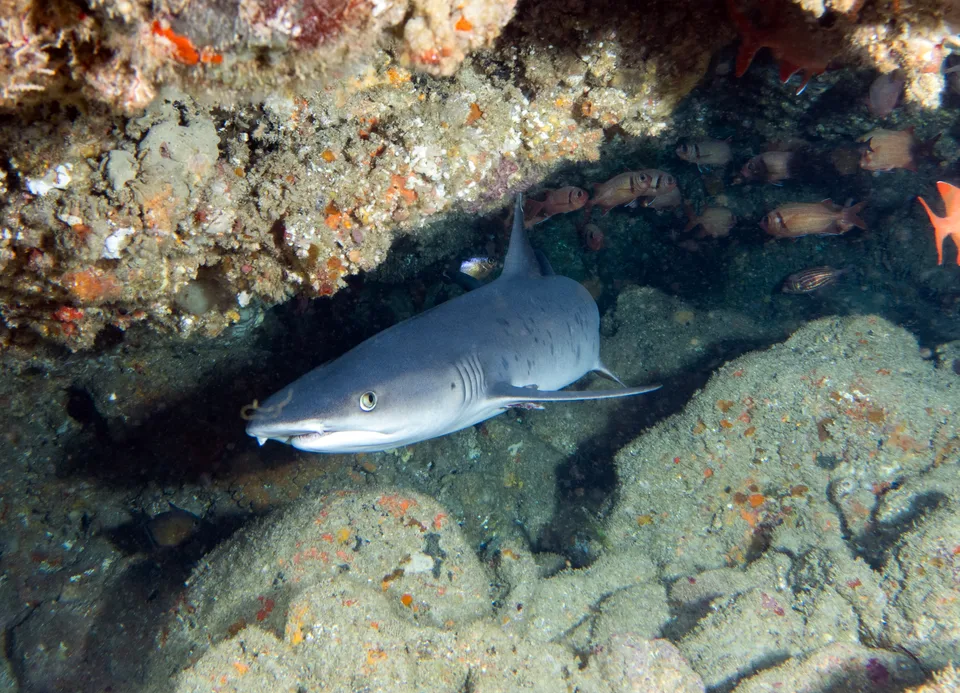
Tropical coral reefs, lagoons, reef flats, caves, crevices and rocky overhangs. It usually rests on or near the seabed during the day and becomes more active at night.
Distribution
Tropical Indo-Pacific, from the Red Sea and East Africa across the Indian Ocean and western and central Pacific, as well as the eastern Pacific from Costa Rica and Panama to the Galápagos Islands.
Conservation status
Vulnerable
Edibility
Its meat is edible and has been used fresh, dried or salted, but consumption is not recommended because the species is Vulnerable and shark products may pose mercury and, in some regions, ciguatera risks.
Culinary quality / 5
3
Danger level
Caution
Usual observation depth
8–40 m
Lifespan (years)
25
Behaviour
Generally solitary or in small groups. Primarily nocturnal, it actively hunts at night; during the day, it often remains motionless in caves or under overhangs, sometimes with other individuals. It can ventilate its gills while at rest.
Observation zones
Reef, lagoon, reef pass, drop-off, coral cave, crevice and under overhangs; occasionally on sandy areas adjacent to the reef.
Diet
Mainly reef bony fishes, notably eels, squirrelfishes, surgeonfishes and parrotfishes; it also consumes octopuses, other cephalopods, crustaceans and occasionally rays.
Reproduction
Viviparous
Identification marks
Slender shark with a small head, short, broad snout, oval eyes, and the first dorsal fin set far back. The tip of the first dorsal fin and the upper caudal lobe are distinctly white; body gray to grayish brown, underside pale.
Similar species
Often confused with the blacktip reef shark (Carcharhinus melanopterus), which has clearly visible black fin tips and a more forward first dorsal fin. The oceanic whitetip shark (Carcharhinus longimanus) is much larger, pelagic, and has broad, rounded fins speckled with white.
Approach rules
Observe calmly from a respectful distance, without blocking its path to shelter; do not touch, pursue, corner, or feed it. Avoid flash near resting sharks and do not bring your hands near its mouth or tail. Monitor all sharks present.
Protection
Classified as Vulnerable globally on the IUCN Red List. Listed in CITES Appendix II; international trade is regulated to promote sustainable and legal sourcing. Protect reefs and avoid supporting the shark fin trade.