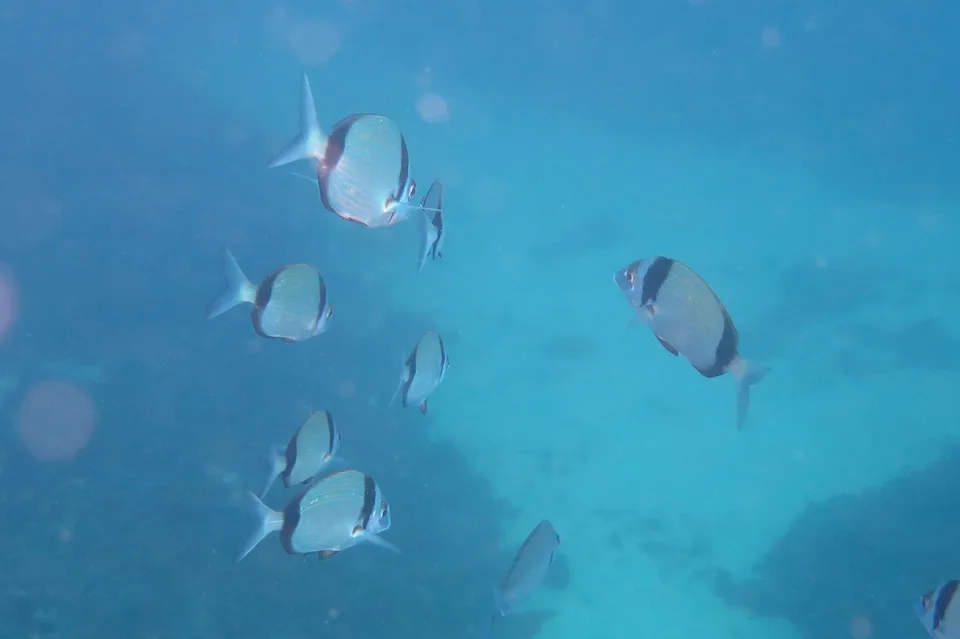
Coastal rocky reefs, reef edges, seagrass beds, and mixed sand-and-rock bottoms; juveniles often occur in very shallow protected water.
Distribution
Eastern Atlantic, from the Bay of Biscay and Madeira south to Senegal, including the Mediterranean Sea and Black Sea.
Conservation status
Least Concern
Edibility
Edible and commonly valued as a food fish. Consume only fish obtained legally and follow local health advice, especially regarding contaminants in large coastal fish.
Culinary quality / 5
4
Danger level
Harmless
Usual observation depth
1–30 m
Lifespan (years)
0
Behaviour
Usually seen alone, in pairs, or in small loose groups; juveniles may form larger schools. Diurnal and mainly active near the bottom, where it forages among rocks, vegetation, and sediment.
An omnivorous benthic feeder, eating small crustaceans, molluscs, worms, echinoderms, other bottom invertebrates, and algae.
Reproduction
Oviparous
Identification marks
Deep, oval silvery body with two broad dark vertical bands: one immediately behind the head and one on the caudal peduncle at the base of the tail. Fins are generally dusky-edged.
Similar species
Often confused with the white seabream (Diplodus sargus), which typically has a dark saddle at the tail base rather than the two clear broad bands of D. vulgaris. The zebra seabream (Diplodus cervinus) has several narrow vertical bars rather than two main bands.
Approach rules
Approach slowly and quietly without blocking its route to shelter. Keep a respectful distance, avoid chasing or touching, use flash sparingly, and never feed fish.
Protection
Globally assessed as Least Concern on the IUCN Red List. No CITES listing is known; fishing and collection may nevertheless be regulated locally.