Not recommended for consumption. Porcupinefishes may contain dangerous tetrodotoxin, and toxin levels can be variable; eating this species can cause severe or fatal poisoning.
Danger level
Caution
Usual observation depth
3–30 m
Behaviour
Generally solitary and mainly nocturnal. During the day, it often rests in sheltered holes or under overhangs; it forages at night. When threatened, it can inflate its body and erect its spines.
Feeds mainly on hard-shelled benthic invertebrates, particularly mollusks, crustaceans, and sea urchins. Its strong, beak-shaped teeth crush its prey.
Reproduction
Oviparous
Identification marks
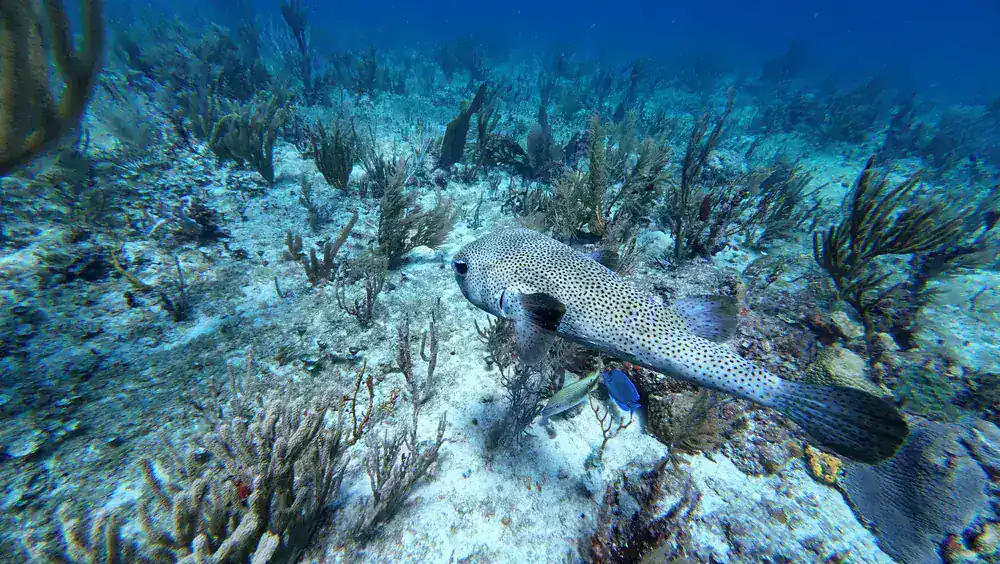
Large porcupinefish with a rounded body, equipped with long movable spines that lie flat when at rest. The body, pale to brownish, bears numerous dark round spots, including on the fins; the head and eyes are large, and the mouth is blunt and beak-shaped.
Similar species
May be confused with other porcupinefish of the genus Diodon. Diodon liturosus generally has broad dark bands or blotches rather than the numerous distinct dark spots of D. hystrix. Diodon holocanthus is generally smaller and has a denser, different spot pattern.
Approach rules
Observe it calmly from a respectful distance and never touch, handle, corner, or pursue it. Do not provoke it to inflate, as this is stressful and can injure it. Avoid repeated flashes at close range and never feed it.
Protection
Assessed by the IUCN as a species of Least Concern globally. It is not listed in the CITES appendices. Follow general best practices for wildlife observation and the rules applicable at the site.