Western Atlantic, from New Jersey to Brazil, including the Gulf of Mexico and Caribbean Sea
Conservation status
Least Concern
Edibility
Edible, but it is not generally recommended as a seafood choice; rays may accumulate contaminants and should be sourced responsibly where consumption is appropriate.
Culinary quality / 5
3
Danger level
Caution
Usual observation depth
1–30 m
Lifespan (years)
13
Behaviour
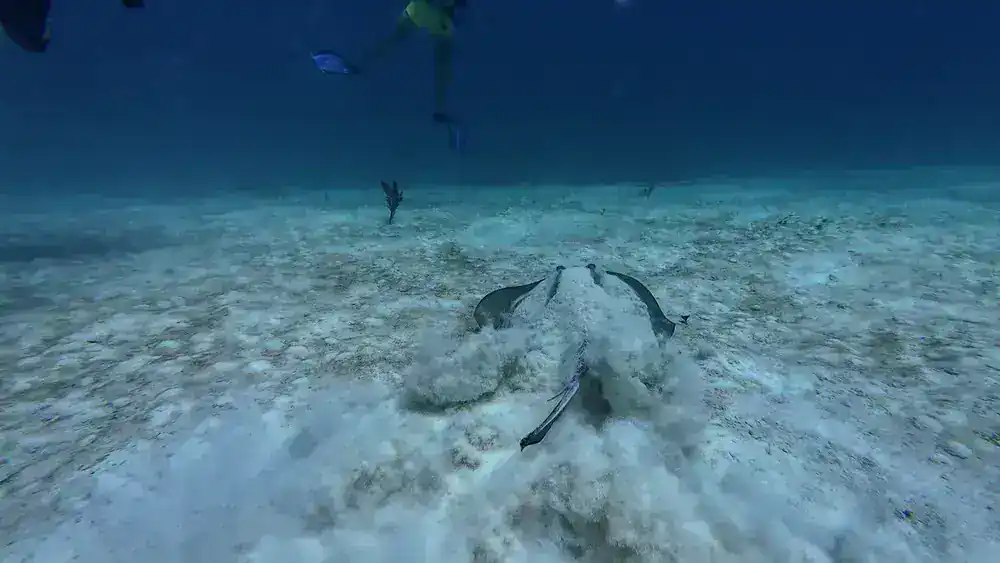
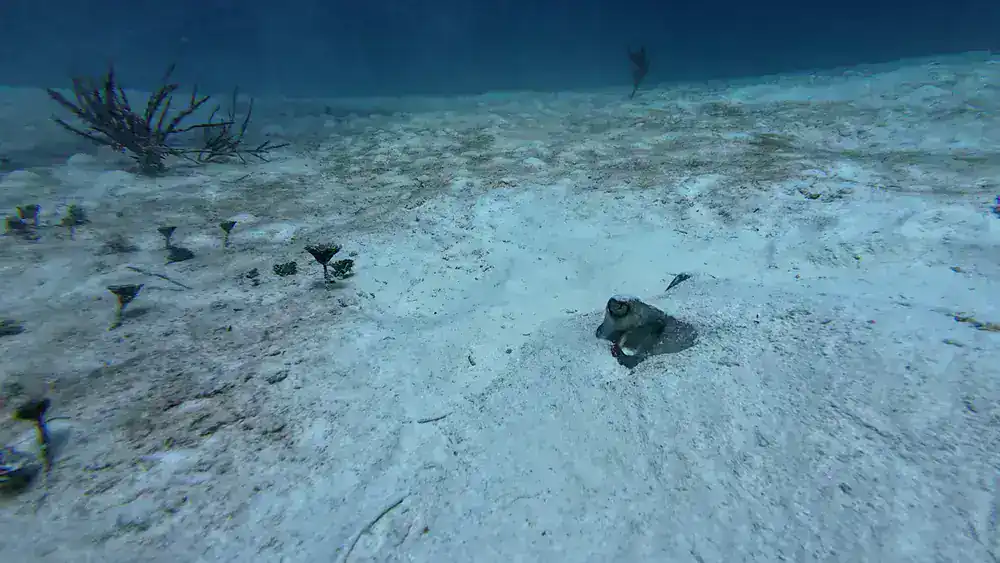
Generally solitary, although several individuals may gather in rich feeding areas or resting sites. Active both day and night, it often rests partially buried in the sand and uses its caudal spine in defense when threatened.
Feeds mainly on benthic invertebrates, notably crustaceans, mollusks and worms, as well as small bony fish.
Reproduction
Viviparous
Identification marks
Large diamond-shaped disc, brown to olive-brown on top and pale to white underneath. The long whip-like tail generally bears one or more serrated venomous spines near its base.
Similar species
May be confused with the small Atlantic stingray (Hypanus sabinus), which generally has a more rounded disc and is noticeably smaller as an adult. The Caribbean whiptail ray (Styracura schmardae) is generally more oval and may have light spots.
Approach rules
Observe calmly from several meters away, stay low, and do not block its path. Never touch, chase, step on, or handle the ray; keep well clear of its tail. Avoid repeated direct flashes and never feed rays.
Protection
IUCN Red List status: Least Concern (LC). Even when it is not specifically protected, avoid disturbance, handling, feeding, and collection, and support the responsible protection of coastal habitats.