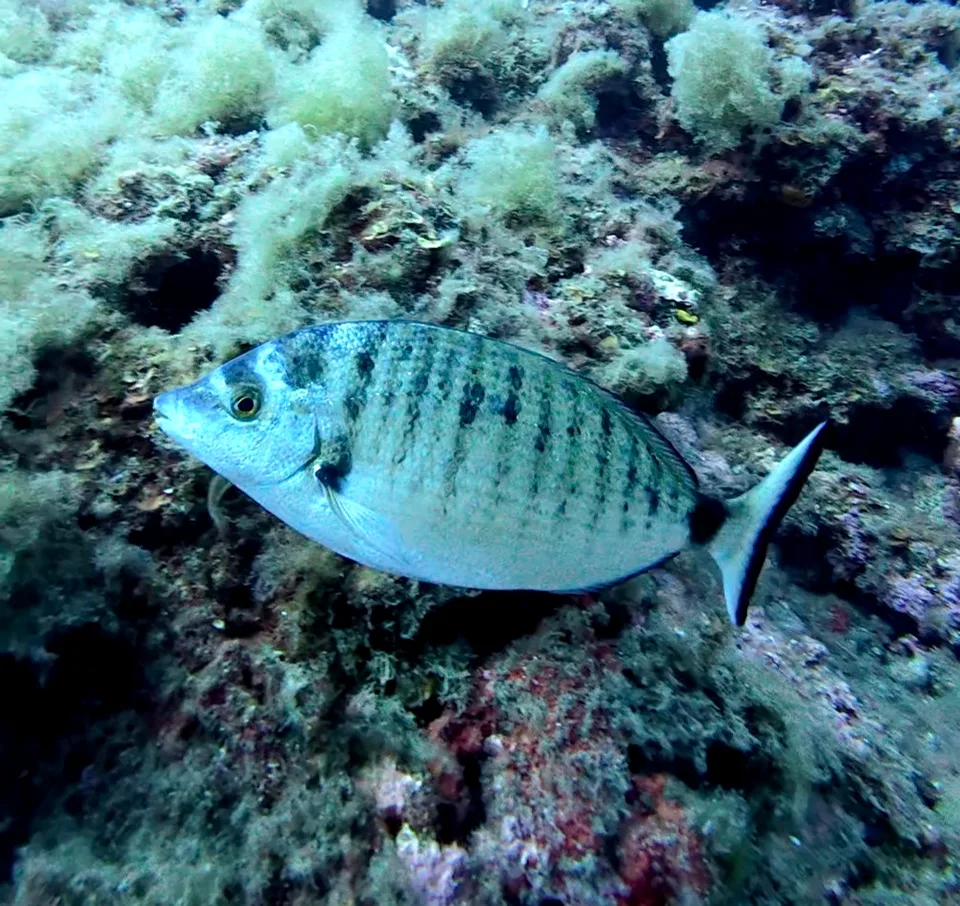
Rocky coastal bottoms, reefs, seagrass beds and rocky-sandy transition areas. Juveniles may also occur in shallow lagoons, harbours and sheltered coastal areas.
Distribution
Eastern Atlantic Ocean, from the Bay of Biscay to Sierra Leone, including the Canary Islands and Cape Verde, as well as the Mediterranean Sea, the Strait of Gibraltar and the Black Sea.
Conservation status
Least Concern
Edibility
Edible and commercially valued in parts of its range. It is best eaten fresh; observe local health advice and fishing regulations.
Culinary quality / 5
3
Danger level
Harmless
Usual observation depth
3–50 m
Behaviour
Usually solitary or found in small groups; juveniles may form schools. It is mainly active by day and forages close to the bottom.
An omnivorous benthic feeder, eating algae and seagrass-associated material as well as molluscs, crustaceans, worms, sea urchins, and other small bottom invertebrates.
Reproduction
Oviparous
Identification marks
Deep, laterally compressed silvery body with several narrow dark vertical bars; a distinctly long, pointed snout gives the head a wedge-shaped profile. The tail base commonly has a dark marking.
Similar species
Often confused with other Diplodus seabreams. Diplodus sargus has a shorter, blunter snout and a more conspicuous dark band at the tail base; Diplodus vulgaris is characterized by two prominent dark bands rather than numerous narrow bars.
Approach rules
Approach slowly and calmly, remaining a few metres away where possible. Do not chase, touch, corner, or feed the fish. Avoid repeated close-range flash photography.
Protection
IUCN Red List: Least Concern (LC). No CITES listing is applicable. Fisheries management and local restrictions may apply depending on location.