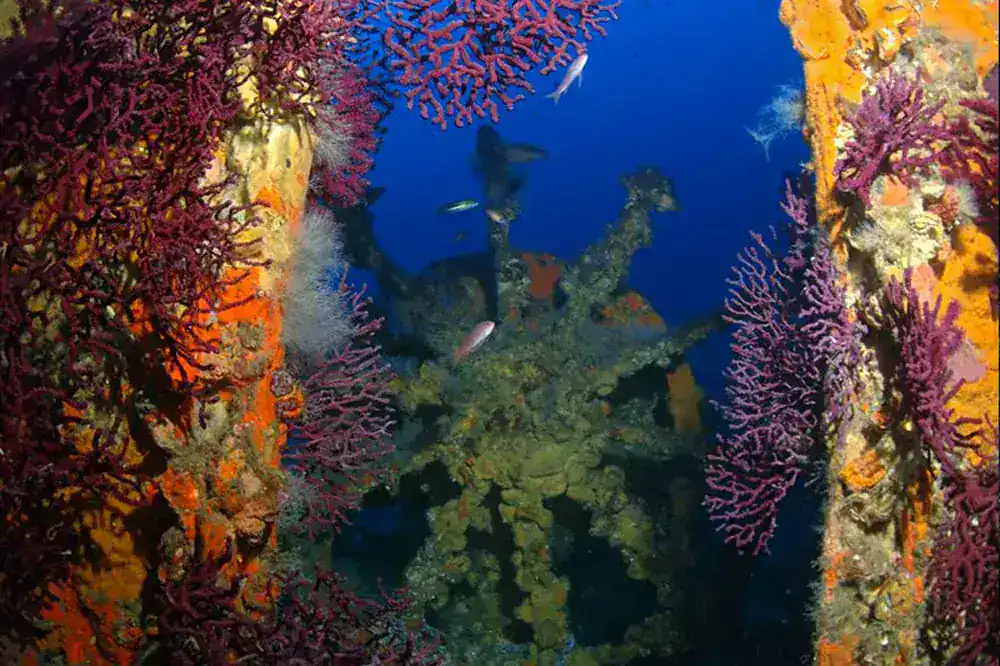
Corallium rubrum typically inhabits deep-sea environments, often found in rocky substrates and caves at depths ranging from 30 to 1,000 meters.
Distribution
This species is primarily distributed in the Mediterranean Sea and the Atlantic Ocean, particularly along the coasts of Italy, France, and Spain.
Conservation status
Least Concern
Edibility
Not normally eaten and not a food species. It is a threatened precious coral; do not collect or consume it.
Danger level
Harmless
Usual observation depth
20–200 m
Behaviour
Sessile and colonial. The polyps extend their tentacles to feed in the water column, especially when currents bring food particles; colonies reproduce sexually and also grow by budding.
Observation zones
Walls of rocky reefs, shaded overhangs, crevices, caves and coralligenous habitats; generally absent from offshore areas, sandy bottoms and mangroves.
Diet
Suspension feeder: captures zooplankton and organic particles in the water using its tentacles.
Reproduction
Viviparous
Identification marks
Small rigid, tree-shaped, branched colonies, with a bright red to orange-red calcareous skeleton and generally white polyps with eight tentacles. The colonies are often modest in size and live in shaded areas.
Similar species
May be confused with other precious corals of the genus Corallium or with red gorgonians. Corallium rubrum has a hard, massive red calcareous axis, as well as white polyps with eight tentacles; many red gorgonians have a more flexible skeleton.
Approach rules
Observe without touching, without pressing equipment against the colony or breaking branches. Maintain excellent buoyancy and sufficient distance with your fins to avoid contact and the resuspension of sediments. Do not feed; avoid flash when it risks disturbing the associated cave fauna, and never collect specimens.
Protection
IUCN Red List: Endangered. This slow-growing precious coral is vulnerable to harvesting and physical damage. International trade is listed in CITES Appendix III; consult applicable national and local regulations before any activity involving specimens.