Its meat is consumed and its fins are traded, but consumption is not recommended because this is an Endangered species; large sharks may also contain elevated mercury.
Culinary quality / 5
3
Danger level
Caution
Usual observation depth
20–150 m
Lifespan (years)
29
Behaviour
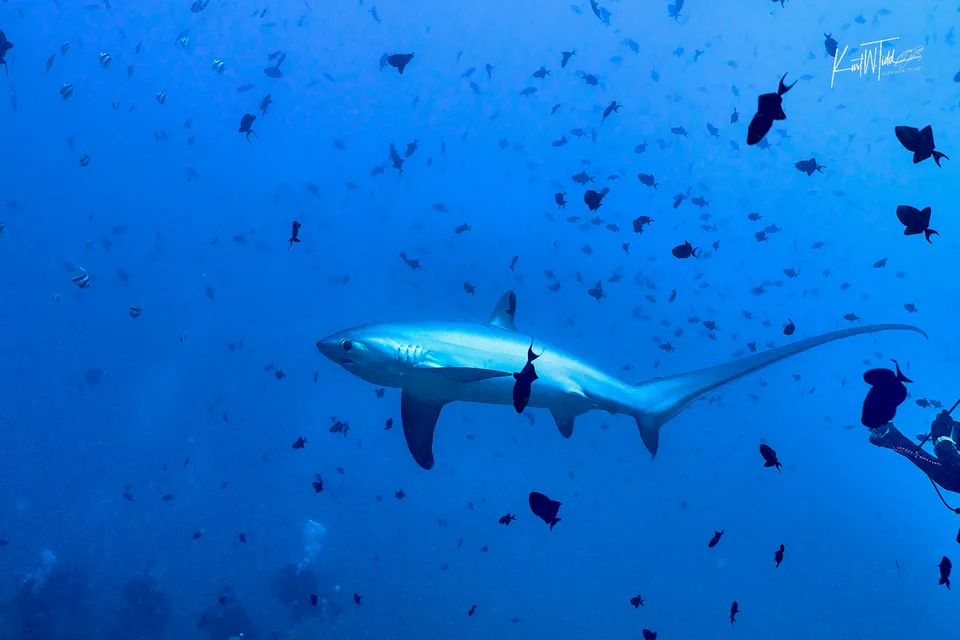
Generally solitary or observed in small groups. A fast and active pelagic shark, capable of making deep vertical movements; it is generally wary of divers. It uses its exceptionally long tail to strike and stun schooling prey.
Observation zones
Open water, seamounts, outer reef slopes, offshore pinnacles and island drop-offs.
Diet
Mainly small schooling bony fish, particularly sardines, anchovies and mackerel, as well as squid and other cephalopods.
Reproduction
Ovoviviparous
Identification marks
Slender shark with a very long, whip-shaped upper caudal lobe, almost as long as the body. The back is dark blue-grey to purplish, the underside white, and the eyes are relatively small compared with those of the bigeye thresher shark.
Similar species
It can be confused with the common thresher shark (Alopias vulpinus) and the bigeye thresher shark (Alopias superciliosus). The latter has very large eyes that extend over the top of the head and deep grooves above the eyes. The common thresher shark is generally associated with more temperate waters and has different white coloration around the pectoral fin region.
Approach rules
Observe calmly at a respectful distance and let the shark choose its path. Do not pursue it, touch it, block its passage, use bait, feed it, or use flash. Stay clear of its long tail and avoid encircling it.
Protection
Listed as Endangered globally on the IUCN Red List. International trade in species of the genus Alopias is regulated under CITES Appendix II; avoid supporting the trade in its meat or fins.