Edible, but consumption of large reef fish carries a potential ciguatera risk. Avoid eating large individuals from areas where ciguatera occurs.
Culinary quality / 5
3
Danger level
Caution
Usual observation depth
10–50 m
Behaviour
Most often observed alone or in pairs; juveniles may form small groups. Diurnal and active on the reef, often swimming steadily in open water near the reef.
Observation zones
Outer slopes, drop-offs, passes, coral lagoons and blue water along the reef edge.
Diet
Feeds mainly on benthic algae, including large brown algae, and also consumes a small amount of zooplankton.
Reproduction
Oviparous
Identification marks
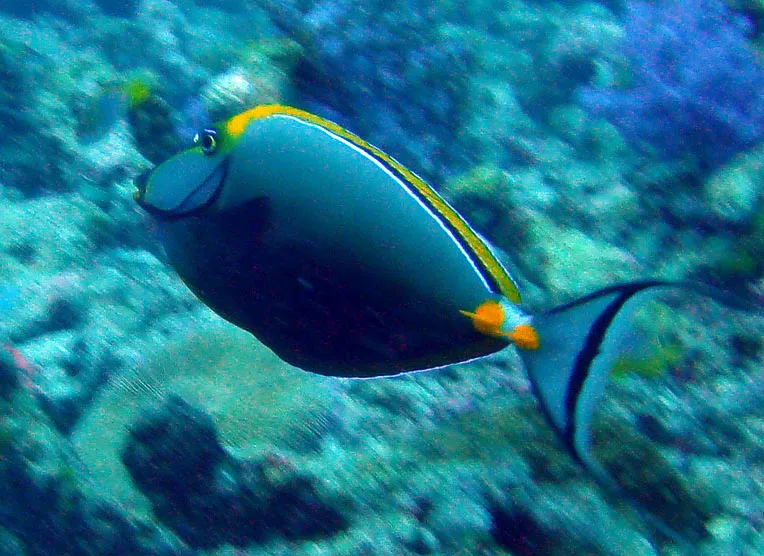
Large brownish-gray, laterally compressed surgeonfish, with blue markings on the head, an orange area around the sharp spines of the caudal peduncle and a lyre-shaped tail. Large adults develop a forward-pointing frontal horn.
Similar species
Can mainly be confused with the orange-spine Pacific unicornfish, Naso lituratus. Naso elegans lives in the Indian Ocean; distribution is the most reliable criterion where the species do not overlap. The other Naso do not have the same combination of orange spines on the caudal peduncle and facial pattern.
Approach rules
Approach slowly from the side, maintain a respectful distance, and do not block its path. Do not touch or handle the animal: the sharp spines of the caudal peduncle can cause cuts. Avoid flash at close range and never feed wildlife.
Protection
Globally assessed as Least Concern on the IUCN Red List. No CITES listing is known. Reef habitats should nevertheless be protected from degradation and collection pressure.