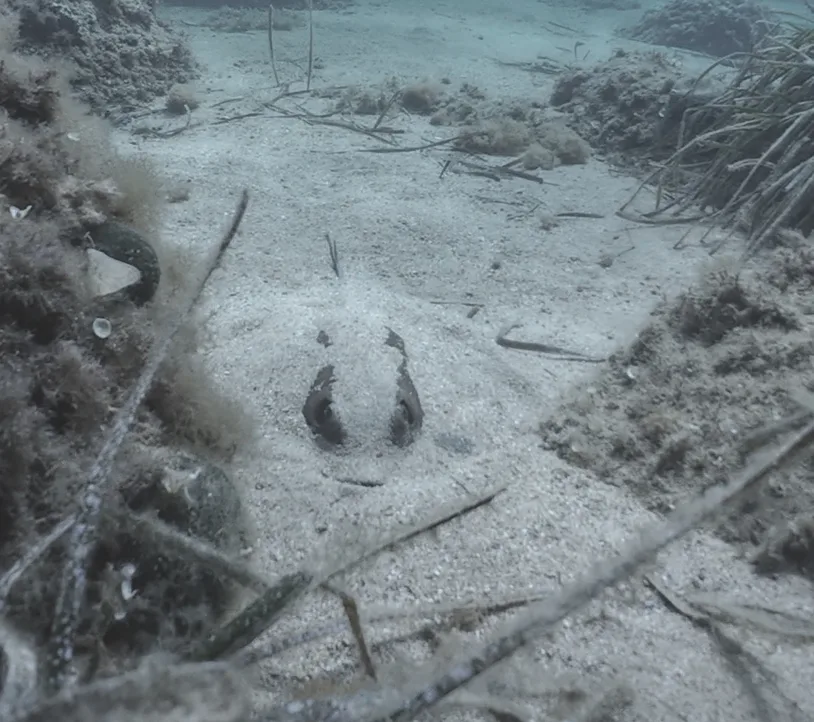
Found on sandy and muddy bottoms in shallow coastal waters.
Distribution
Found in the eastern North Atlantic, from Norway to Morocco.
Conservation status
Least Concern
Edibility
Edible, but not highly sought after and of modest culinary quality. Handle with caution: it can deliver a strong electric shock; release is preferable.
Culinary quality / 5
2
Danger level
Caution
Usual observation depth
10–100 m
Behaviour
Generally solitary and bottom-dwelling, often motionless or partly buried during the day. It mainly hunts at night and uses electric organs to capture prey and defend itself.
Observation zones
Sand, mud, seagrass beds, shelly or detrital bottoms, and edges of rocky reefs; mainly in coastal areas.
Diet
Mainly small bottom-dwelling fishes, as well as crustaceans and other benthic invertebrates.
Reproduction
Ovoviviparous
Identification marks
Nearly circular, thick disc; short tail; smooth skin; and prominent eyes. The upper surface is brown to grey-brown with irregular dark marbling; two large electric organs lie on either side of the head.
Similar species
It may be confused with the ocellate electric ray (Torpedo torpedo), which usually has five large, conspicuous blue ocelli on its back. The Atlantic torpedo ray (Tetronarce nobiliana) is much larger and generally more uniformly dark.
Approach rules
Observe from a distance without touching or blocking it. Do not put hands near the head or on the disc, even if it appears motionless; avoid close flash photography, do not feed it, and do not attempt to move it.
Protection
Assessed as Least Concern (LC) by the IUCN. Not listed by CITES; reduce bycatch and avoid unnecessary handling or disturbance.