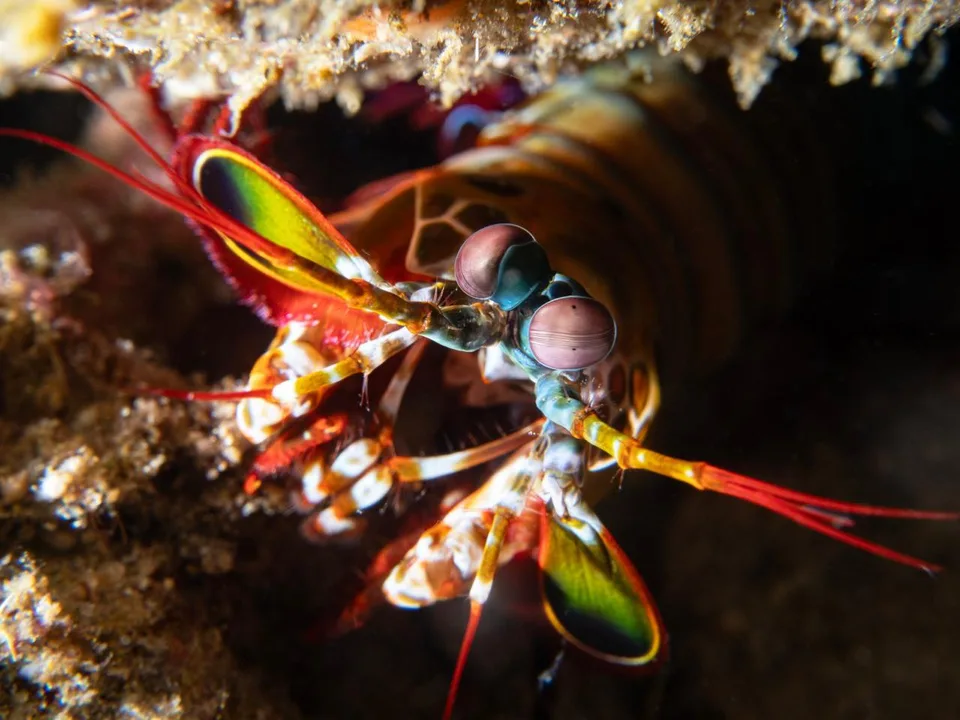
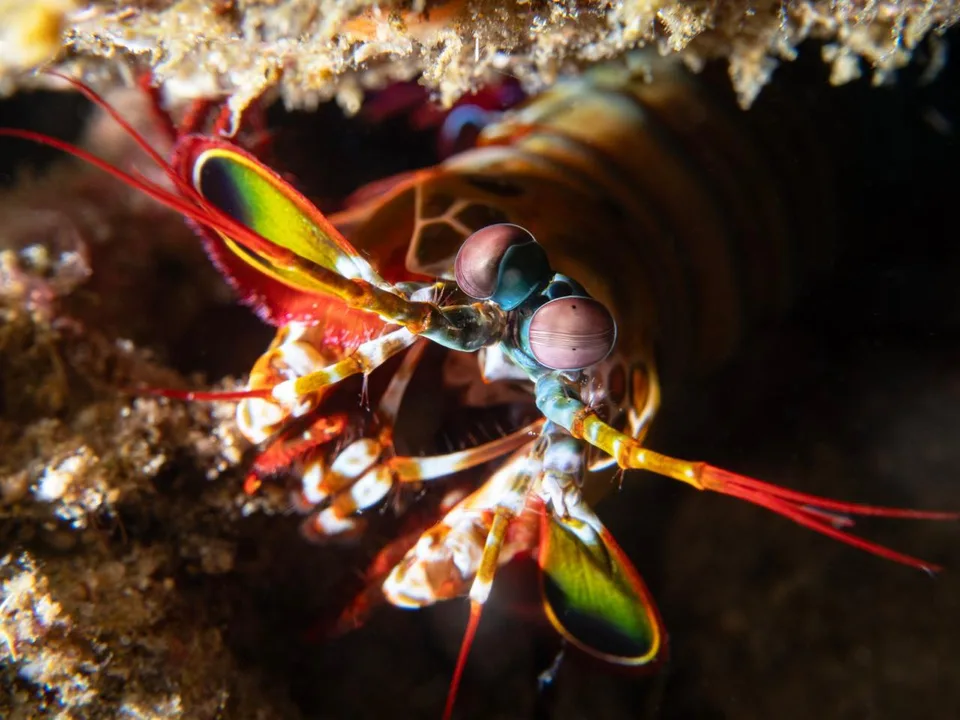
Shallow tropical and subtropical waters, often found in burrows or crevices.
Distribution
Indo-Pacific region, including the Red Sea and the eastern coast of Africa to the central Pacific.
Conservation status
Least Concern
Edibility
Edible and locally consumed in parts of its range, but handling is risky because of its powerful striking appendages. Prepare only from legally and sustainably obtained specimens.
Culinary quality / 5
3
Danger level
Caution
Usual observation depth
10–30 m
Behaviour
Generally solitary and highly territorial. Primarily diurnal, it remains near its burrow and uses its club-shaped raptorial appendages to strike prey and defend itself.
Predatory crustacean feeding mainly on hard-shelled prey, notably crabs, gastropods, bivalves and other crustaceans; it can also capture small fish.
Reproduction
Oviparous
Identification marks
Large robust mantis shrimp with bright green, blue, orange and red colors. The caudal fan bears eye-like spots, and the animal has large stalked eyes as well as powerful blue-green clubs.
Similar species
May be confused with other large Indo-Pacific smasher mantis shrimps, notably Odontodactylus latirostris. O. scyllarus is generally more vividly multicolored and has particularly conspicuous eyespots on the caudal fan.
Approach rules
Observe without touching or blocking the burrow. Keep hands, fingers, and camera ports at a distance: its bite can cause injuries. Maintain a respectful distance, avoid repeated flashes, and never feed or provoke it.
Protection
No CITES listing is known. General conservation recommendation: avoid collecting individuals from reefs and minimize disturbance to burrows and reef habitat.