Indo-Pacific region, including the Red Sea and parts of the Indian and Pacific Oceans.
Conservation status
Vulnerable
Edibility
Edible and highly valued as food, but this Endangered species is heavily depleted. Avoid consumption and purchase; international commercial trade is regulated under CITES Appendix II.
Culinary quality / 5
4
Danger level
Caution
Usual observation depth
1–30 m
Lifespan (years)
32
Behaviour
Generally solitary or observed in small groups; adults use extensive home ranges. Juveniles are inconspicuous in coral shelters. Individuals may gather for breeding; the species is a protogynous hermaphrodite, with some females becoming males.
Powerful predator of hard-shelled prey and reef-associated animals, including mollusks, crustaceans, echinoderms, and fish. It can consume toxic prey such as the crown-of-thorns starfish.
Reproduction
Oviparous
Identification marks
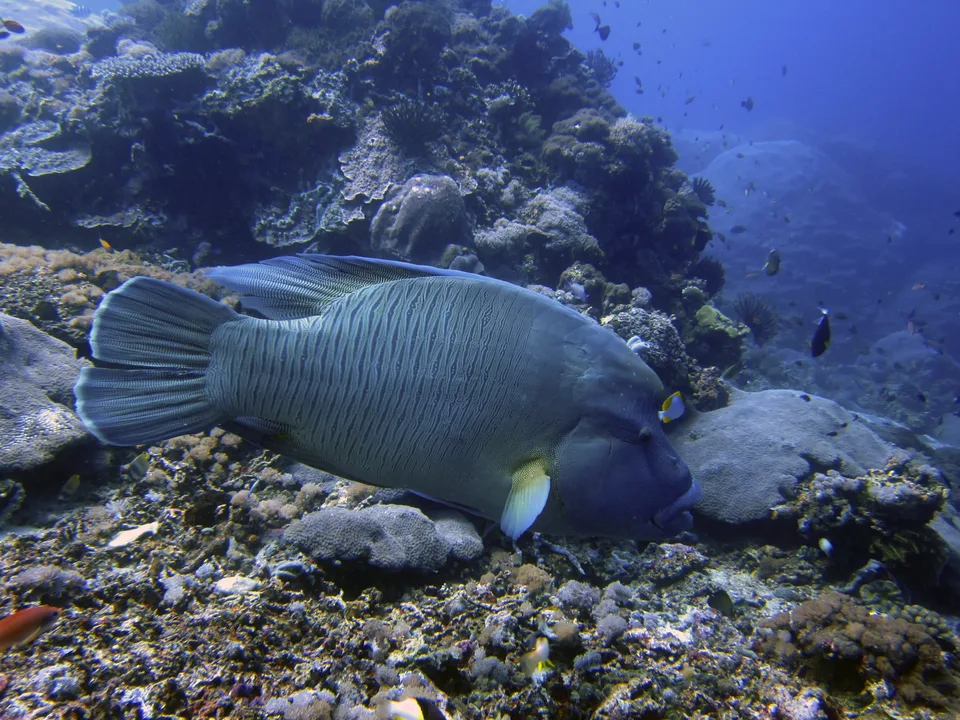
Very large wrasse with a deep body, a pronounced forehead hump in large adults, exceptionally thick and fleshy lips, a wide mouth, and characteristic dark lines radiating behind the eye. The colour varies from blue-green to yellowish green; juveniles have more distinct pale markings.
Similar species
May be confused with other large wrasses of the genus Cheilinus, notably the tripletail wrasse (Cheilinus trilobatus). The humphead wrasse is distinguished by its much larger adult size, prominent forehead hump, massive lips, and radiating facial lines.
Approach rules
Approach slowly and calmly, without blocking its path or cornering it. Maintain a respectful distance of at least 3 m, do not touch or pursue it, avoid using flash at close range, and never feed it. Give cleaning stations and breeding aggregations more space.
Protection
Classified as Endangered on the IUCN Red List and listed in Appendix II of CITES. International trade is subject to CITES controls; conservation priorities include preventing overexploitation and protecting reef habitat and spawning aggregations.