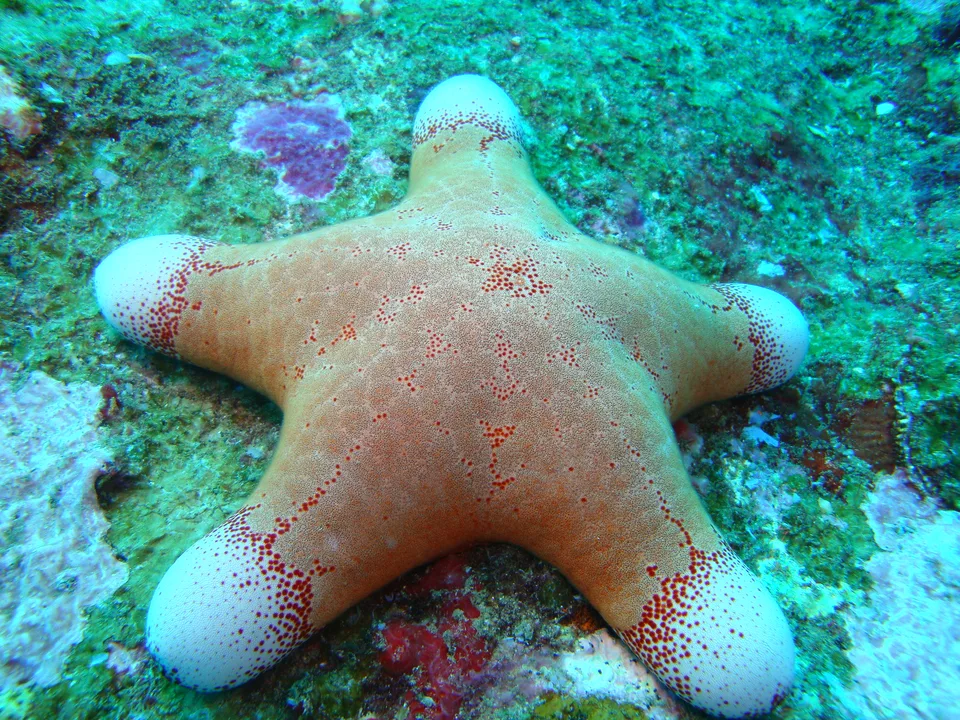
Found in shallow waters on rocky substrates and coral reefs.
Distribution
Widespread in tropical and subtropical regions of the Indo-Pacific.
Conservation status
Least Concern
Edibility
Not regarded as a food species; culinary use is undocumented. Do not collect animals from reefs.
Danger level
Harmless
Usual observation depth
2–30 m
Behaviour
It is generally observed alone or in small, loosely structured groups. It moves slowly over the substrate and is mainly active while foraging; it may remain concealed among corals, debris, or seagrass beds during the day.
Opportunistic predator consuming organic detritus and benthic invertebrates, notably sponges and sessile cnidarians when available.
Reproduction
Oviparous
Identification marks
Large, thick, cushion-shaped starfish with five short, broad, rounded arms. The upper surface is covered with clearly visible rounded granules or tubercles; coloration is variable, often cream, yellow, orange, reddish, or mottled.
Similar species
It can be confused with Culcita novaeguineae, another inflated cushion star. Choriaster granulatus has a distinctly granulated and tuberculated upper surface, with more prominent broad arm contours. Protoreaster nodosus has longer, more pointed arms, as well as fewer, larger nodules, often with dark tips.
Approach rules
Observe it without touching, lifting, turning over, or moving it. Keep a respectful distance, do not block its path, use flash sparingly, and do not feed or collect it.
Protection
Globally assessed as Least Concern; not listed under CITES. Avoid any collection and follow the conservation rules applicable at the site.