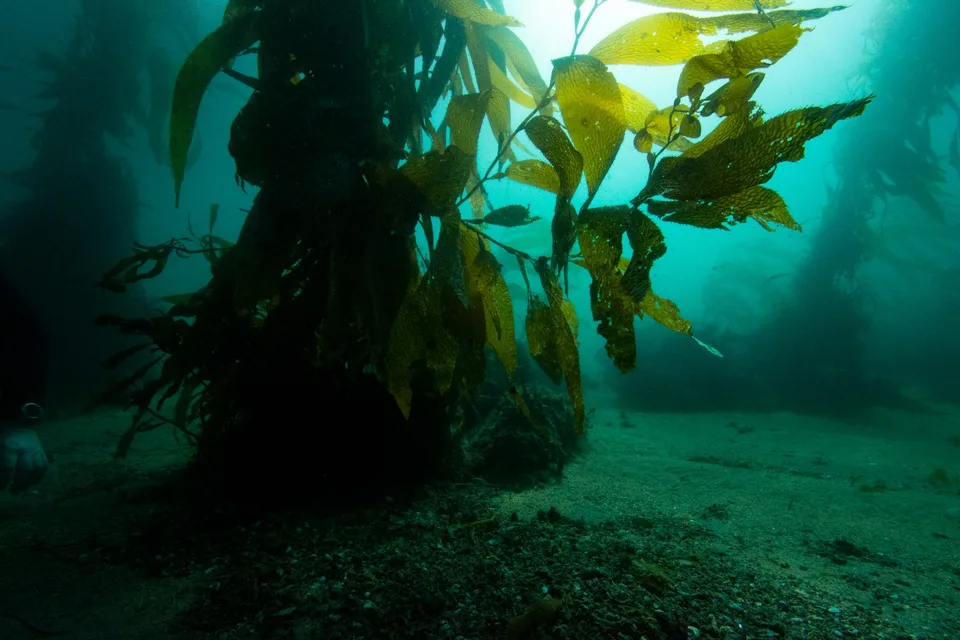
Grows in underwater forests in shallow coastal waters.
Distribution
Found along the Pacific coasts of North and South America.
Conservation status
Least Concern
Edibility
Edible. Young blades and tender portions may be eaten fresh, cooked, dried or processed; harvest only from clean water and avoid damaged or heavily fouled material.
Culinary quality / 5
3
Danger level
Harmless
Usual observation depth
1–20 m
Lifespan (years)
3
Behaviour
Large perennial brown alga with rapid growth when conditions are favorable. It is immobile and frequently forms vast, complex kelp forests as well as floating surface canopies.
Observation zones
Rocky reef, kelp forest, shallow coastal drop-off and surf zone; often from the seafloor to a floating surface canopy.
Diet
Photosynthetic; uses light, carbon dioxide and dissolved nutrients to produce organic matter. It feeds on neither animals nor plants.
Reproduction
Unknown
Identification marks
Very large brown kelp with a root-like holdfast, numerous branched stipes and long flat blades. Each blade generally bears a round to oval gas bladder at its base, which helps the fronds rise toward the surface.
Similar species
May be confused with other large kelps, notably species of Lessonia and the bull kelp, Nereocystis luetkeana. Macrocystis pyrifera is distinguished by its numerous branched stipes and by the individual floats at the base of most blades; Nereocystis has a single large terminal float.
Approach rules
Maintain good buoyancy and move slowly through kelp beds. Do not pull on or cut the holdfasts or fronds, stand on them, or deliberately disturb them; avoid becoming entangled. Flash is not a problem for the algae, but limit disturbance to the animals living there. Do not feed wildlife.
Protection
Not listed under CITES and not assessed globally on the IUCN Red List. Kelp forests are ecologically important and may be affected by pollution, warming, marine heatwaves, grazing and harvesting; comply with conservation measures applicable to the site.